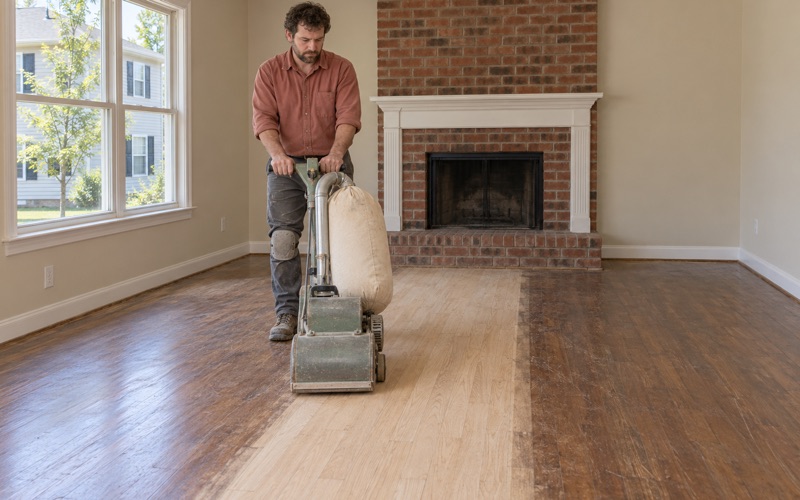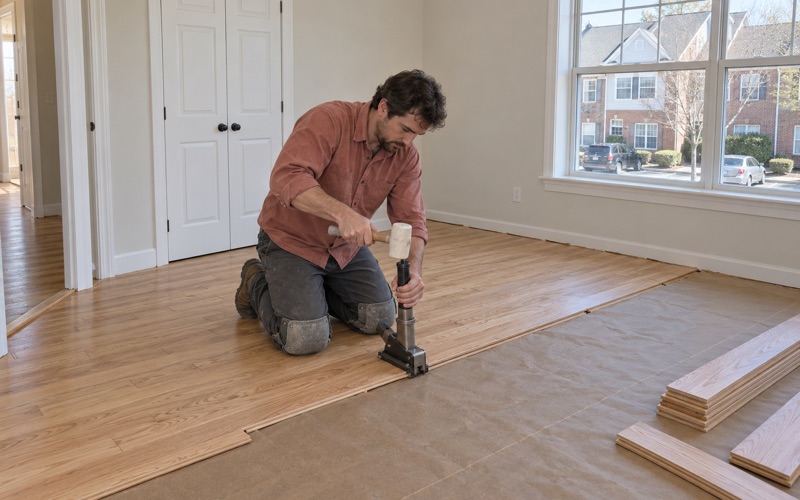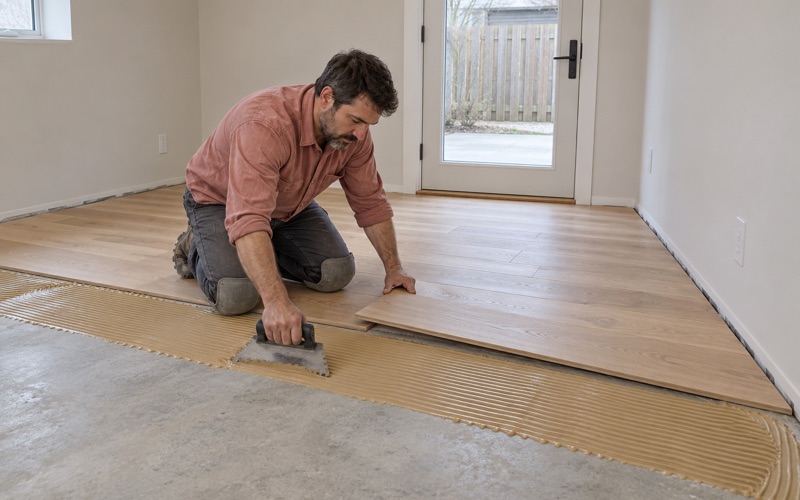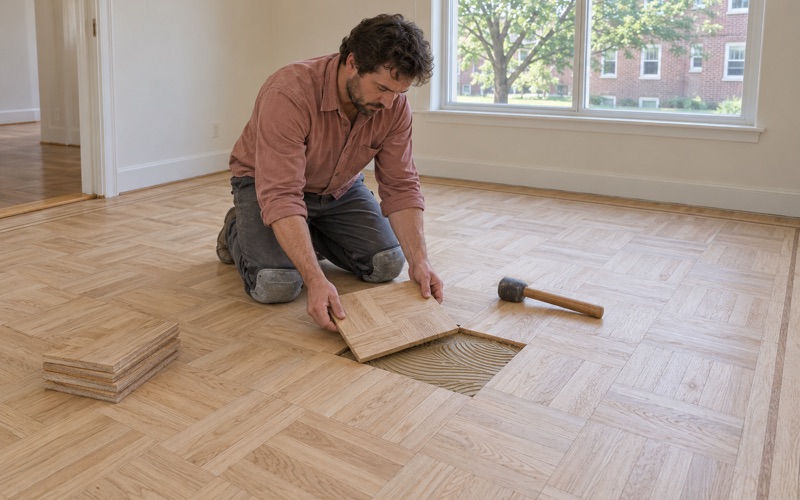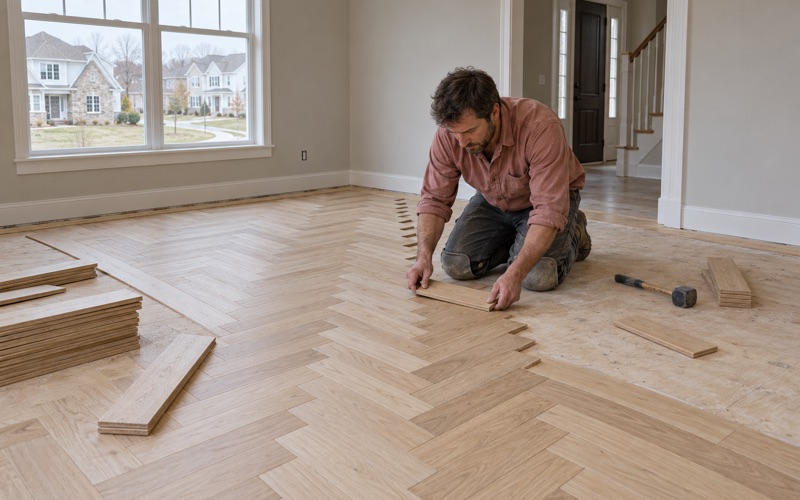
Severn Wood Flooring brings more than 20 years of hands-on work to wood-flooring in Baltimore Highlands, where most of our calls come from owners who intend to keep their house and want the floors done once, properly. We sand and refinish worn hardwood, repair damaged boards, install new solid hardwood and engineered floors, and rebuild staircases. Every job starts with a look at the house itself, because the right method depends on what the floor is, when it went down and what has been laid over it since.
Before any number reaches you, we walk the rooms, take moisture readings and check what sits under the carpet pad or the old tile. The estimate you get is written and itemized line by line, so you can keep it for an insurer, a refinance or a future sale. Stairs are priced tread by tread rather than folded into a square-foot rate, since a staircase takes a different kind of labor than an open room.
While we work, dust stays in the rooms we are working on. Doors and return vents are sealed, the sanders feed a collection system, and a HEPA vacuum follows the grit sequence. If you are living in the house during the job, we plan finish coats and drying times around your household rather than the other way around.
From William Dawson’s English Consul Estate to the 1909 Subdivision
The ground under Baltimore Highlands was once the English Consul estate of William Dawson, the first English Consul to Maryland. In 1909 developers bought the property and divided it into four sections: Baltimore Highlands, Rosemont, Friendship Gardens and English Consul. The Maryland State Archives holds the Baltimore County Circuit Court record of that division, the English Consul Estate plat recorded July 26, 1909, in Plat Book WPC 3, page 22.
A plat that took most of a century to fill
Recording a subdivision and building it out are two different things, and here they were separated by decades. One house in the neighborhood can be prewar while another went up in the 1960s or the 1990s. For floor work, that means the age of the neighborhood tells us very little about the age of a particular floor, so we never quote a house here from its address alone.
Unincorporated Baltimore County, not Baltimore City
Baltimore Highlands is a census-designated place with no city government of its own. It sits in Baltimore County, directly south of the city line, and is bounded by the Baltimore City border to the northeast, the Baltimore-Washington Parkway to the west and the Patapsco River to the south and southeast. Questions about permits, code enforcement or housing programs go to Baltimore County and its Department of Permits, Approvals and Inspections, not to any Baltimore City office. The name causes real confusion, because Baltimore City has a separate neighborhood that shares it.
The census boundaries have shifted too. At the 2000 census and earlier, the area was counted as part of the Lansdowne-Baltimore Highlands CDP, which was divided for 2010 into separate Baltimore Highlands and Lansdowne CDPs. The housing figures on this page come from the newer Baltimore Highlands geography, not the older combined one.
Looking for wood-flooring closer to Severna Park? See Wood-Flooring Services in Severna Park.
One Plat, Many Build Dates: Prewar, 1950s, 1960s and 1990s Houses
The American Community Survey 2024 five-year estimates count 630 homes in Baltimore Highlands built in 1939 or earlier and 799 built in the 1950s. Another 469 date from the 1960s, and 403 went up in the 1990s. Those four eras account for most of the housing here, and each tends to bring a different kind of floor question to our door.
Pre-1978 houses and lead-safe preparation
The prewar, 1950s and 1960s houses together make up well over half of the stock, and every one of them was built before 1978. That date matters because renovation work that disturbs painted surfaces in older homes falls under the EPA RRP Rule. We confirm the build year and check painted baseboards, shoe molding, stair stringers and old finishes before a drum sander or orbital sander touches anything, and we set up containment to match.
What the older floors usually need
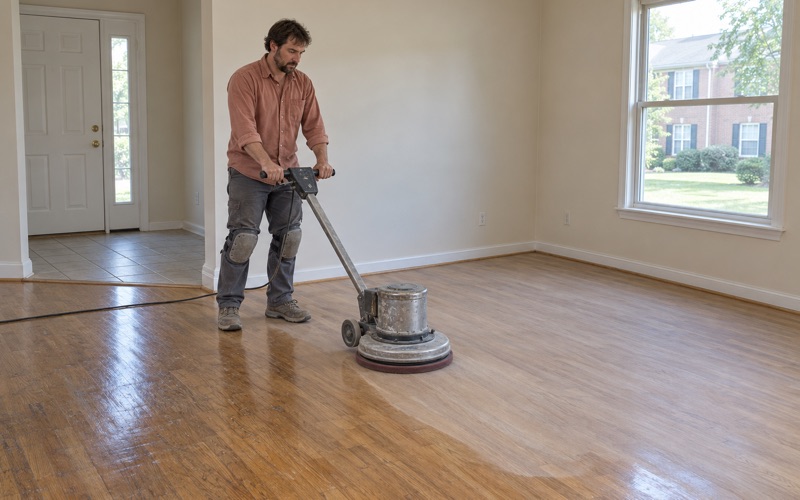
In the older houses we often meet floors that have been sanded several times, refinished with whatever was popular in a given decade, or covered entirely. Typical findings include traffic lanes worn through the finish, wax residue that will gum up sandpaper, peeling polyurethane, pet urine stains, water stains and a rug shadow where furniture sat for years. Some floors have face nails working loose or squeaky floorboards over a tired subfloor. We check how much wear layer is left above the tongue and groove before we promise a full sanding, because a board that has been sanded too many times may only tolerate a screen and recoat.
Resilient tile and black mastic
Older resilient floor tile and the black mastic beneath it are common finds when carpet or newer flooring comes up in houses of this age. We identify them before anything is sanded and leave their removal to the right trade, rather than grinding through a layer whose makeup we have not confirmed. Once that layer is handled, we can assess the wood or subfloor underneath.
The 1990s houses
The 403 houses from the 1990s raise a different set of issues. Builder-grade hardwood from that period is often prefinished strip flooring with a factory sheen, and some of it has worn unevenly or shows board gapping and winter gaps. Many of these floors can be sanded and site-finished, but we check thickness first, and an engineered floor with a thin wear layer may call for a different plan. Squeaks and nail pops in these floors often trace back to fasteners or a subfloor that moved as the house settled, and we fix that before refinishing.
Owner-Occupied Detached Houses and Floors That Grew With Them
Baltimore Highlands has 1,574 owner-occupied households, and 1,225 of them live in detached houses, according to the same ACS estimates. That is the market we know best here: owners in single-family houses who have lived with their floors for years and want them to match from room to room. A detached house also tends to collect changes over time, and the floors usually show every one of them.
Matching floors across additions and decades
An older detached house may have its original strip flooring in the front rooms, a newer floor in a kitchen or rear addition, and plywood or carpet where a wall once stood. When an owner wants one continuous floor, we compare species, board width and thickness, then decide whether to weave new boards in or replace a section outright. Red oak and white oak can look similar raw yet take stain very differently, so we test before committing.
Weave-in repairs where registers and walls came out
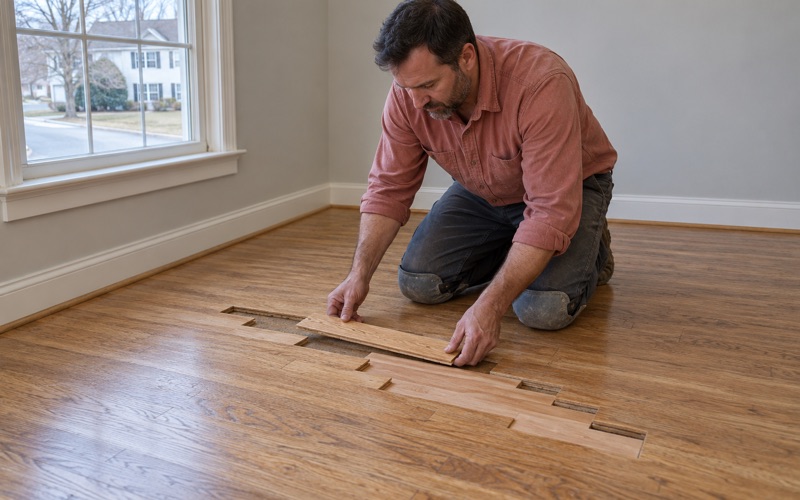
Openings left by relocated floor registers or a removed partition wall are among the most common repairs we handle. Rather than dropping in a square patch that will always read as one, we remove short lengths of the surrounding boards and weave new ones into the existing pattern. Done properly, the repair disappears once the whole floor is sanded and finished together. The same approach works for a damaged board in the middle of a room, where board replacement is cleaner than filling.
Replacing carpet with hardwood
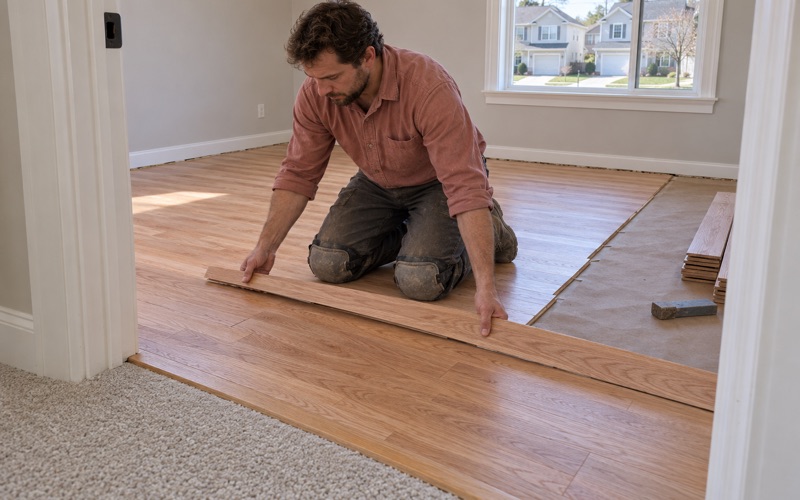
Many owners here start by pulling carpet that has covered a floor for decades. Under the carpet pad and tack strip we may find solid hardwood worth saving, a subfloor that needs new wood, or a mix of both from different eras of work. Tack strip holes and staple marks along the walls usually sand out or hide under shoe molding, while missing boards are woven in before the floor is finished. Where nothing salvageable remains, we install new solid hardwood fastened with flooring cleats over a sound subfloor and joists.
Cupping, crowning and moisture underneath
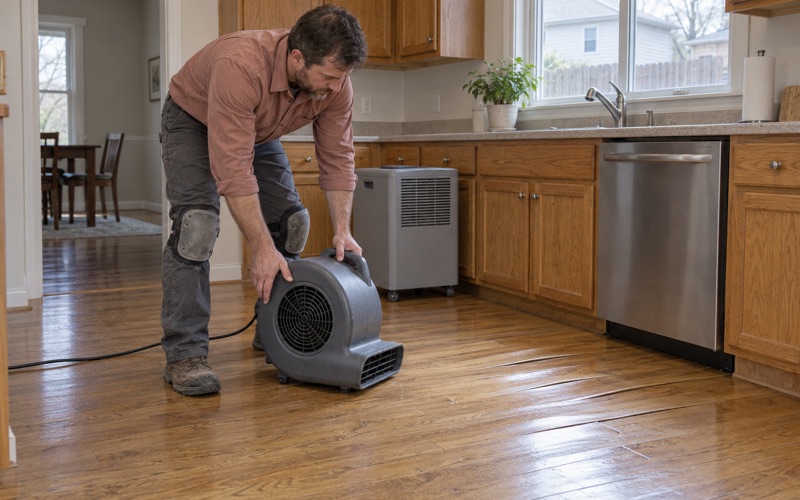
Cupping, crowning and buckling usually mean moisture is moving through the floor from somewhere, whether a leak, a crawlspace or a basement. We trace the source with a moisture meter before we sand, because flattening a cupped floor that is still wet only brings the problem back. Where water damage is involved, we dry and document the affected areas room by room so you have a clear record for an adjuster.
Planning Floor Work in a Baltimore Highlands Home
A good floor job here starts with a few decisions made in the right order. We help you sort out what the floor needs, what the house can handle and how the work fits around daily life. Most jobs move from inspection and moisture readings to repairs, then sanding, then finish, and changing that order usually costs time.
Choosing color and finish
We lay stain and sheen samples on your own floor, in your own light, before you choose a color. Red oak, white oak and maple each respond differently, and a stain that looks warm on a sample board can turn orange on an older floor. For the topcoat, we compare waterborne polyurethane, oil-modified polyurethane and hardwax oil, choosing products that fit Maryland’s VOC limits for wood coatings with drying times you can plan around.
Basements and below-grade rooms
If you are finishing a basement, we take moisture readings on the concrete before recommending anything. In many below-grade rooms, engineered wood or a different floor is the better choice than solid hardwood, and we will say so after reading the moisture and the grade. If a sump pump or old water marks suggest the slab gets wet, we plan for that rather than hoping it stays dry. Acclimation and the right underlayment matter more downstairs than anywhere else in the house.
What the written estimate covers
Our estimate lists each room, the repair work, the sanding and the finish as separate lines, along with stairs and any board replacement. If termite damage, powderpost beetle holes or frass turn up once a floor is opened, we show you the damaged boards and price their replacement as its own line before going further. Nothing is added after the fact without a conversation first.
Stairs and scheduling
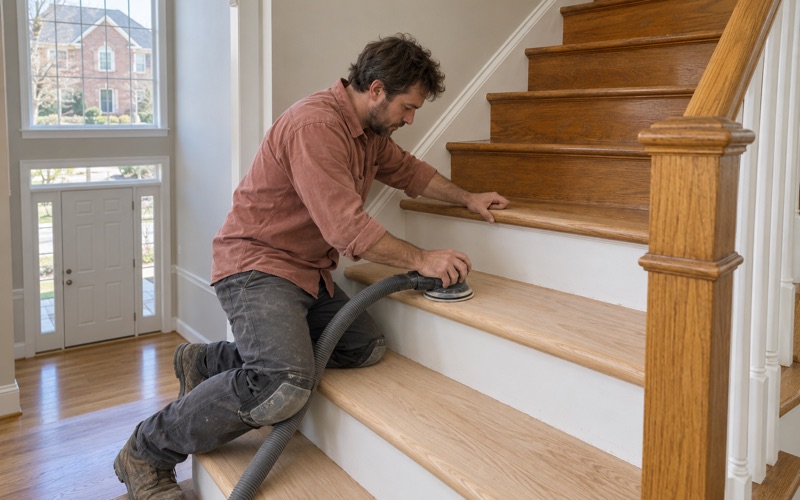
Stair treads, stair risers and stair nosing are measured and priced one by one, and we can refinish an existing staircase or replace worn treads to match the floors above. We schedule the work so you keep a usable path through the house while finish cures. Tell us what your week looks like, and we will build the job around it.
- 20+ Years Experience
- Written Itemized Estimates
- Dust-Contained Sanding