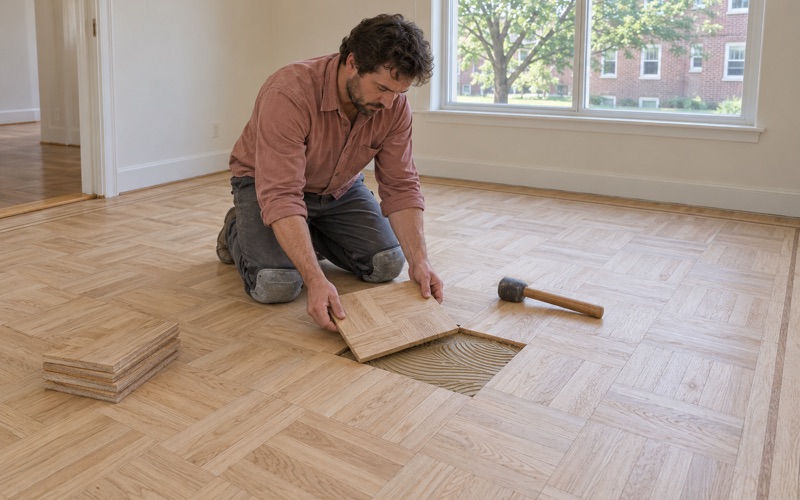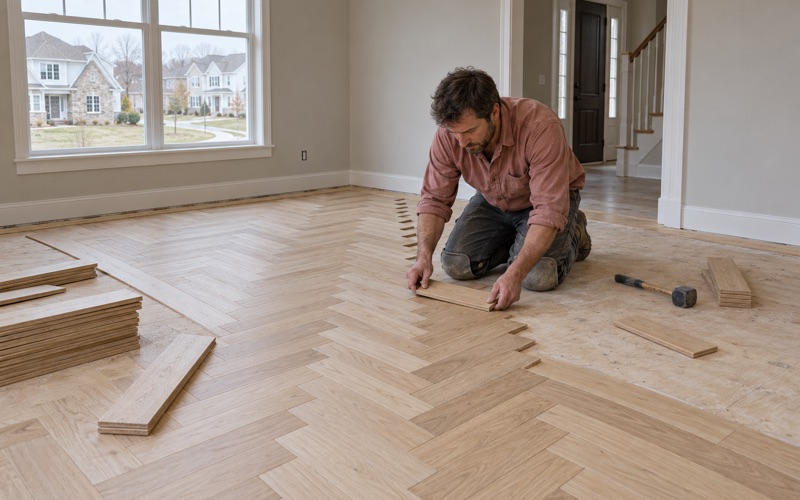
Severn Wood Flooring brings more than 20 years of wood-flooring work to Brooklyn Park, and most of the floors we are asked to look at here are far from new. They are original boards that have been sanded, carpeted over, patched and walked on for generations. Our first job is to tell you which parts of a floor can still be saved and which have worn past saving.
That line matters more in an older house than anywhere else. A floor that only looks tired can usually be brought back with sanding and finish, while boards that are split, soft or worn down to the tongue are a repair problem rather than a cosmetic one. We put that difference in writing, room by room, so you have something solid to work from whether you pay for the job yourself or look into outside help.
This page walks through the houses themselves, the county rehabilitation program that names deteriorated flooring as an eligible repair, what that program says it will and will not pay for, and how floor work usually fits into a home here. It is written for owners who live in their houses and plan to keep living in them.
Brooklyn Park’s Houses: Built Before 1960, Mostly Still Owner-Occupied
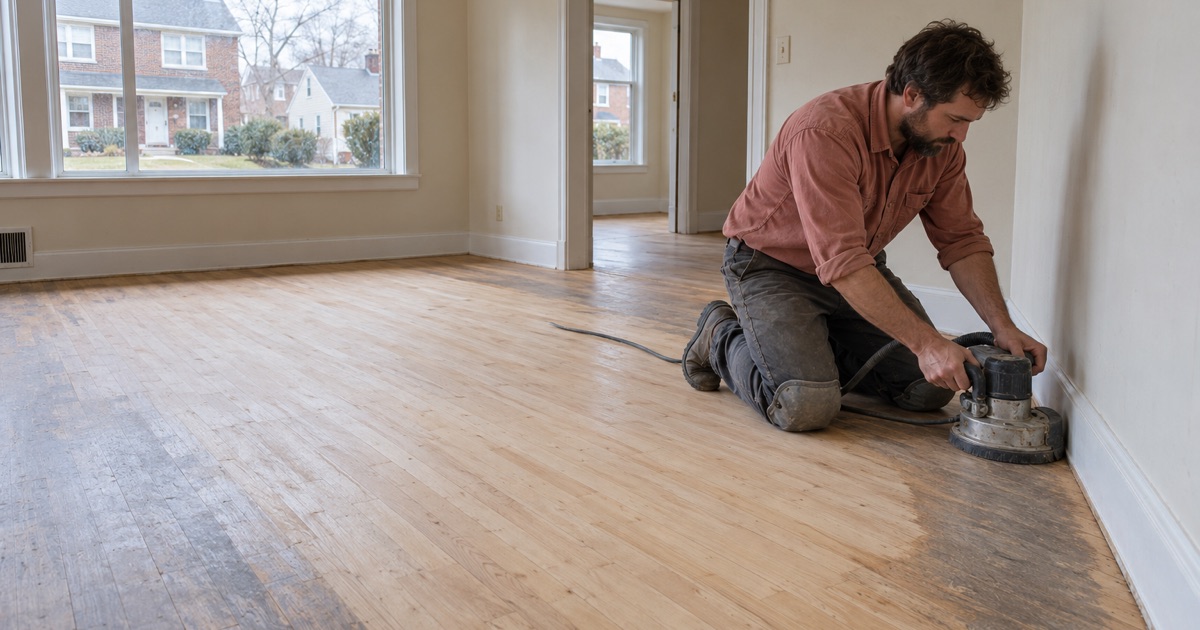
The housing figures explain why so much of our work here starts with old flooring. Census data paints a clear picture of an established community where the same families tend to stay put.
A housing stock built mostly before 1960
The American Community Survey 2024 five-year estimates put the median year built for Brooklyn Park housing at 1955. Of roughly 6,000 housing units, 1,055 were built in 1939 or earlier and another 1,192 went up in the 1940s, which means 37.4 percent of units date from before 1950. The 1950s added 1,679 more, so a newer house is the exception rather than the rule.
A floor in a house that age has usually been through several owners and more than one renovation. We often find original strip flooring under two or three later coverings, each laid with its own fasteners and adhesives. Reading those layers correctly is the first step in any estimate we write here.
Owners who stay
The same survey counts 79.7 percent of occupied homes as owner-occupied. That includes 1,166 owner households living in one-unit attached homes, the duplexes and rowhomes found alongside detached houses here. Owners in these houses tend to be fixing a floor they intend to keep living on, not dressing one up for a quick sale.
That changes the conversation. A long-term owner is usually better served by a repair that lasts than by the cheapest cover-up, and we price both options so the choice is yours.
Anne Arundel County, not Baltimore City
Brooklyn Park is an unincorporated census-designated place in Anne Arundel County, bordering Baltimore City along the city’s southern boundary of 1919. The street grid may feel continuous with the city, but the county line is real, and Baltimore City rules and programs do not apply on this side of it. Anne Arundel County is the authority for permits, licensing and code enforcement here.
The community takes in old Brooklyn Park, Brooklyn Heights, Arundel Village, Roland Terrace, Arundel Gardens and Pumphrey. In the county’s Plan2040 visioning summary from 2019, Brooklyn Park residents named great looking houses as what is special about their community. Good floors are part of keeping them that way.
Looking for wood-flooring closer to Lansdowne? See Wood-Flooring in Lansdowne.
When a Worn Floor Becomes a Repair: The County’s Property Rehabilitation Program
For some owners, the hardest part of a floor problem is paying for it. Anne Arundel County has a program that speaks directly to deteriorated flooring, and it is worth knowing how it describes itself before you call anyone.
Who runs it and who it serves
The Property Rehabilitation Program is run by Arundel Community Development Services, Inc. (ACDS) for owner-occupants in Anne Arundel County, with the City of Annapolis handled separately. The program states that the owner must own and occupy the property as a primary residence. Household income must be at or below 80 percent of the area median income, which ACDS lists as $74,800 for one person and $106,800 for a household of four, effective July 1, 2026.
ACDS funding is described as a loan of up to $40,000 at 0 percent with no monthly payment, deferred until the home is sold or transferred, stops being owner-occupied, or reaches 30 years. ACDS also estimates the whole process could take about six months from the first application. Whether any household qualifies is a decision ACDS makes, never one we can promise.
What the program says it covers
The program describes itself as addressing health, safety and code related rehabilitation work, such as a leaking roof or a broken furnace. Its list of other eligible repairs includes replacing windows and exterior doors, replacing defective plumbing and electric, removing peeling paint, and replacing deteriorated flooring. That last item is why worn floors in older Brooklyn Park houses belong in this conversation at all.
The word deteriorated carries the weight. A floor that is merely dull or out of fashion is a different matter from one with rotted boards, broken subflooring or surfaces that have become a hazard underfoot.
What it excludes
The program is just as plain about limits. Its wording states that funds cannot be used to purchase furnishings or install luxury items such as hot tubs or Jacuzzis. Nothing in that description speaks to refinishing for looks, upgrading to a new species, or choosing a decorative pattern.
So we keep the two kinds of work separate on paper. If you plan to talk with ACDS, our written assessment describes the condition of each room in plain terms, and any cosmetic work you want is listed on its own so nobody confuses the two. How the program handles contractors and scopes is a question for ACDS directly.
Floors in 1940s Duplexes, Rowhomes and 1950s Detached Houses
The floors in these houses follow a pattern, though every one holds a surprise or two. Here is what we usually find and how we handle it.
What is under the carpet
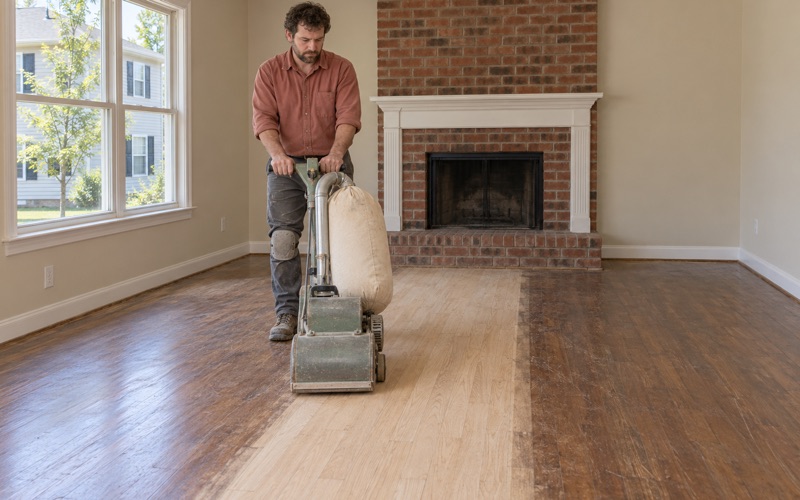
Many houses from this era were built with red oak strip flooring nailed to a plank or plywood subfloor. Decades of carpet leave tack strip around the edges, staples across the field and a carpet pad that may have stuck to the finish. Underneath we see traffic lanes worn gray, rug shadow where furniture sat, pet urine stains and water stains near doors and radiators.
None of that rules out refinishing on its own. What decides it is how much wood is left above the tongue and groove, and how many earlier sandings the boards have already taken.
Boards, joists and the structure below
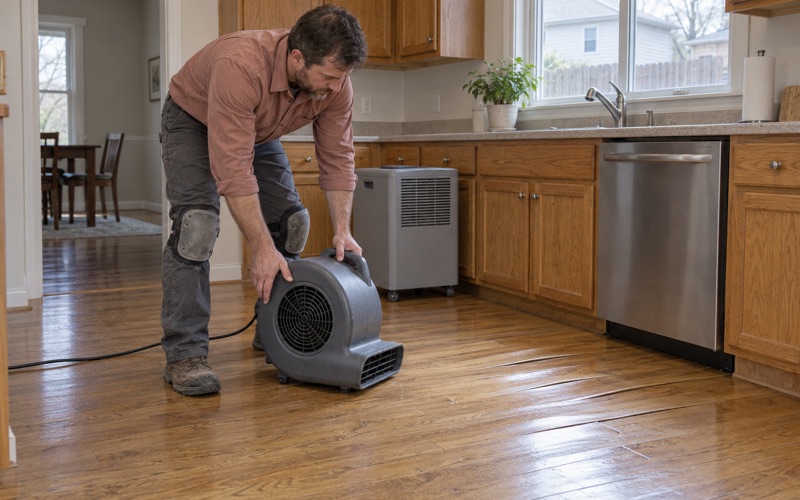
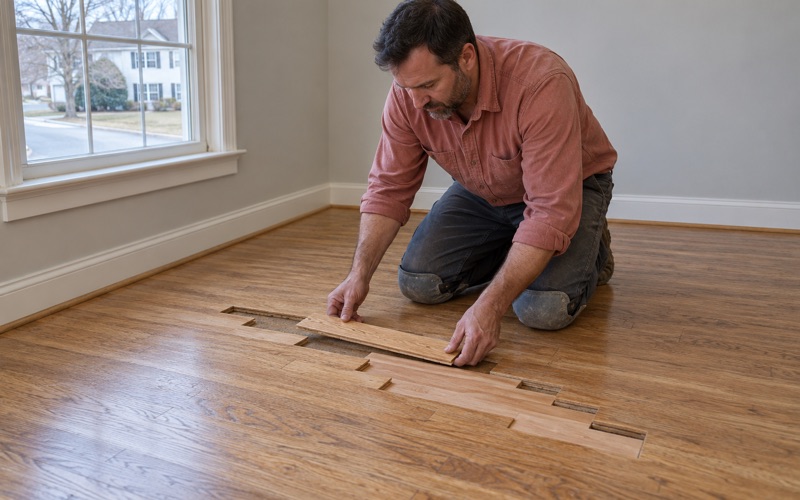
Squeaky floorboards and nail pops are common in houses this old and are usually fixable from above with flooring cleats or carefully set face nails. Board gapping, cupping or crowning across a room tells us to check moisture and look at the joist and subfloor below before anything is sanded. Where we find termite damage, or the fine powdery frass that powderpost beetle activity leaves, the affected boards come out and the cause is named in our notes.
When an old floor register was closed or a wall removed, the hole gets a weave-in repair with matched boards laced into the existing rows rather than a square patch. Done properly, the repair disappears once the floor is sanded and finished as one surface.
Lead paint, old tile and mastic come first
In houses built before 1978, we check the build year and any painted surfaces before a drum sander touches the floor, because that work falls under lead-safe renovation rules such as the EPA RRP Rule. Painted borders and trim can turn up in houses from the 1940s and 1950s. We also identify resilient floor tile and black mastic in kitchens and basements before sanding, and leave that material for the right trade instead of grinding it into the air.
During the work itself, dust stays contained to the rooms in progress. Doors and returns are sealed, and we clean with a HEPA vacuum between each pass of the grit sequence.
Planning Floor Work in a Brooklyn Park Home
A good plan starts with an honest look at the floor and a clear record of what it needs. From there the choices are mostly about scope, finish and timing.
Start with an itemized estimate
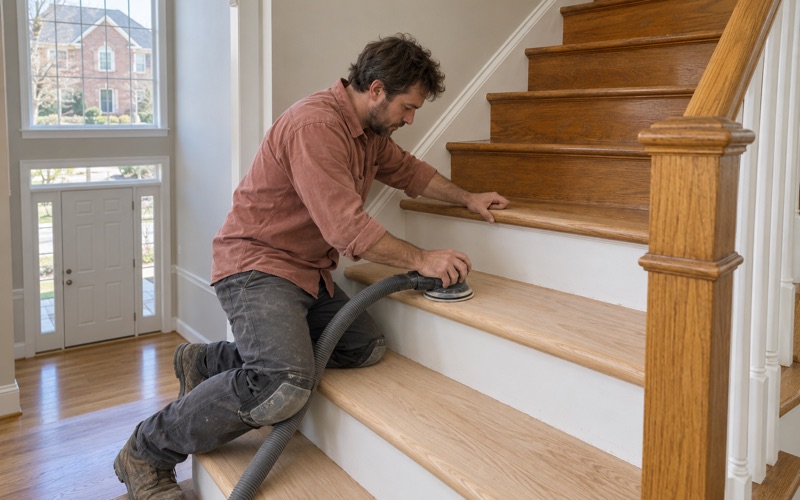
We write an itemized estimate that separates repair from refinishing, room by room. It is yours to keep for your own files, an insurer or a future sale, and it gives you something concrete to bring to any conversation about financing. Stairs are quoted tread by tread, with treads, risers and nosing listed separately, because a staircase is never priced by the square foot.
Repair, refinish or replace
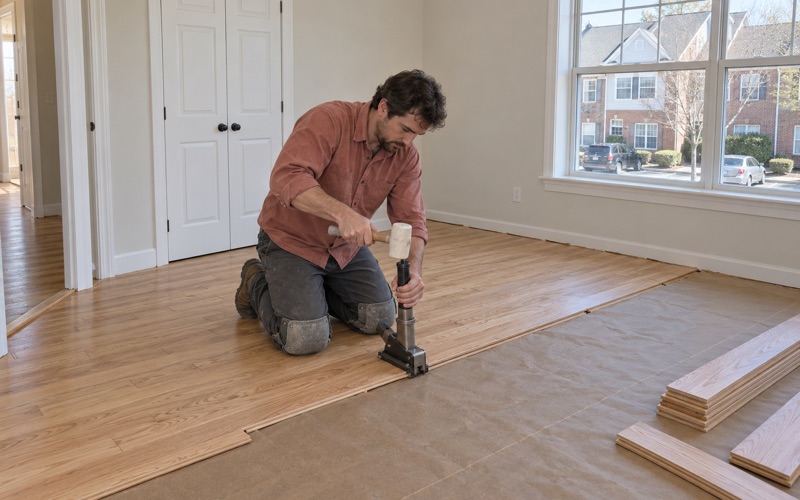
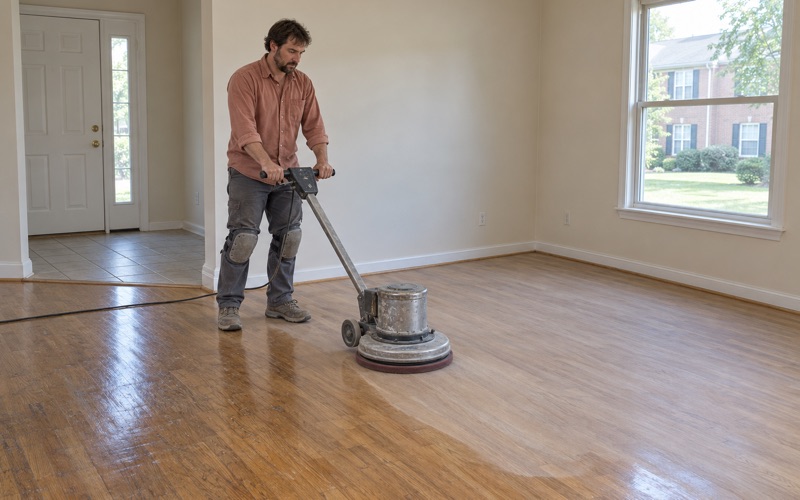
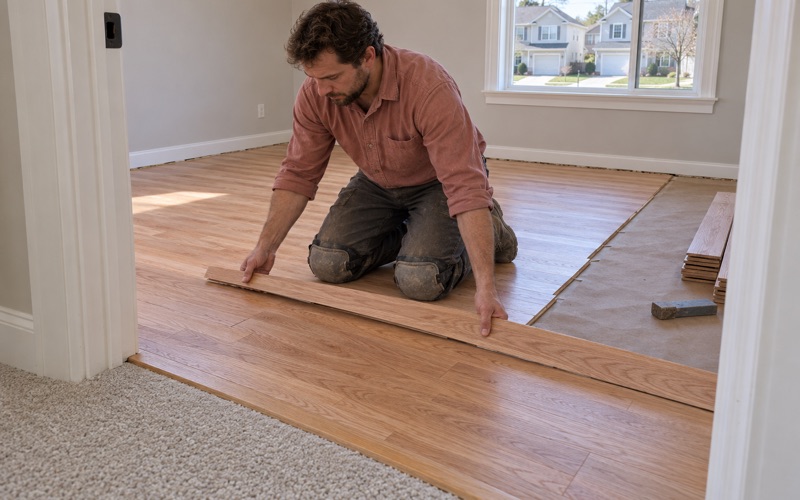
If the finish is worn but the wood is sound, a screen and recoat may be enough. Floors with peeling polyurethane, wax residue or deep wear usually need a full sanding, and boards worn too thin get board replacement before finishing. Before you settle on a color, we lay stain and sheen samples on your own floor, because stain on red oak often looks different in your own daylight than in a photo.
For finish, we weigh waterborne polyurethane against oil-modified polyurethane and choose coatings that fit Maryland’s VOC limits for wood coatings. Fume and drying times are planned around the people and pets living in the house.
Timing in an attached home
In a duplex or rowhome, sound and smell travel through shared walls, so we plan the noisiest sanding days and finish coats with that in mind. If you are pursuing the county program, its own estimate of about six months from application is worth building into your plans. We can schedule an assessment early so the condition of each floor is documented well before any work begins.
- 20+ Years Experience
- Written Itemized Estimates
- Dust-Contained Sanding