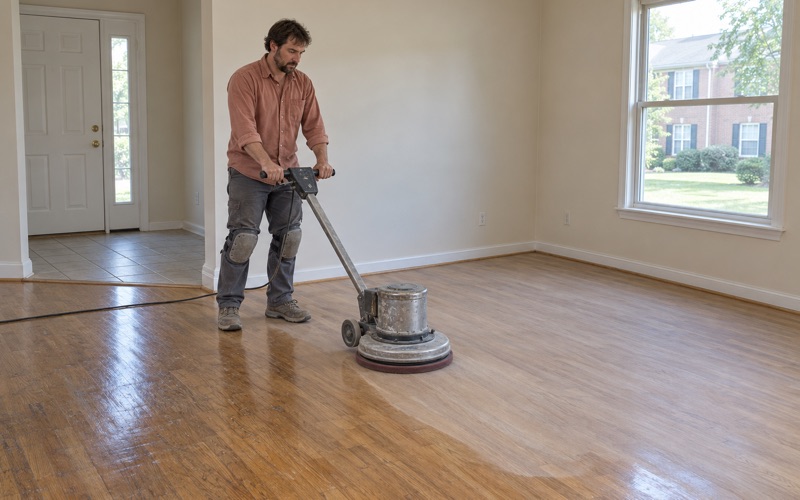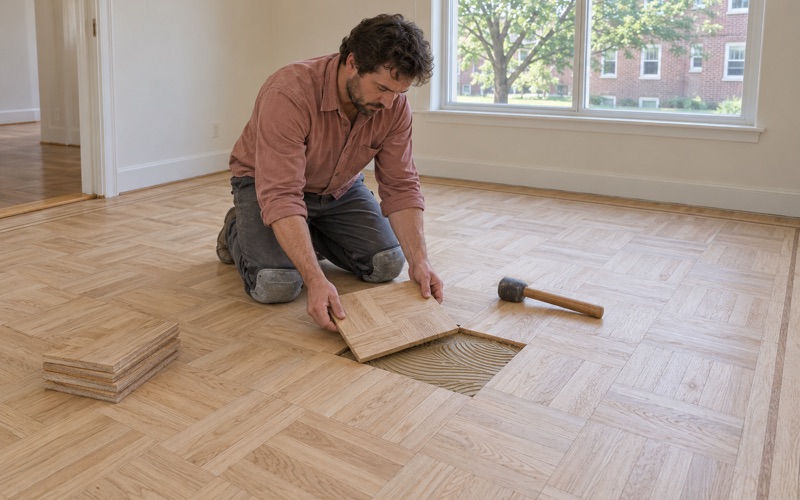
Severn Wood Flooring has handled wood-flooring in Catonsville for homeowners and landlords for more than 20 years, and a large share of that work starts with one question: what did the water do to this floor? We refinish, repair and install solid hardwood and engineered floors, but on a storm-damaged floor the first job is reading it, not sanding it.
That means finding where the water came in, how far it traveled under the boards, and whether the subfloor took any of it. We trace it, dry it, check it with a moisture meter, and write it up room by room so the person handling the loss has a record to work from. Only then do we talk about refinishing, board replacement or a new floor.
This page explains how storm water reaches a wood floor in an upland suburb away from the river, and what we look for after it does. It also covers how we plan the work so the decision rests on readings rather than guesses.
May 27, 2018: When Rain, Not the River, Flooded Catonsville
The National Weather Service Baltimore/Washington office wrote up that afternoon on an event page titled “Ellicott City & Catonsville,” and the pairing matters. Ellicott City drew the headlines, but the weather service also recorded that Catonsville, portions of Baltimore City, and the Dundalk and Perry Hall areas all experienced significant flooding. For anyone who owns a wood floor here, that second sentence is the more useful one.
How fast it came
The weather service reported total rainfall estimates of six inches by 5:15 p.m. in the Oella and Catonsville areas, with between 6 and 12 inches in the heaviest band. A Flood Warning went out at 3:19 p.m. covering Ellicott City, Catonsville, Dundalk and Baltimore City. Wikipedia, citing reported totals, lists Catonsville at 10.38 inches, the highest figure in the area, though that number comes from a secondary source rather than the event page itself.
What it looked like on the ground
According to the weather service, social media images showed water up over the bottoms of cars in the downtown area of Catonsville, and up to a foot deep in some backyards. A chunk of road washed out on Thistle Road southwest of town. That is street and yard flooding, driven by rain falling faster than the ground and storm drains could take it.
The 2016 comparison
The weather service measured the 2018 storm against the 2016 flood that came before it. Gauges near Catonsville and near Elkridge came close to, or exceeded, their 2016 levels, and the Catonsville gauge rose about 13.5 feet in an hour, against roughly 14 feet in 2016. Two events that close together are a good reason to treat heavy downpours as a real risk to floors here rather than a once-in-a-lifetime story.
Why the record matters for a floor
The weather service record describes streets, cars and backyards, not the inside of any particular house. That is exactly why it is useful to a homeowner: it shows how much water can gather against a foundation in a few hours on ground that never sees the river. When we look at a floor after a storm, we start from that picture rather than from a flood map.
Looking for wood-flooring closer to Laurel? See Wood-Flooring in Laurel.
How Surface Water Reaches a Wood Floor Away From the River
Catonsville is an upland suburb near the Patapsco River and Patapsco Valley State Park, so it is easy to assume that flooding is a valley problem. The 2018 record says otherwise. When rain piles up in streets and backyards, it looks for the lowest opening in the house, and that is rarely the front door.
The common entry points
Water a foot deep in a backyard presses against basement walls, window wells and the gap under a back or walkout door. A sump pump that cannot keep pace, or that loses power in the storm, lets water rise across a finished basement floor. Gutters and downspouts overwhelmed by several inches of rain in a few hours can dump water against the foundation right beside a ground-floor room with oak strip flooring.
Townhouses, split-levels and basements
A split-level puts a family room a half flight below the yard, and a townhouse often has a walkout lower level facing the backyard, so both sit close to where storm water collects. A finished basement with solid hardwood laid over concrete is the most exposed of all. That is why we take moisture readings on concrete and basement floors before any wood goes down, storm or no storm.
What wood does with it
Solid hardwood is built from boards milled tongue and groove, and each board swells as it takes on moisture. Edges that rise above the center are cupping; a center that rises after a cupped floor is sanded flat while still wet is crowning; boards that lift off the subfloor entirely are buckling. Water stains, dark lines at the board seams and a musty smell under a carpet pad are often the first signs someone notices.
Why the age of the house matters
Catonsville has a deep stock of older homes, with 3,132 of its 16,926 housing units built in 1939 or earlier and another 3,515 built in the 1950s, according to the 2024 American Community Survey. Houses of that age can have red oak strip flooring nailed over board subfloors and joists that have seen decades of seasonal movement. Floors that old can hold more history than they show, including earlier patches, layers of finish and sometimes black mastic from an old resilient floor tile.
After the Water: Drying, Documenting and Deciding
Whether a wet wood floor can come back depends on how long it stayed wet, what was under it, and how the drying went. We will not promise a result before we have readings, because no single rule fits every floor. What we can promise is a process that gives you facts to decide with.
Trace and dry first
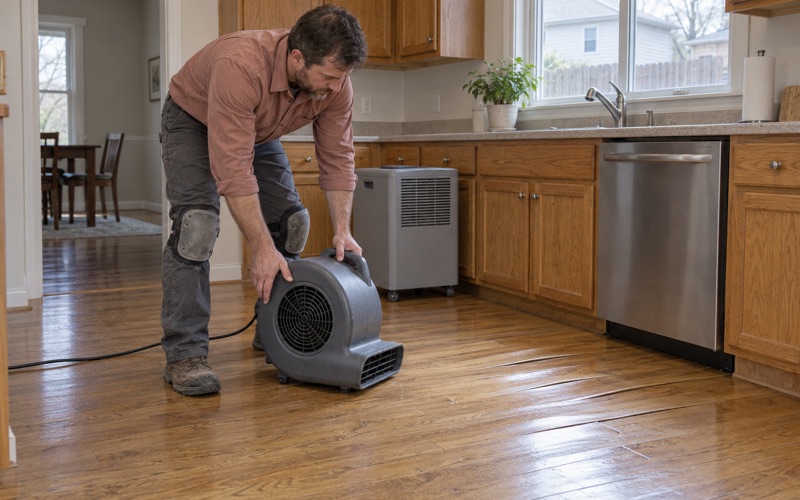
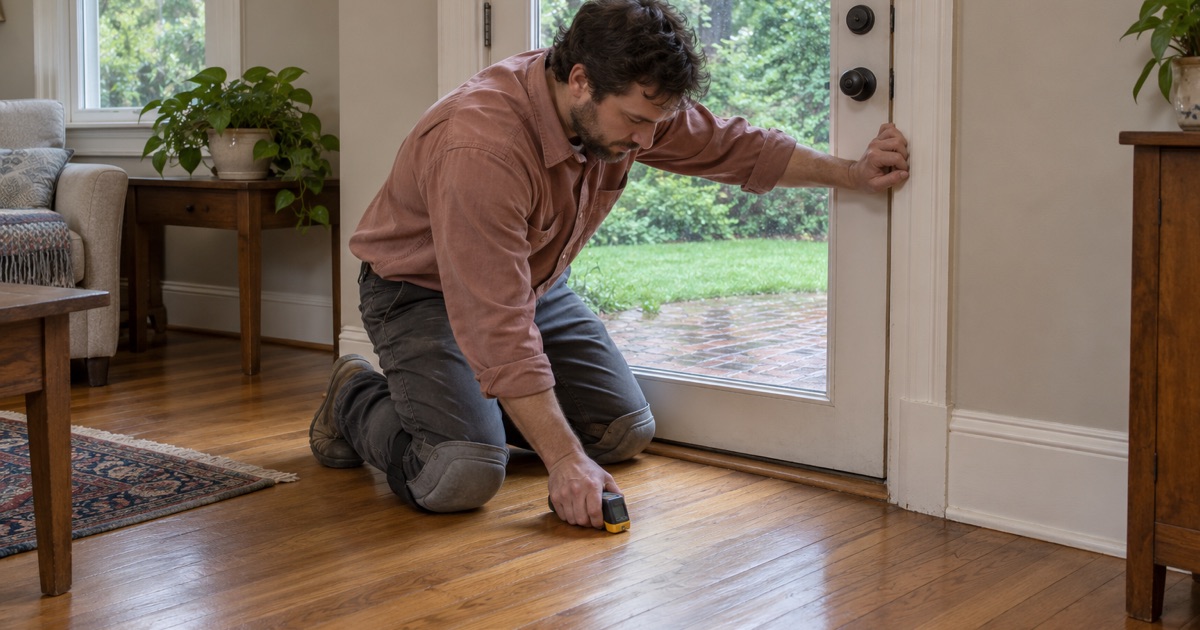
We start by finding where the water came in and where it went, since water often runs under boards well past the visible stain. Wet carpet pad and tack strip come out so the floor can breathe. We take moisture meter readings across the affected rooms and in a dry room for comparison, and we record them so the drying can be tracked against a baseline instead of judged by eye.
Document room by room
Each room gets its own notes: readings, photos, which boards cupped or buckled, and what the subfloor looked like where we could see it. We put that into a written, itemized estimate you keep. An adjuster, a landlord file or a future buyer can read the same document we worked from, and we leave coverage questions to the people who handle them.
Repair, refinish or replace
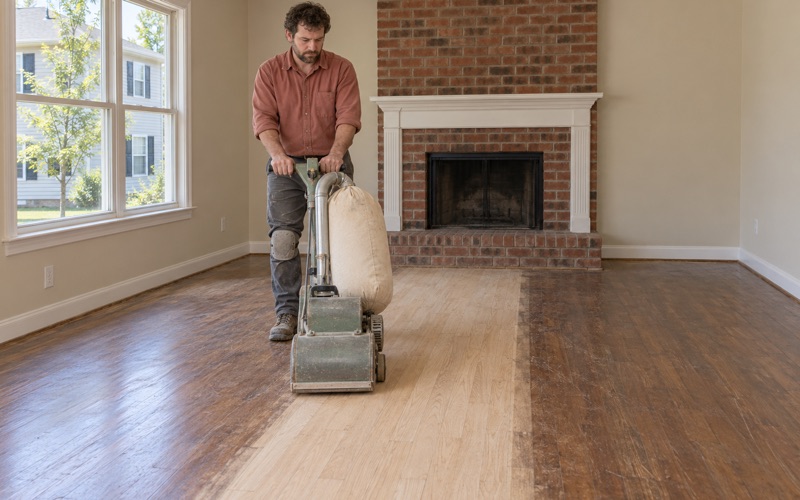
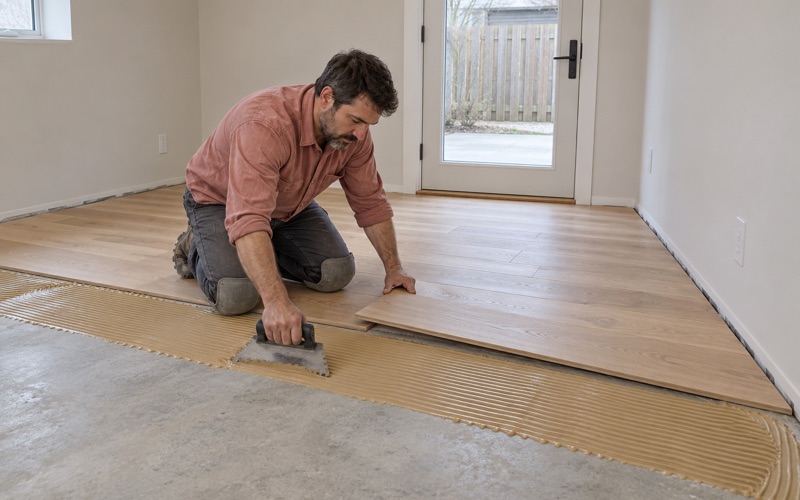
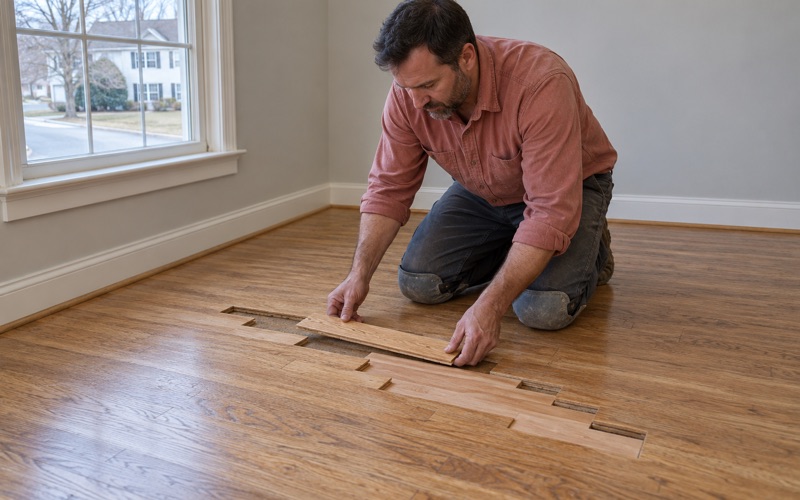
Once readings settle, the floor tells us more. Mild cupping sometimes flattens as the boards dry and can then be sanded with a drum sander and orbital sander through a full grit sequence. Boards that stay distorted, stained black or loose can be cut out and replaced with a weave-in repair so the new wood runs with the old. Where the damage reaches the subfloor or a below-grade room, we talk through replacement, including engineered wood or another floor for a finished basement after we read the moisture and the grade.
When the floor is dry but not right
Some floors dry back to normal readings and still show the event, with board gapping, squeaky floorboards or nail pops where the wood moved and settled. Gaps that open in winter and close in summer are normal seasonal movement, while gaps that stay wide year-round can point to boards that shrank after swelling. We note which is which before recommending a screen and recoat, a full sand, or board replacement.
Planning Floor Work in a Catonsville Home After a Storm
Catonsville is unincorporated, so Baltimore County is the local government, and its Department of Permits, Approvals and Inspections handles building matters. We confirm what applies to a specific job with the county directly rather than assume it. The same goes for anything a lender, insurer or association asks for in writing.
Before anything is sanded
A storm repair in an older house often means sanding near trim, stairs or doors that carry old paint. We check the build year and any painted surfaces first, because homes built before 1978 fall under lead-safe renovation rules such as the EPA RRP Rule. If we uncover old tile or black mastic under a damaged floor, we identify it and leave that part to the right trade before we go any further.
Stairs and patched openings
Water that reaches a lower level often touches the bottom stair treads and risers too. We quote stairs tread by tread, because a staircase is not priced by the square foot. Where a damaged section or an old floor register has to come out, we patch the opening with boards woven into the existing floor rather than a square plug.
Rentals and turnovers
About 69.7 percent of occupied homes here are owner-occupied, which leaves a sizable rental share in houses, townhouses and small buildings. When a storm hits a rental, we schedule floor work in a pre-1978 unit around the lead dust test Maryland requires at each change of tenant. Our itemized invoice also separates ordinary wear from damage, which gives a landlord the documentation Maryland’s security deposit law calls for.
Finishes and a livable house
After a flood, households want the rooms back quickly, but a finish applied over wood that is still drying can fail. We wait for the readings, then lay stain and sheen samples on your own floor before a color is chosen. Finishes are picked to fit Maryland’s VOC limits for wood coatings, waterborne polyurethane or oil-modified, with fume and drying times planned around who is living in the house. Dust stays contained to the rooms we are working in, with doors and returns sealed and a HEPA vacuum used throughout.
- 20+ Years Experience
- Written Itemized Estimates
- Dust-Contained Sanding