Severn Wood Flooring has spent more than 20 years on wood-flooring in Cherry Hill and the rest of our service area, and most of what we are asked to do here happens inside homes where someone still lives. Our work is sanding, repairing and refinishing floors in apartments and townhomes one unit at a time, so an owner can keep a building in good condition without asking a household to leave.
That changes how a project is planned. Instead of clearing a whole building and running a drum sander through every room in a week, we sequence the work around tenancies, lease end dates and the hallways and entries that every resident shares. Dust stays in the rooms we are working on, with doors and returns sealed, and finishes are chosen so the people next door are not living with fumes for days.
Before any sanding starts, we check the build year and look for painted surfaces, because most of this housing predates 1978 and falls under lead-safe renovation rules. Every job is priced on a written, itemized estimate the owner can keep in the unit file.
Cherry Hill’s Rental Communities and a Plan Built on Keeping Residents in Place
Cherry Hill is one of the southernmost neighborhoods in Baltimore City, a peninsula bounded by the Middle Branch of the Patapsco River, and it is overwhelmingly a neighborhood of renters. The 2024 five-year American Community Survey counts 2,965 of its 3,155 occupied homes as rented, about 94 percent. Of the housing units counted, 979 sit in buildings of five or more units, and most of the rest are attached rowhouse and townhouse homes.
That pattern is not new. The 2020 Cherry Hill Transformation Plan notes that by 1956, when the original core of the community was finished, it was about 30 percent homeowners and 70 percent renters. Cherry Hill was built in the 1940s as a planned community for Black war workers and veterans, and renting was the majority arrangement from its first decade.
What the Transformation Plan asks for
The Baltimore City Planning Commission voted unanimously to accept the Transformation Plan as the official community-managed plan for the neighborhood. Its housing goal is plain: improve life for the people who live in Cherry Hill now, whether they rent or own. The community stated loud and clear that growth cannot displace existing residents, and the plan names preventing displacement as its top priority.
The plan also judges the current risk of displacement to be low, because there is ample vacant land and room for renovation. For a flooring contractor, the practical reading is simple. The work that keeps units in good shape has to happen around the people living in them, not after they have gone.
Private communities maintained while residents stay
The plan maps several private rental communities, including Middle Branch Manor, Harbor City Townhomes, Southwood Townhomes, Cherrydale Apartments and Riverfront Townhomes. It records that the owner of the first three plans to keep them at the same level of affordability and perform annual maintenance to keep units and buildings up to date. Many private complexes here also carry affordability requirements tied to their financing, and those typically last 15 years.
Annual maintenance on occupied, affordable homes is exactly the kind of program floor work has to fit into. A refinish that pushes a family out for a week, or a repair that leaves a hallway closed, cuts against the whole point of the plan. We build schedules that let maintenance happen while the leases carry on.
Looking for wood-flooring closer to Catonsville? See Catonsville Wood-Flooring.
Floor Work One Unit at a Time, Around Turnover and Shared Spaces
In a building where nobody is moving out, each unit is its own job. We walk every apartment or townhome separately, note its traffic lanes, water stains near kitchens and baths, pet urine stains, nail pops and board gapping, and price it on its own line. A manager can then approve the units that need it most this year and schedule the rest for the next maintenance cycle.
Working in an occupied unit
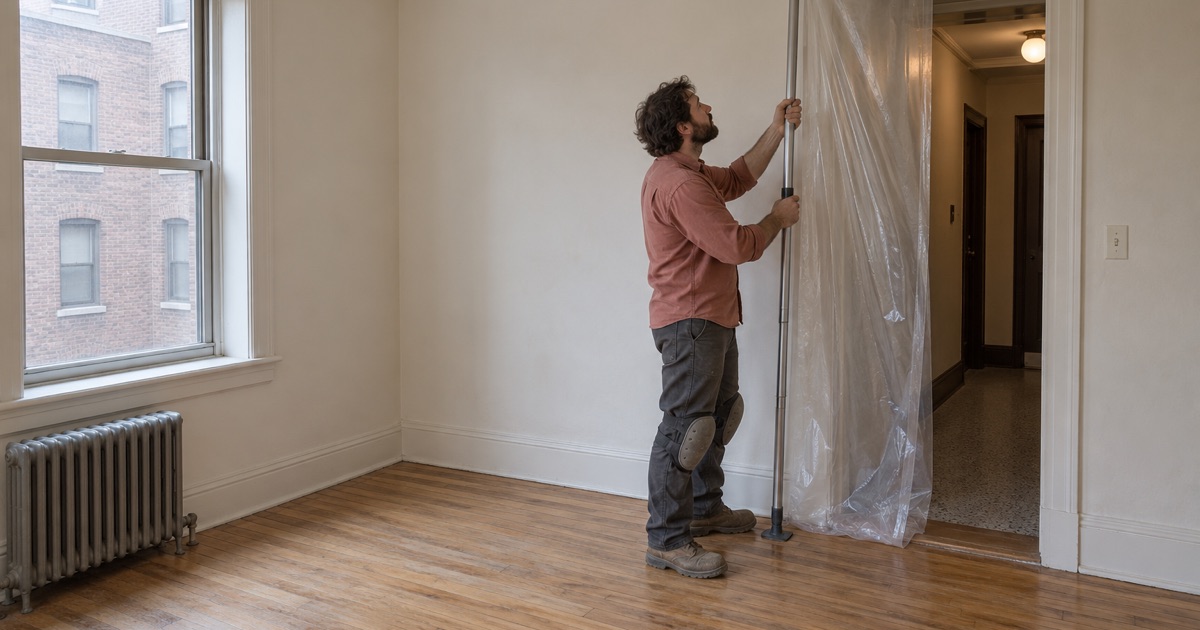
When a resident is staying, we break the unit into zones. Bedrooms can be done while the household uses the living room, then the living area while furniture waits in a finished bedroom, so no one goes without a place to sleep. We tape off doorways, run a HEPA vacuum as we go, and keep sanding inside the containment rather than letting dust drift into the corridor.
Finish choice matters more when someone sleeps in the next room. A waterborne polyurethane that fits Maryland’s VOC limits for wood coatings airs out faster than an oil-modified polyurethane, and we give the resident and the manager the drying and fume times in writing before the first coat goes down.
Using turnover windows
A vacant unit between tenants is the one time a full sand to bare wood is easy. When a lease ends, we aim to finish the floors inside the turnover window so the next household moves in on schedule. In pre-1978 units, that work is sequenced around the lead dust test Maryland requires at each change of tenant, so the floor is finished and cleaned before the test rather than after it.
We also record what we found. Our itemized invoice separates ordinary wear from damage room by room, which gives a landlord the supporting documentation Maryland’s security deposit law, Real Property 8-203, asks for when a deduction is taken.
Keeping shared spaces open
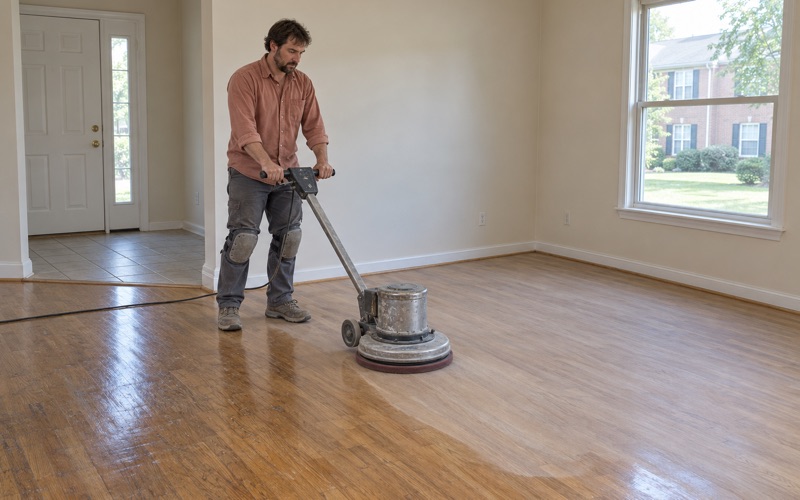
Hallways, stairwells and entries in a building of five or more units belong to everyone. We carry the drum sander and orbital sander in at set times, stage nothing in a shared path, and clean the route behind us. Where a common area has a wood floor, we plan it in halves so one side of a corridor or lobby stays usable while the other cures.
Repair Before Refinish Across a Mid-Century Rental Portfolio
Cherry Hill’s housing is mostly mid-century. The same census figures date 972 units to the 1940s, 660 to the 1950s and 422 to the 1960s, while only 19 were built since 2010. A portfolio of that age has seen decades of tenants, and a refinish only holds up if the floor under it is sound.
Fix the boards first
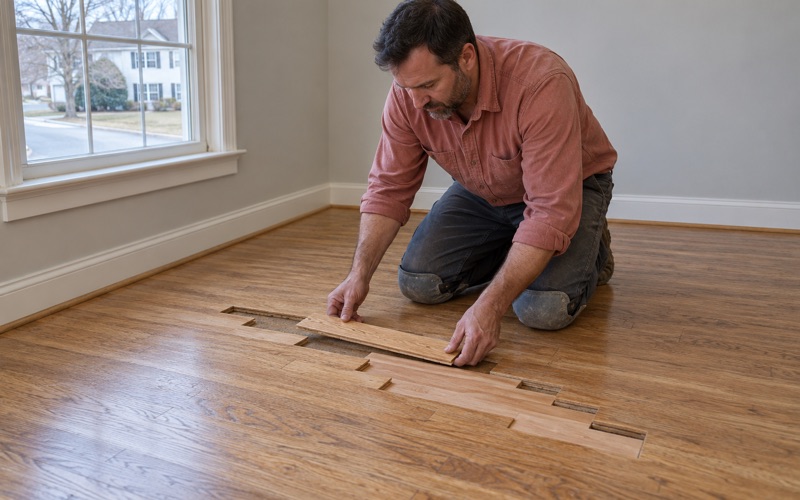
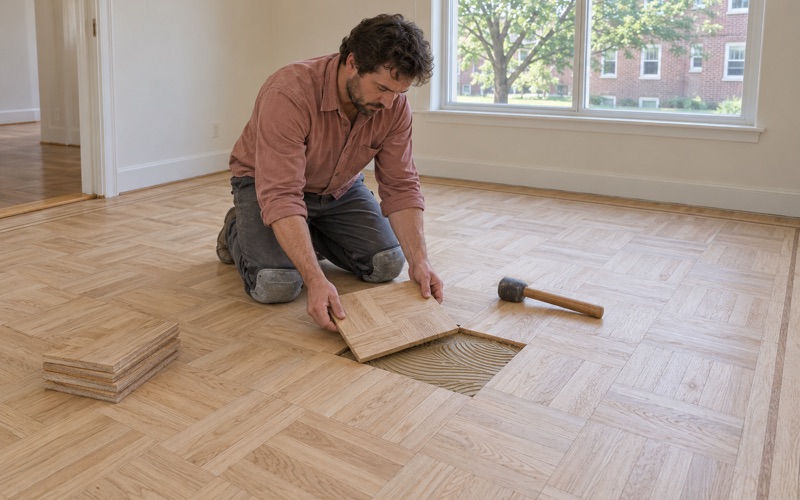
We start with the structure. Squeaky floorboards and loose boards usually trace to fasteners or the subfloor, cupping and crowning point to moisture, and a dark, soft patch under a window often means a board has to come out rather than be sanded. Board replacement and weave-in repair, where new tongue and groove boards are laced into the existing floor, go in before sanding so the room finishes as one surface.
Moisture gets read with a moisture meter before and after any repair. Water damage is traced to its source and dried before a board is replaced, and where an adjuster is involved, we document it room by room.
Know what is under the carpet and the tile
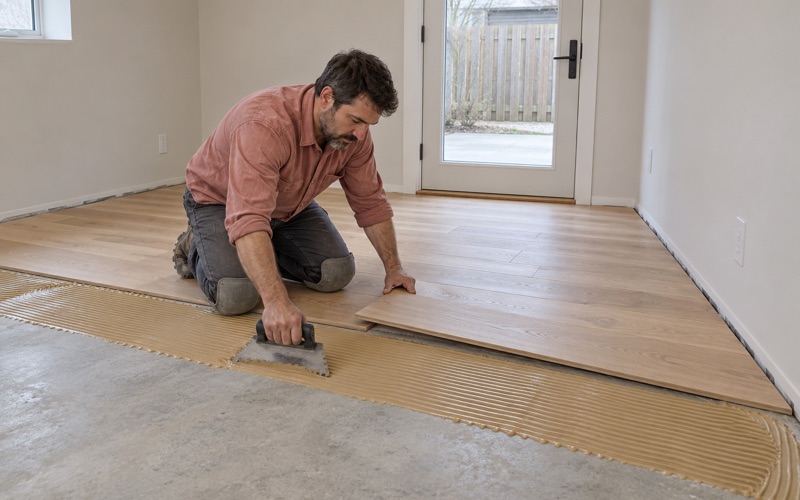
Many rental units have had several floor coverings over the years, and we do not assume what a 1940s or 1950s home has under it. When carpet comes up, we pull the tack strip and carpet pad and check for face nails and staples before deciding whether the wood can be refinished. Old resilient floor tile and black mastic are identified before anything is sanded, and if they need to come out, we leave that to the right trade.
Screen and recoat or a full sand
Not every unit needs bare wood. A floor with a sound finish and light traffic wear can often take a screen and recoat in a day, which is the least disruptive option for a household that is staying. Peeling polyurethane, deep pet stains and gray water stains need a full sand, so we tell the manager which units are which before anything is scheduled.
Planning Floor Work With a Cherry Hill Property Manager
Cherry Hill is a Baltimore City neighborhood with no government of its own, and rental properties are registered and licensed through the Baltimore City Department of Housing and Community Development. The city’s 2024 building code lists interior finish work such as painting, tiling and carpeting as exempt from permits, but wood flooring is not named on that list. We check with DHCD Permits and Inspections whenever a project goes beyond refinishing an existing floor.
What we ask for up front
A good plan starts with a unit list: which homes are occupied, which leases end soon, which buildings were built before 1978, and which hallways must stay clear. From that we propose a sequence, phasing occupied units around residents’ routines and saving full sands for turnover windows wherever the calendar allows.
We also ask about stairs, since a townhome staircase is quoted tread by tread rather than by the square foot. If a unit has a finished basement, we read the moisture and the grade before recommending engineered wood or a different floor altogether.
What the manager gets back
Every unit receives a written, itemized estimate, then an itemized invoice once the work is done. Stain and sheen samples can be laid on one representative floor so a manager picks a single color and sheen level for the whole community, which keeps later touch-ups consistent from unit to unit.
That paperwork also serves the plan’s larger aim. A record of what each floor needed and when it was done lets an owner hold units to the same standard year after year while the people who live in Cherry Hill stay in their homes.
- 20+ Years Experience
- Written Itemized Estimates
- Dust-Contained Sanding