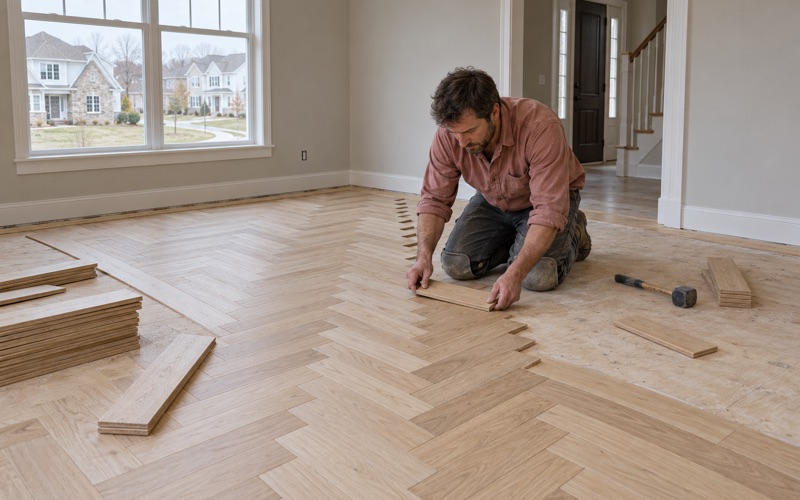
Severn Wood Flooring has spent more than 20 years on wood-flooring in Columbia and the surrounding county, and much of that work begins after something else in the house has already gone wrong. A supply line lets go under a vanity, a window is pulled and reset, or a new heat pump moves the ductwork, and a strip of boards is left stained, lifted or cut. We plan the floor around that larger repair so neither job undoes the other.
Most of the floors we see here sit inside owned townhomes and condominiums. Red oak strip flooring and builder-grade hardwood both show water the same way: cupping first, then dark staining along the board edges. We read the moisture, trace where it came from and write up the floor as its own scope, separate from the plumbing, roofing or window work around it.
That separation matters most when the bigger repair is being paid for through a county program. The sections below cover who owns these homes, what Howard County’s repair loan is written for, where floors fit beside it and where they do not, and how we put a Columbia floor project on paper so it stands on its own.
Owned Townhomes and Condos in Columbia

Columbia is a planned community in Howard County made up of ten villages, opened between Wilde Lake in 1967 and River Hill in 1990. It is an unincorporated census-designated place with no city government of its own, so building permits run through the Howard County Department of Inspections, Licenses and Permits rather than a local office. The Columbia Association, a not-for-profit management company, manages the common areas and facilities.
Townhomes carry a large share of ownership
The Census Bureau’s 2024 five-year American Community Survey counts 26,665 owner households in Columbia out of 41,143 occupied homes. Of those owners, 8,209 live in townhomes, the one-unit attached houses that line so many of the village neighborhoods. Another 2,147 owner households live in buildings of five or more units.
Those two groups shape the work we do here. A townhome shares walls with its neighbors and often stacks finished levels over a finished basement, while a condo sits inside a building where the floor below belongs to someone else. Both change how we stage a job, where we run dust containment, and how we handle water that has traveled from one level to another.
Build era and what sits under the finish
The median Columbia home was built in 1983, and 57.2 percent of the housing stock went up between 1970 and 1989. The owners are an older group as well: the same survey puts 53.0 percent of owner householders at age 55 or older. In homes of this age we often see worn traffic lanes, rug shadow, wax residue over an old finish, and boards that have gapped or squeaked over the joists.
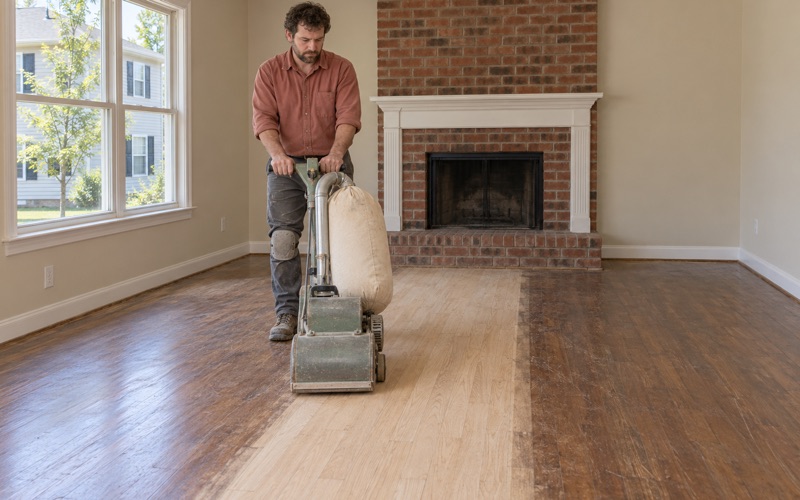
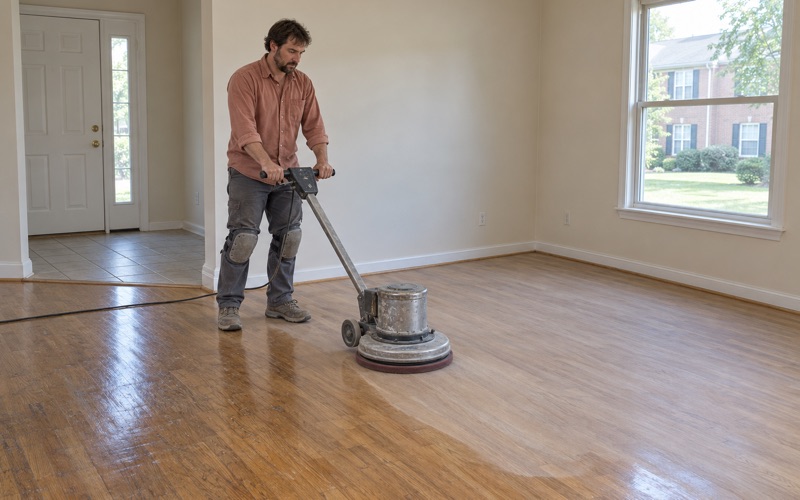
With 42.9 percent of Columbia’s housing built before 1980, we check the build year and look for painted surfaces such as baseboards and stair risers before any drum sander or orbital sander touches the floor. Homes built before 1978 fall under lead-safe renovation rules, so we plan the sanding and cleanup with a HEPA vacuum and sealed work areas.
Looking for wood-flooring closer to Scaggsville? See Wood-Flooring Services in Scaggsville.
Howard County’s Reinvest Renovate Restore Loan: Who Qualifies
Howard County’s Department of Housing and Community Development runs the Reinvest Renovate Restore (RRR) Home Rehabilitation Loan Fund Program for income-eligible owners who need repairs. The program is written plainly for the kinds of homes that dominate Columbia’s owner market. It is a county loan, decided by the county, and we have no role in who receives one.
The ownership and residency tests
To apply, a household must own a single-family home, townhome, condo or mobile home in Howard County. The owner must live there full time as a principal residence and must have owned the property for at least one year. That puts Columbia’s owned townhomes and condos squarely inside the kind of home the program describes.
The county lists further tests on its resource page. Debt-to-income can be no more than 45 percent, the mortgage, taxes, insurance and any HOA fees must be current, the credit score must be at least 620, and loan-to-value cannot exceed 110 percent.
The income line and the loan ceiling
Household gross annual income must not exceed 80 percent of Howard County’s median income. The maximum loan the program offers is $50,000. Anyone weighing the program should confirm the current figures directly with the county, since the income limit is tied to the county median rather than a fixed dollar amount.
The county describes three tiers of terms. Tier 1 carries 0 percent interest over five years with 20 percent forgiven each year, Tier 2 carries 1 percent deferred until sale, and Tier 3 carries 2 percent for up to 30 years.
What the repair list names
The county’s program page says repairs may include, but are not limited to, heating and air conditioning systems, electrical improvements, plumbing, roof replacements, installation of windows and doors, painting and even landscaping. It also allows the loan to be used for improvements that assist with mobility, hearing, vision or other special needs. Floors do not appear on that list, and we never tell an owner that they do. Whether any piece of a project fits the program is the county’s decision, made through its own process.
When Floor Work Travels With a Plumbing, Roof or Window Repair
Even though the repair list stops short of floors, the repairs it does name regularly leave damaged floors behind them. A plumbing failure soaks the subfloor, a roof leak runs down an interior wall, and a window replacement disturbs the boards at the sill. The floor is not the reason for the repair, but it is often what the owner sees first when the repair is finished.
Plumbing leaks, cupping and crowning
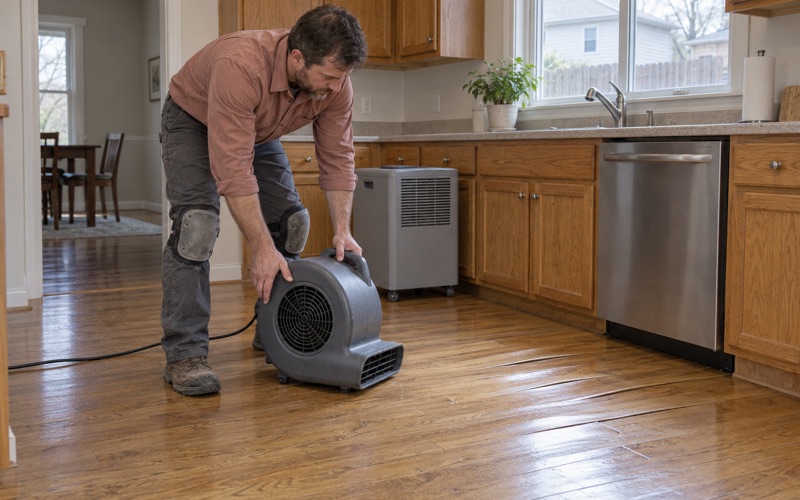
Water from a slow leak under a kitchen sink or a second-floor bath raises the moisture in the boards from below. The edges swell and the board cups; if someone sands it flat too soon, it can crown once it dries. We trace the leak path, take moisture meter readings across the affected rooms, and wait for the subfloor and boards to come back to normal before deciding between drying in place, board replacement or a wider refinish.
When the damage is part of an insurance claim, we document it room by room for the adjuster. In a condo, water that started one floor up can end in your unit, so we record where the readings were high and where they were not.
Windows, doors and roof leaks
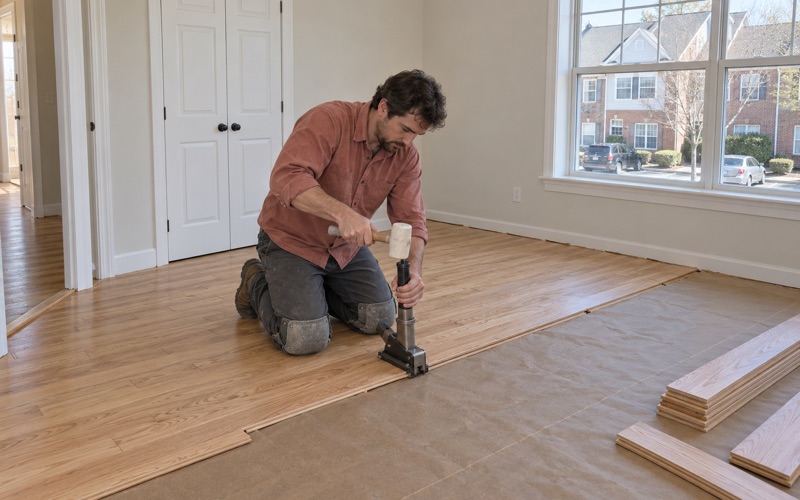
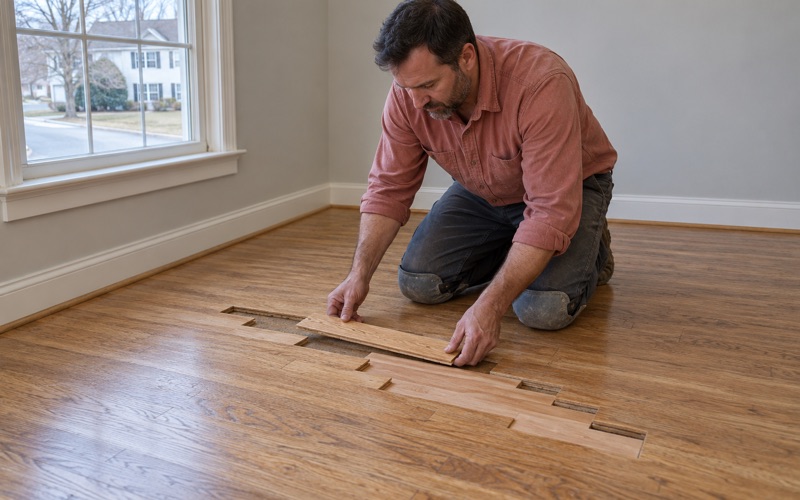
New windows and doors are among the repairs the county names, and an old unit that leaked can leave its mark on the floor long before it is replaced. The boards under a failed sill typically show black water stains, softened fibers or a gap where the old trim sat. We cut out the damaged boards and weave in new ones, matching red oak, white oak or maple to what is already there so the repair does not read as a patch.
A roof replacement on a townhome often follows a stain on an upstairs ceiling or wall. When that water reached the floor, we check the top level for cupping and nail pops, then plan any sanding after the roof work is done so the new finish is not scuffed by crews coming and going.
Heating, cooling and electrical work
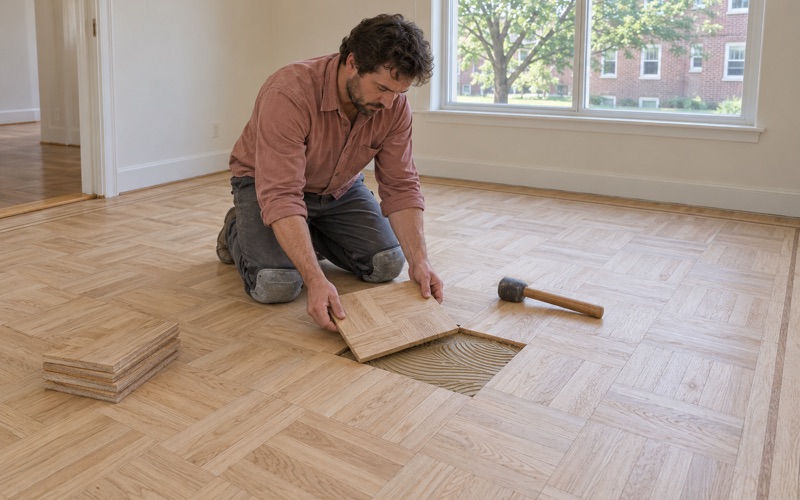
A new heating and air conditioning system can move registers or close off old ones, and electrical work sometimes opens a section of floor to reach wiring. We patch those holes with boards woven into the surrounding floor rather than a square plug or a metal cover. If a wall came out as part of the job, we treat the strip it left the same way.
Scoping a Columbia Floor Project Beside a County Loan
Because the floor and the larger repair can be paid for in different ways, how the work is written down matters as much as how it is done. We keep the two clearly apart on paper and in the schedule.
An itemized estimate that stands on its own
Every Columbia job gets a written, itemized estimate the owner can keep. Floor work is listed as its own scope: square footage refinished, boards replaced, stair treads priced tread by tread, finish system and sheen level, and any moisture testing. Nothing in it is described as part of a county loan, and any question of what the loan can be used for is between the owner and the county.
That same estimate is useful if an insurer is involved or if the home is later sold. It records what was damaged, what was repaired and what was simply worn, which keeps the floor’s history readable long after the larger repair is closed out.
Sequencing around the main repair
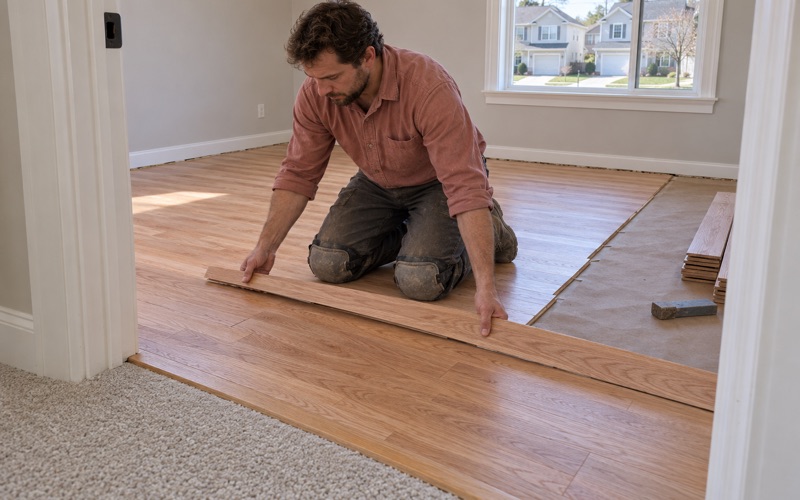
The floor comes last. We schedule after the plumber, roofer or window installer is finished, after moisture readings are back in range, and after any new boards have had time for acclimation. In an occupied townhome, we seal doors and returns so dust stays in the rooms being worked on.
For finishes, we choose between waterborne polyurethane, oil-modified polyurethane and hardwax oil to fit Maryland’s VOC limits for wood coatings. We plan drying times around the household, which matters for an owner living in the home through the work. Stain and sheen samples go down on your own floor before a color is chosen.
Older materials and shared buildings
Homes of this era can hide resilient floor tile or black mastic under carpet or in a basement. We identify those materials before anything is sanded and leave them for the right trade instead of grinding through them. In a condo or a townhome with an association, we read the association’s own documents for any rules that apply to the floor rather than assuming what they say.
- 20+ Years Experience
- Written Itemized Estimates
- Dust-Contained Sanding