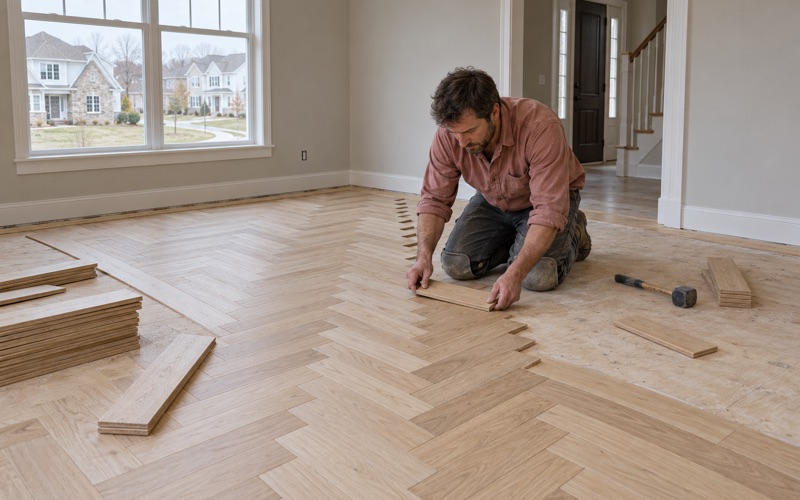
Severn Wood Flooring has handled wood-flooring in Crofton for more than 20 years, and most of that work happens in two kinds of houses: attached townhouses and detached single-family homes. We refinish worn oak, repair damaged boards, install new solid hardwood or engineered floors, and rebuild stairs that have taken decades of foot traffic. Every job starts with a visit, a look at the boards and the subfloor, and a written estimate itemized line by line.
The questions that shape a floor project here are rarely about the wood alone. Owners want to know how old the house is, which neighborhood paperwork applies to it, and how long a room will be out of use. We answer what we can from the house itself and point you to the right office for the rest, so the plan you sign reflects your floor and not a guess.
If you are weighing a refinish against a replacement, we will tell you which one the boards can support. A solid floor with enough wood above the tongue usually sands again; a thin engineered wear layer or a floor already sanded several times may not. That reading comes first, before any color or finish is discussed.
Crofton’s Planned Beginnings and Its Special Community Benefit District
Crofton did not grow up around an old town center. In 1963, after the Crawford Corporation had assembled more than 1,600 acres, it announced it would build a new community called Crofton, founded at the same time as Reston, Virginia. The plan was anchored by a community golf course that later became the Crofton Country Club, and Crofton Parkway, a 3.5-mile loop road, still circles the center of the community.
What the district is
The original section of Crofton is a Crofton Special Community Benefit District, formed under Anne Arundel County Code Article 4, Title 7 and administered by the Crofton Civic Association. For the taxable year running July 1, 2026 to June 30, 2027, the county’s Bill 33-26 sets the district levy at $0.1086 on each $100 of assessed valuation of each platted lot. That money supports community-wide purposes the Association’s membership approves; it has nothing to do with what happens to your living room floor.
The district as it stands today was set up by the county’s Bill 51-21, enacted in June 2021. Its listed purposes include acquiring, improving and maintaining community property approved by a majority vote of the Association’s general membership, and the county levies the assessment to repay a fifteen-year loan that financed land on Crain Highway. It is a community fund, in other words, not a review board for home projects.
Why the boundary matters
The census-designated place called Crofton and the special district are not the same area. The district covers the original planned section, so not every home counted in the Crofton census-designated place sits inside it. Before we talk about neighborhood paperwork, it helps to know which side of that line your house falls on, and the district levy line on your property tax bill is one way to confirm it.
Looking for wood-flooring closer to Cherry Hill? See Wood-Flooring Services in Cherry Hill.
About 40 Sets of Covenants Under a Civic Association, Not an HOA
According to the Crofton Civic Association’s own explanation of how covenants work in Crofton, the first set was put in place in 1973, once the first neighborhood was fully developed. As each later section was completed, its own covenants were added, and the result is approximately 40 sets of covenants within the tax district. Two houses a few streets apart can belong to different sets.
Finding the set your house belongs to
Which set applies depends on the section your lot was platted in, not on your street name or the style of the house. We do not read covenant text on your behalf, and we will never tell you that a set allows, restricts or ignores interior floor work. What we do suggest is a call to Crofton Town Hall at (410) 721-2301 before a project begins, so you know which covenant set your house sits under and can read it yourself.
How covenant review actually works
The Crofton Civic Association is a nonprofit civic association that includes everyone who owns a home in the district, and it is not an HOA. As the Association puts it, a homeowners association may police a community and issue citations, while its Covenant Review Committee is not vested with that authority. Action starts with a complaint from a neighbor within the same set of covenants, followed by a first notice by certified mail allowing 14 days and a second notice allowing 7.
An owner can appeal within 7 days, a forum is held within 30 days, and the Board decides whether any legal action follows. The Association also may not spend tax dollars on covenant-related expenses. None of that tells you what your set says about floors, which is exactly why we treat the document as something to read rather than something to assume.
What we do with that on a job
For a townhouse owner, we plan the floor around the association’s own rules as written in the documents you hand us, not around what a neighbor remembers. If the set you belong to raises a question we cannot answer from the page, we say so plainly and leave the interpretation to you and the Association. Our part is the floor itself: the boards, the finish, the schedule and the written estimate you keep.
Townhouses and Detached Houses From the 1970s Through the 1990s
Crofton splits almost evenly between two building types. The ACS 2024 five-year estimates count 4,983 one-unit attached homes and 4,965 detached homes out of 10,850 housing units, which works out to 45.9 percent attached and 45.8 percent detached. The median year built is 1988, with large waves of construction in the 1970s and again in the 1990s.
Floors in the townhouses
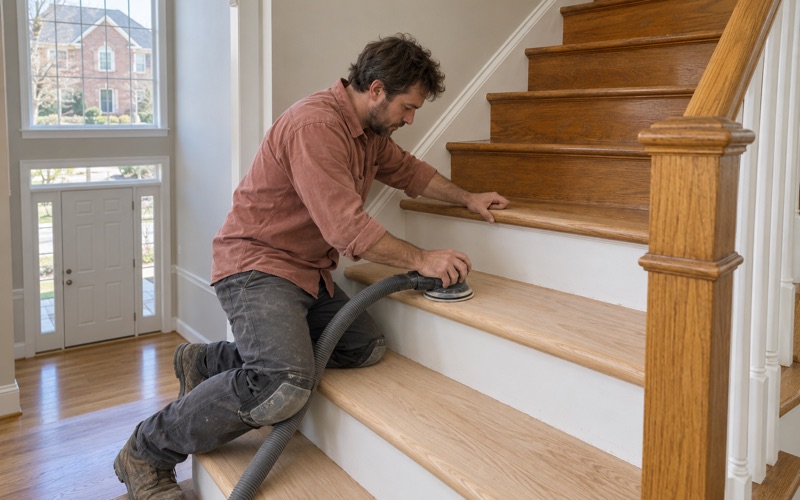
Townhouses from those decades can arrive with builder-grade hardwood on the main level, such as red oak strip flooring, and carpet over plywood upstairs. After years of use we see traffic lanes worn through the finish at the kitchen and front door, board gapping along the long runs, and nail pops where the subfloor has moved against the joist. Stair treads in a narrow townhouse take a beating, and we quote them tread by tread rather than by the square foot, because each tread, riser and stair nosing is its own piece of work.
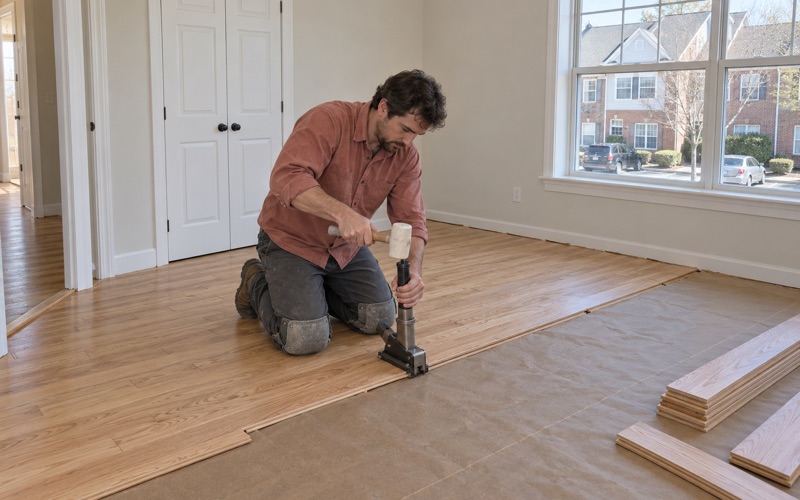
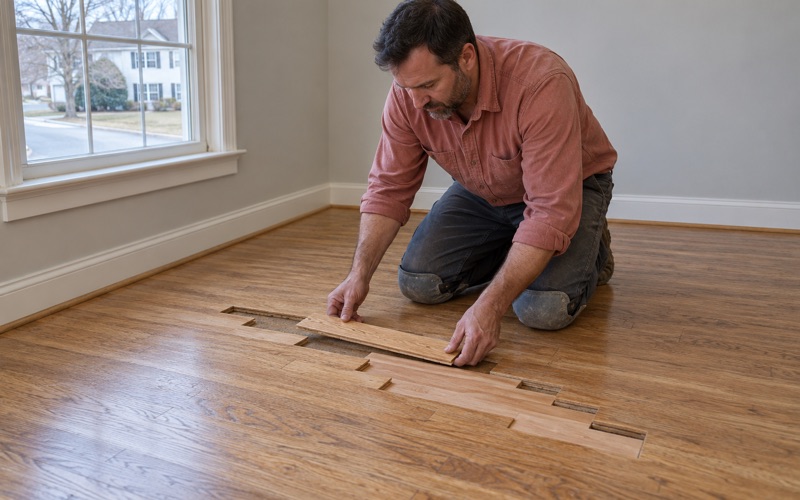
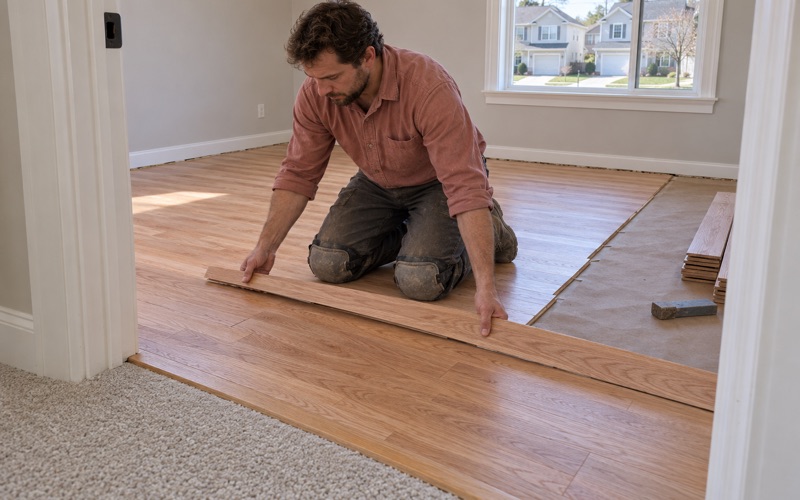
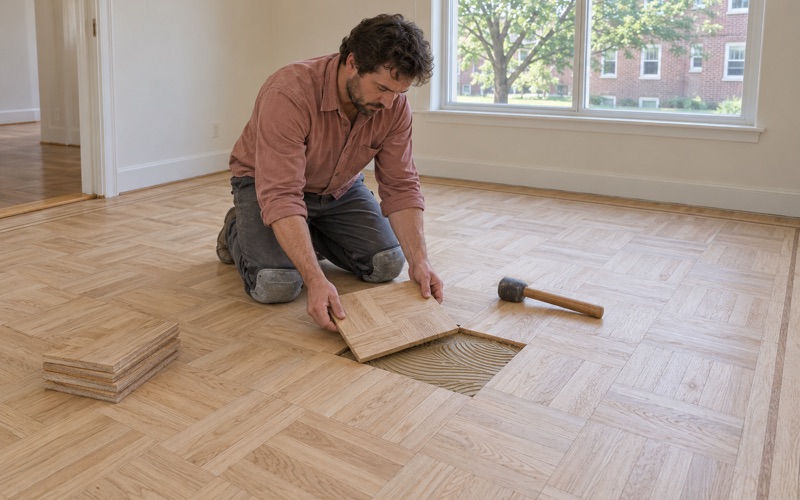
When an owner wants carpet pulled and wood carried upstairs, we lift the carpet pad and tack strip, check the subfloor for squeaks and soft spots, and fasten new boards with flooring cleats. Where a wall or floor register has been removed, we patch the gap with a weave-in repair so the new boards run into the old ones instead of leaving a filled square.
Floors in the detached houses
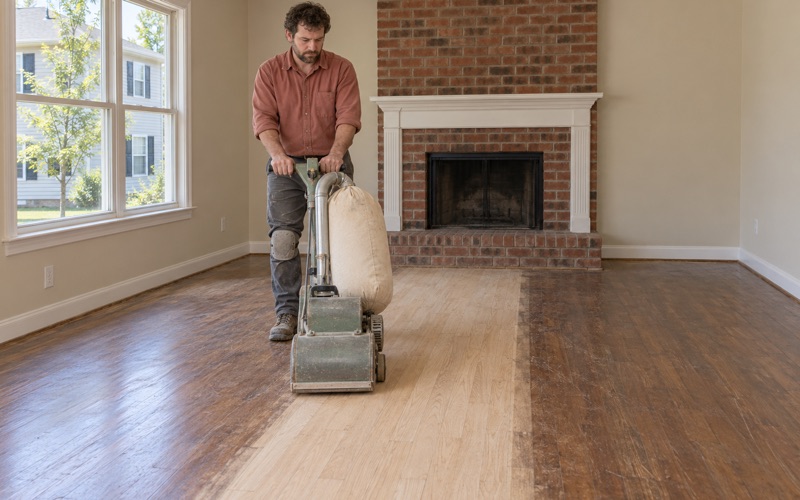
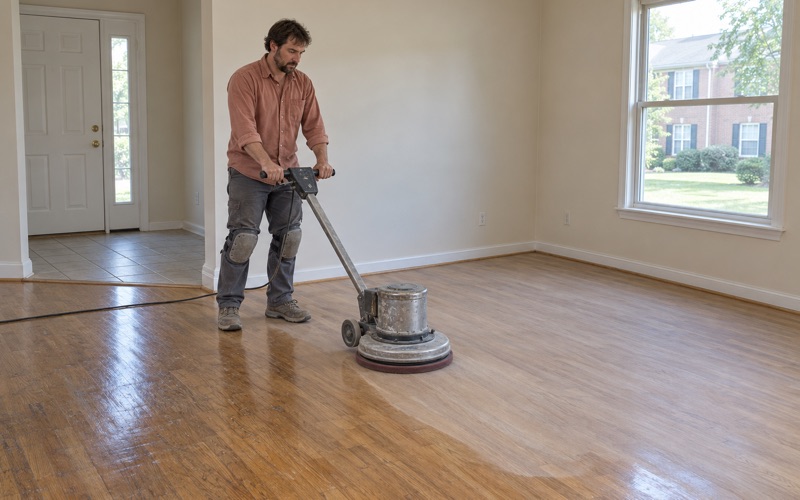
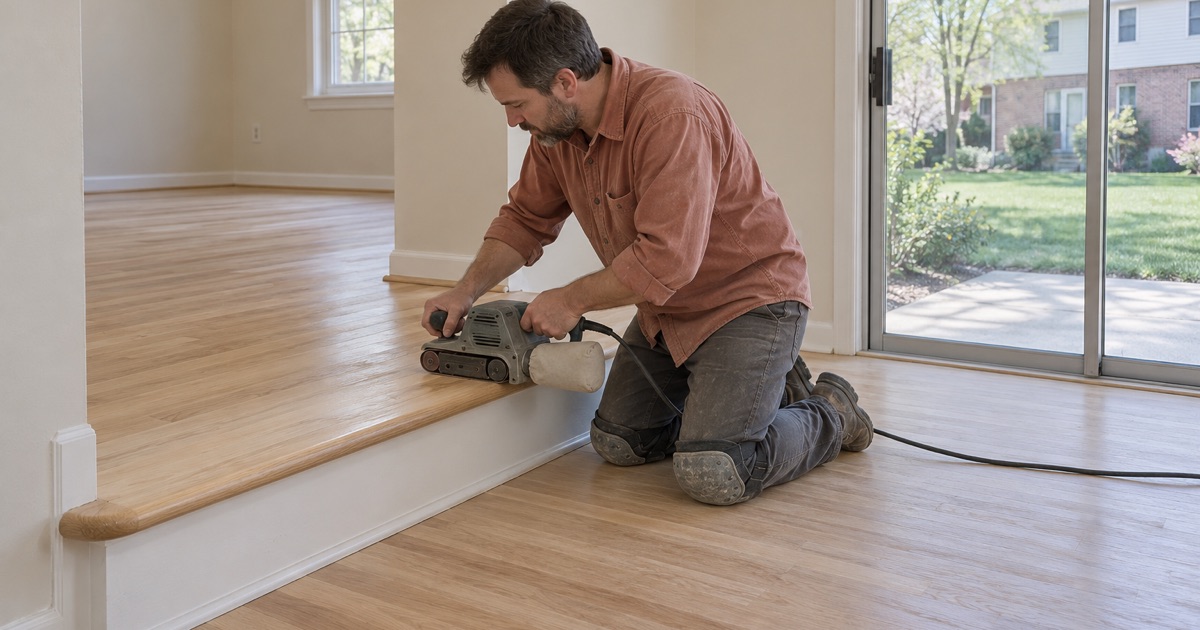
Detached homes from the 1970s can hold solid oak that has been refinished once or twice and has turned orange under old oil-based finishes. Many are good candidates for a full sanding with a drum sander and an orbital sander through a proper grit sequence, then a choice of waterborne polyurethane, oil-modified polyurethane or hardwax oil. We lay stain and sheen samples on your own boards so you see the color in your light before committing to it.
Not every floor needs to go back to bare wood. Where the finish is dull and scuffed but the stain and the wood beneath are intact, a screen and recoat can restore the surface in far less time, provided there is no wax residue to block adhesion. Where the finish is already peeling polyurethane, or the boards show cupping or crowning from past moisture, a full sanding is usually the honest recommendation, and we will show you why on the floor itself.
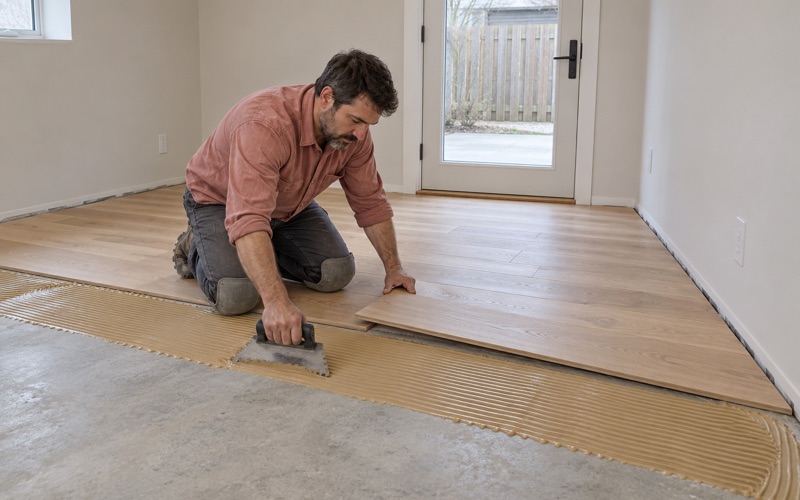
Some 1990s houses have finished basements, and those need a different conversation. We take moisture readings on the concrete first and, depending on what the meter and the grade show, recommend engineered wood or a floor that tolerates below-grade conditions better than solid hardwood would.
Planning Floor Work in a Crofton Home
Roughly 82.2 percent of occupied homes in Crofton are owner-occupied, and many owners have lived in their houses since the 2000s or 2010s. That usually means a floor that has seen one family’s whole routine: pet urine stains by the back door, water stains near the dishwasher, and a rug shadow where furniture sat for a decade. We map each of those before quoting, because some sand out and some call for board replacement.
New wood also needs time in the house before it goes down. We deliver boards for acclimation, check them with a moisture meter against the subfloor, and only then start the install, which avoids the winter gaps and buckling that come from fastening wood that has not settled to the room. The estimate spells out those days so the schedule holds no surprises.
Build year and older finishes
Crofton’s 1960s houses and many of its 1970s ones were built before 1978, so we check the build year and any painted surfaces before sanding begins, since those homes fall under lead-safe renovation rules. We also look for old resilient floor tile and black mastic under carpet or in back rooms. When we find them, we stop and leave that material for the right trade rather than sanding through it.
Rental houses
The rest of the occupied homes are rented, and a landlord turning over a townhouse needs the floor done between tenants and documented. In a pre-1978 rental we schedule floor work around the lead dust test Maryland requires at each change of tenant. Our itemized invoice separates ordinary wear from damage, giving a landlord the supporting record Maryland’s security deposit law asks for.
Keeping the house livable
Many families stay home while we work, so we contain dust to the rooms being refinished, sealing doors and returns and finishing with a HEPA vacuum. We pick finishes that fit Maryland’s VOC limits for wood coatings and plan drying and fume times around your household. If water has already reached the floor, we trace the source, dry the boards, read them with a moisture meter and document each room for your adjuster before any repair begins.
- 20+ Years Experience
- Written Itemized Estimates
- Dust-Contained Sanding