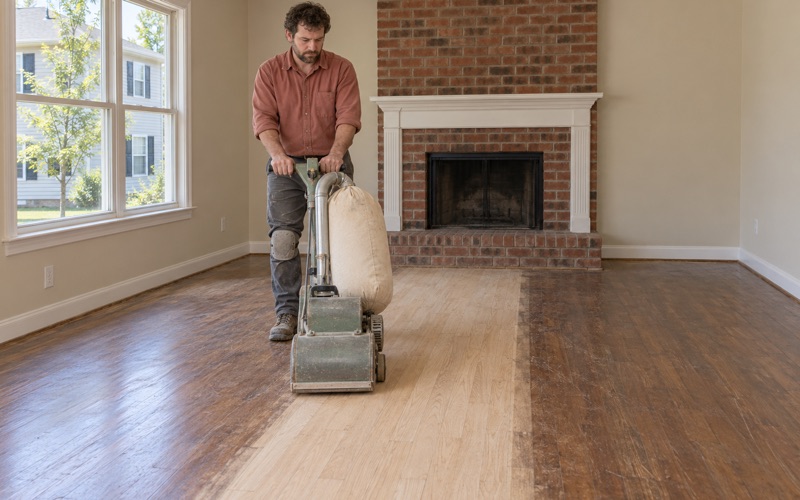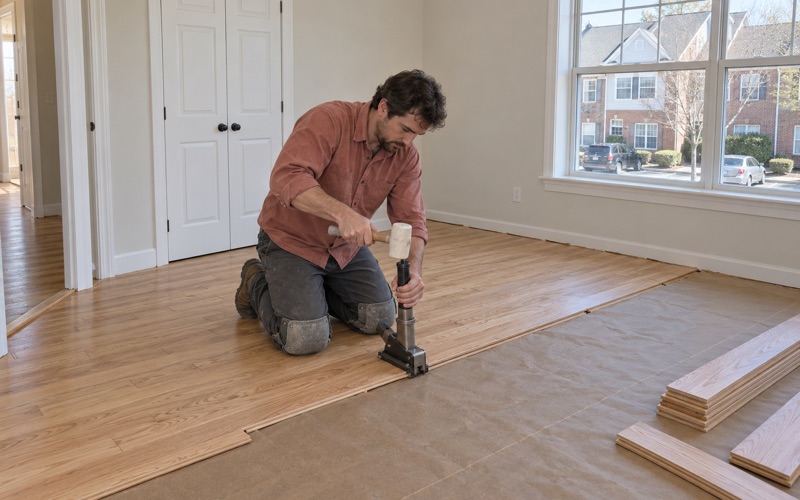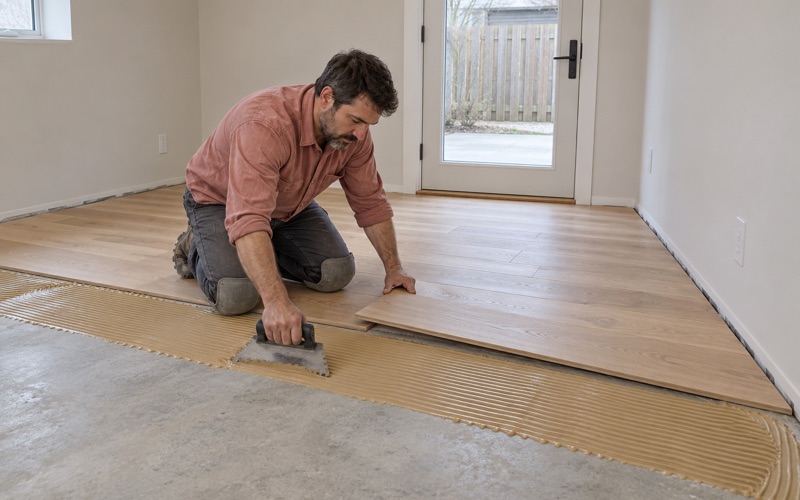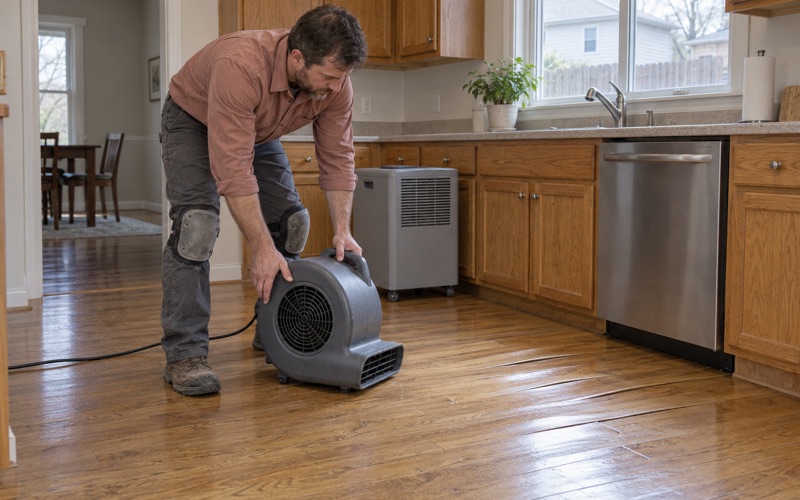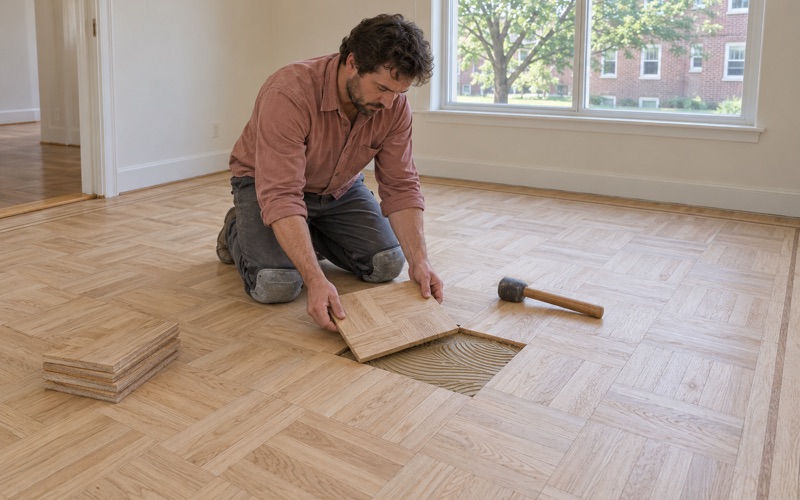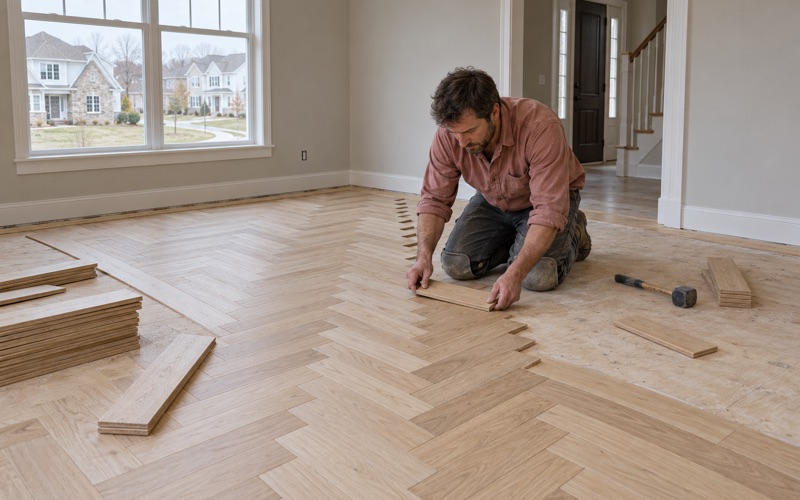
Severn Wood Flooring has handled wood-flooring in Crownsville for more than 20 years, refinishing, repairing and installing hardwood in houses where every room tends to be lived in by the people who own it. We sand, stain and finish solid hardwood, lay new tongue and groove or engineered boards, and fix the damaged patches that a whole-floor job would otherwise have to work around. Each job starts with a visit to the house itself, because the floor, the subfloor and the route in from the driveway all shape the plan.
We identify any old resilient tile or black mastic under carpet before anything is sanded, and leave it for the right trade rather than grinding through it. Then we lay stain and sheen samples on your own boards so the color is chosen in your light, not from a printed chart.
If a leak has already reached the floor, we trace the source, dry the boards and confirm the result with meter readings. Each affected room is then documented for your adjuster, so the claim rests on a record rather than a guess.
Owner-Occupied Detached Homes Along Generals Highway
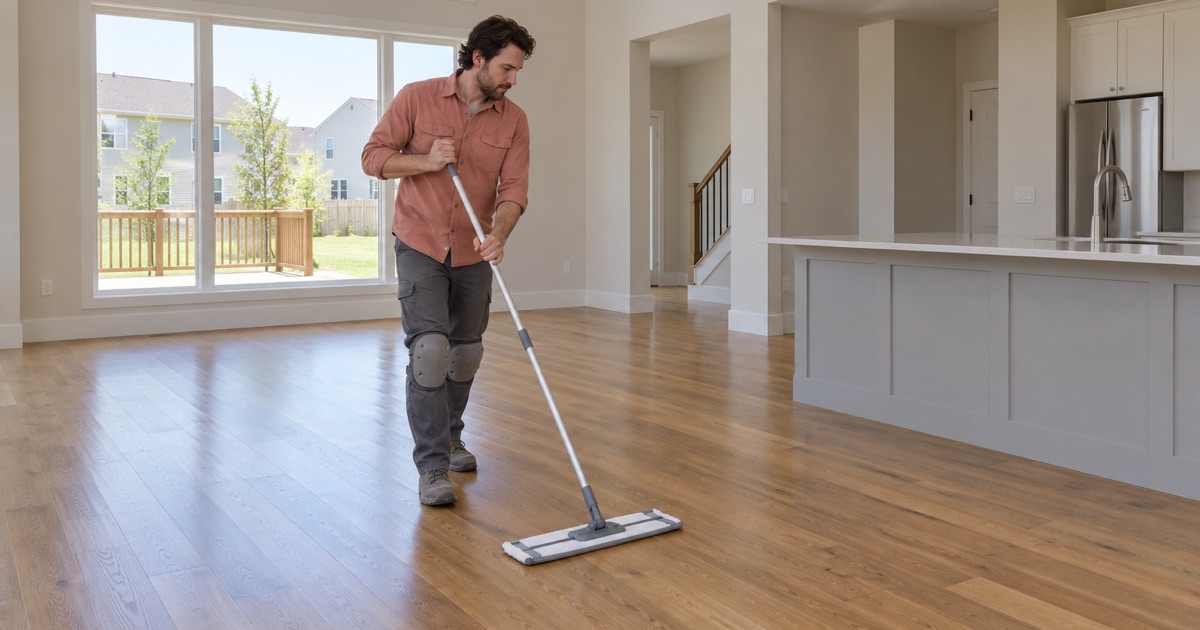
Crownsville is an unincorporated census-designated place in Anne Arundel County, and its housing has a single, clear profile. The ACS 2024 five-year estimates count 579 occupied homes there, and all 579 are owner-occupied, with no renter households recorded. Of the 592 housing units in the place, 569 are one-unit detached houses.
The 2020 census found that 84.5 percent of Crownsville residents lived in rural areas. Generals Highway, MD 178, runs through the center of the community, and I-97 forms its southwestern boundary. That shape matters for floor work: houses sit along roads and lanes rather than on a tight subdivision grid, and the job is planned around getting to each one.
Owners Deciding for the Long Term
When every occupied home is owned by the household living in it, the person who signs off on the floor is the person who will walk on it for years. The useful questions become how long a finish will last, whether a worn floor can take another full sanding, and what the work does to the original boards. Those are the questions our estimate is built to answer.
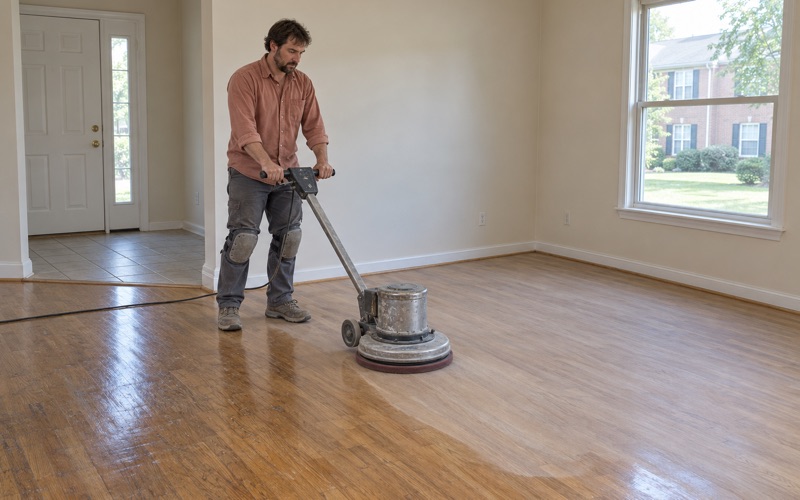
We measure the remaining wood above the tongue before recommending a drum sander, because solid hardwood can only be sanded so many times. Where a floor still has a sound finish and only dull traffic lanes, a screen and recoat is often the better call. Where boards show deep scratches, pet urine stains or water stains, we explain which ones will sand out and which need board replacement.
Detached Houses, One at a Time
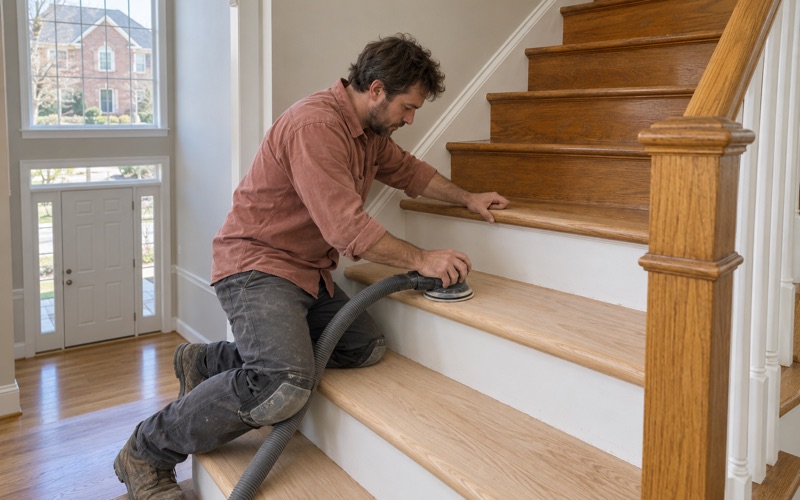
A detached house has no shared wall, no shared hallway and no neighbor below to schedule around. That frees us to plan the work room by room on the household’s timetable, moving furniture in stages so part of the house stays usable. Stairs are quoted tread by tread, since stair treads, risers and nosing are not priced by the square foot.
When a room is carpeted, the tack strip and carpet pad come out before we can judge what is underneath. Sometimes that is sound solid hardwood that only needs sanding; sometimes it is a subfloor that calls for new tongue and groove boards or a different product.
Looking for wood-flooring closer to Columbia? See Wood-Flooring in Columbia.
From Prewar Houses to 1990s Builds
Crownsville’s housing spans a wide range of ages. The ACS counts 64 units built in 1939 or earlier and none in the 1940s, while the largest groups went up in the 1990s and 2000s. The median year built is 1991, which puts the middle of the housing stock at roughly 35 years old.
Prewar Houses and Lead-Safe Work
A house from 1939 or earlier often has painted trim, baseboards and stair parts sitting right against the floor. Because homes built before 1978 fall under lead-safe renovation rules, including the EPA RRP Rule, we confirm the build year and look at every painted surface near the work before a sander is switched on. That check decides how we set up containment, how we clean up, and how we handle the baseboards.
Older solid floors in prewar houses can show cupping, crowning, nail pops or squeaky floorboards that trace back to the subfloor or a joist rather than the wood on top. Some carry old wax residue that has to come off before any modern finish will bond. We also look for frass, the fine powder powderpost beetles leave behind, before deciding whether a board can be saved.
1990s and 2000s Detached Houses
The ACS counts 165 units built in the 1990s and 134 in the 2000s, together about half of Crownsville’s housing. Houses from that era commonly came with builder-grade hardwood, often red oak strip flooring under a finish that has since ambered toward orange oak. When an owner wants that color gone, a full sand to bare wood and a fresh stain sample show what the oak looks like without it.
Prefinished floors from the 2000s are a different case. An engineered wear layer can be thin enough that a full sanding would go through it, so we check the board edge before quoting anything more than a screen and recoat. Where a section has failed, a weave-in repair with matching boards usually beats replacing the whole room.
Matching New Boards to Old
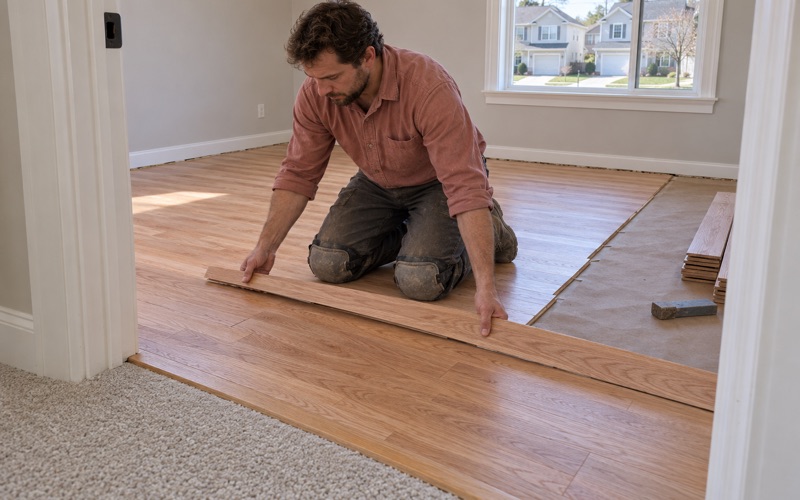
When owners extend hardwood into a room that never had it, matching species matters. Red oak, white oak and maple each take stain differently, and a room laid in wide plank or in a herringbone or chevron pattern changes how the floor reads from the next doorway. We set sample boards beside the existing floor before anything is ordered.
Douglas fir turns up in some older houses too, and because it is softer than oak we sand it with a gentler grit sequence, switching to an orbital sander where the boards need it. Parquet gets similar care, since its short blocks run in several directions at once.
Working at a Rural House: Access, Staging and Dust
With most Crownsville residents counted as rural, the job comes to the house rather than to a block of identical units. Before the first day we ask about the drive, where a trailer or van can park, and which door gives the straightest path to the rooms being worked on. A drum sander, edgers, a dust extractor and boxes of flooring all have to travel that path, often several times.
Long carries from the drive to the work rooms mean more chances to scuff a finished floor elsewhere in the house. We lay protection along the path, keep equipment off finished surfaces, and move the heavier pieces in before any new finish goes down. Once the last coat is on, the rooms stay closed until it has cured enough to walk on.
Staging Materials and Acclimation
New solid hardwood needs acclimation inside the house before it goes down, so we agree on a room where the boxes can sit without blocking daily life. We take moisture meter readings on the new boards and the subfloor, following the NWFA Installation Guidelines, and install only once the numbers are close enough. Skipping that step is a common cause of board gapping, winter gaps and, in the worst cases, buckling.
Below-grade rooms get their own reading. If a finished basement is part of the job, we test the concrete for moisture first and may recommend engineered wood or a different floor altogether, depending on what the meter and the grade tell us.
Keeping Dust in the Work Rooms
When the household stays in the house through the job, dust containment matters as much as the sanding. We seal doors and HVAC returns around the rooms being worked on, run sanders connected to extraction, and finish each day with a HEPA vacuum. The rest of the house stays usable, and the finish goes down on a clean floor.
Finish choice follows the same logic. Waterborne polyurethane, oil-modified polyurethane and hardwax oil each have different fume levels and drying times, and we pick from coatings that fit Maryland’s VOC limits for wood finishes. We then plan the coats around when your household needs the rooms back.
Crownsville Hospital Memorial Park and Planning Your Project
Crownsville is also home to a former state psychiatric hospital, whose grounds and buildings now house the Anne Arundel County Food Bank. The property was transferred to the county in December 2022 and is now Crownsville Hospital Memorial Park, with a master plan managed by the county Department of Public Works. It is a county property rather than housing, and the homes we work in are the privately owned houses around it.
Crownsville also hosts the Anne Arundel County Fair each September and the Maryland Renaissance Festival, held annually since 1985. We check the calendar for those event weekends when we book delivery days for flooring and equipment.
What to Expect From an Estimate
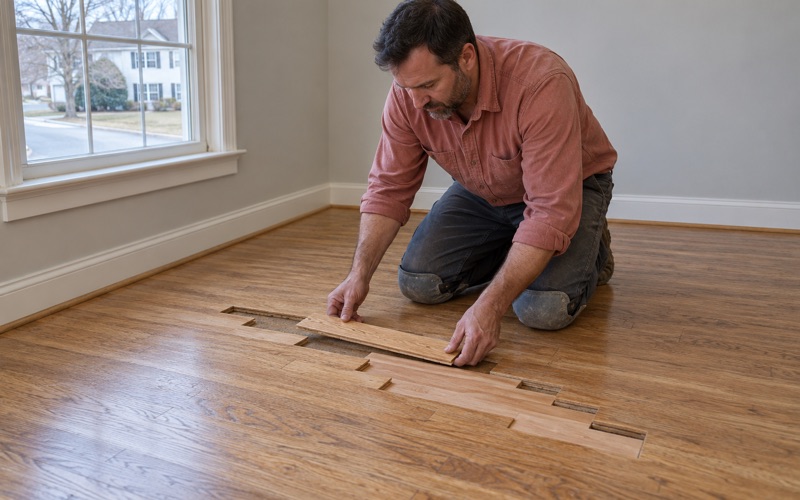
A first visit covers the rooms, the stairs, the subfloor where we can see it, and the route in from the drive. We look for termite damage, rug shadow and old patches where floor registers or a wall came out, which we repair with boards woven into the existing floor. Then you get a written, itemized estimate that separates sanding, repairs, stairs and finish so each line can be weighed on its own.
Anne Arundel County is the authority for permits, licensing and code enforcement in Crownsville, through its Department of Inspections and Permits. If a project reaches beyond the floor itself into framing or walls, that is the office to ask about requirements before work starts.
Call us to set up a visit, and we will walk the house with you, answer questions about finish and timing, and build a schedule around the rooms you need most. Nothing is sanded until you have seen the color and agreed to the plan.
- 20+ Years Experience
- Written Itemized Estimates
- Dust-Contained Sanding