
Severn Wood Flooring has handled hardwood floor repair in Severn, MD for 20+ years, serving surrounding cities including Jessup, Elkridge, Odenton, Glen Burnie and Linthicum. We fix squeaky floorboards and nail pops, replace boards stained by pets or water, weave new wood into holes left by registers and walls, and repair damage from termites and wood-boring beetles. The goal on every repair is a floor where you cannot find the spot we worked on.
Repair work is where knowing how a floor was built matters most. A floor fastened with flooring cleats over plywood, a glued engineered floor on a slab and wide pine planks face-nailed to joists in an older house all come apart and go back together differently. We open the floor only as far as the repair needs, and we price each fix separately on a written estimate.
Many repairs are best finished as part of a sanding and refinish of the room, which blends the new boards with the old. Where you only want the repair, we tell you how close the match will be before we start.
Squeaks, Loose Boards And Nail Pops
Squeaky Floorboards
Squeaky floorboards are usually two pieces of wood rubbing together: a board against its neighbor, a board against a nail shank, or the subfloor against a joist. We find the exact spot by walking the floor and, where there is an open basement ceiling, by watching from below while someone walks above.
From below, the subfloor can be shimmed and screwed tight to the joist. From above, we drive fasteners through the board at an angle into the joist and set and fill the holes so they disappear into the grain.
Nail Pops And Loose Face Nails
Face nails along walls, at doorways and at the start of each row can work their way up as the floor moves through the seasons. A nail head standing above the finish snags socks and rugs and can eventually split the board around it. We reset the nail, add a fastener where the board has lost its hold, and fill the hole to match.
When nail pops appear across a whole room rather than in a few spots, the cause is usually moisture moving the floor, not the fasteners themselves. We take moisture readings in the room and below it so the repair is not undone by the next season.
Hollow Or Bouncy Spots
A floor that sounds hollow or flexes underfoot may have a gap between the boards and the subfloor, a missing fastener, or a subfloor panel that has lost its grip on the joists. On glued engineered floors, hollow spots often mean the adhesive never fully bonded. We locate the area, then refasten, inject adhesive or lift and relay boards depending on the cause.
A bouncy area near a bathroom or kitchen deserves extra care, because a soft subfloor there is often a sign of an old leak. We check for water staining and rot before refastening anything over it.
Board Replacement And Weave-In Repairs
Replacing Damaged Boards
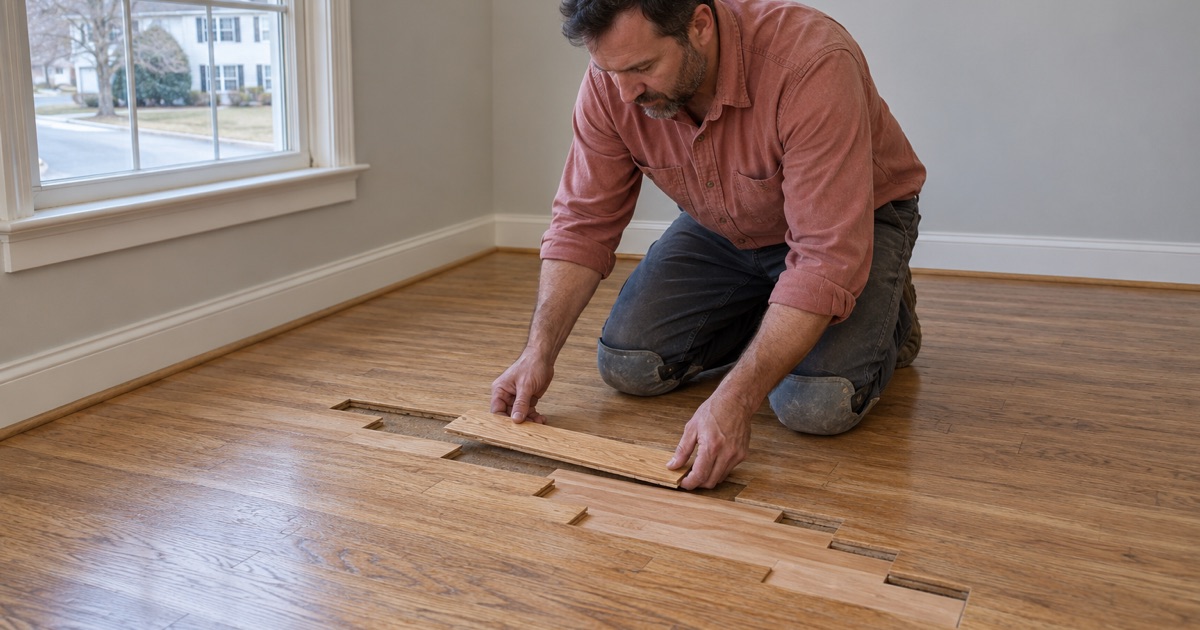
Boards with deep gouges, splits, burns, black water stains or pet urine stains are cut out cleanly without damaging their neighbors. New boards of the same species and width are fitted with the tongue or groove trimmed as needed and fastened so they sit flush.
Where urine has soaked through, we also seal or replace the subfloor underneath, since the odor lives there as much as in the wood. Skipping that step leaves a smell that returns on the first humid day.
Weave-In Repairs For Registers, Walls And Stair Openings
Moving a floor register, removing a wall, closing an old stair opening or taking out a kitchen island all leave a hole in the floor. A square patch always shows. We remove boards around the opening in a staggered pattern and weave new boards in so the end joints fall where the original installer would have placed them.
Once sanded and finished with the rest of the room, a weave-in repair reads as part of the original floor. On prefinished floors, we look for the same product or the closest match and replace whole boards rather than patches.
Matching Older And Unusual Floors
Older houses sometimes have species or widths that are no longer stocked, such as wide pine planks, Douglas fir or narrow strip oak. We source matching wood where we can, or borrow boards from a closet or under a built-in and use new wood in the hidden spot instead.
Insect Damage: Termites And Powderpost Beetles
Powderpost Beetle Holes And Frass
Tiny round exit holes with fine, flour-like frass below them are the sign of wood-boring insects such as the powderpost beetle. The damage is mostly inside the board, so a floor that looks lightly pitted can be weak underneath. We probe the affected boards and the subfloor to see how far it goes.
Active infestations go to a pest professional first. Once treatment is complete, we replace the damaged boards and refinish the area so the repair blends.
Termite Damage Under The Floor
Termites eat wood from the inside out, leaving boards and subfloor that look intact on top and hollow below. Boards that sink underfoot, break when lifted or show mud tubes along the joists all need a closer look. We open the floor and check boards, subfloor and joists before quoting the repair.
Structural damage to joists goes to a carpenter or framing contractor; we handle the subfloor and the finished wood above. We coordinate with your termite company so the floor goes back only after treatment.
Gaps, Finish Failures And Surface Damage
Winter Gaps And Permanent Gaps
Board gapping that opens when the heat runs and closes in a humid summer is normal movement and should not be filled. Gaps that stay open all year, often in older floors, can be filled with thin slivers of matching wood glued into the joint during a refinish. We tell you which kind you have before suggesting a fix.
Keeping indoor humidity steadier through the year, with a humidifier in winter and a dehumidifier in a damp summer, reduces how far the boards move. That is often a better first step than any filler.
Peeling Polyurethane And Wax Residue
Peeling polyurethane is usually a bonding failure: a new coat applied over wax residue, polish or a contaminated surface. Spot touch-ups rarely hold on a floor like that. The lasting repair is to sand the affected area or the whole room to bare wood and refinish, so the new finish bonds to clean wood.
Scratches, Dents And Gouges
Light scratches in the finish can often be blended with a screen and recoat. Dents from dropped objects and gouges from furniture that has reached the wood need sanding or, when deep, board replacement. Felt pads, area rugs at entries and keeping pet nails trimmed prevent most of this from coming back.
On a prefinished or engineered floor, a single badly gouged board is usually replaced rather than sanded, because sanding one board leaves a flat, unfinished patch in a factory-finished surface. We keep a note of the product so the next repair is just as straightforward.
- 20+ Years Experience
- Written Itemized Estimates
- Dust-Contained Sanding