
Severn Wood Flooring has handled hardwood stair refinishing in Severn, MD for 20+ years, serving surrounding cities including Jessup, Elkridge, Odenton, Glen Burnie and Linthicum. We sand stair treads, stair risers and stair nosing by hand, repair loose and squeaky steps, change the stain color or paint the risers, and convert carpeted staircases to wood. Every staircase is quoted tread by tread on a written estimate, because no two stairs take the same time.
Stairs take more concentrated wear than any floor in the house, and they cannot be sanded with the big machines used on open floors. Every tread has a nose, a front edge and two ends against the skirt board or the balusters, and each of those has to be worked with hand tools and detail sanders. That is why stair refinishing is priced and scheduled as its own job, even when it is done alongside the floors.
Refinishing Treads, Risers And Nosing
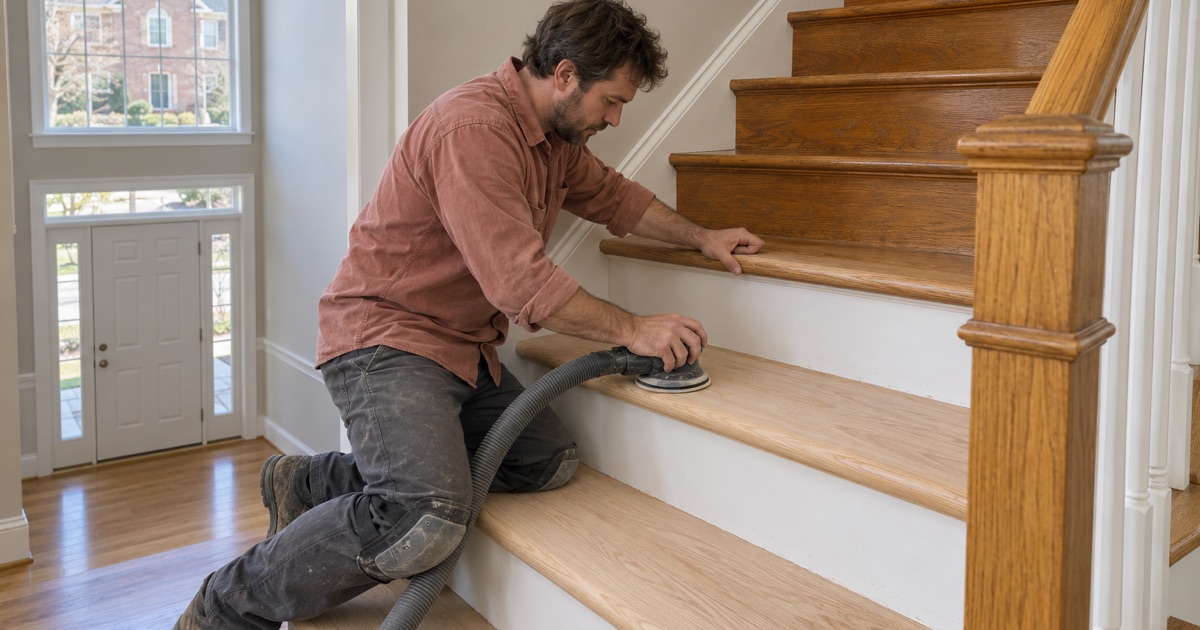
Sanding Each Tread By Hand
The walking surface of each tread is sanded with a small orbital sander through the same grit sequence we use on floors, then the corners and edges are finished with detail sanders and hand scrapers. The worn center where everyone steps usually needs more work than the edges, and we feather it so the tread finishes evenly rather than with a dished area in the middle.
Before sanding, we check every tread for movement. Loose treads are glued and refastened from below where the underside is open, or from above with fasteners that are set and filled, so the finished staircase is quiet as well as good looking.
Worn And Damaged Stair Nosing
The rounded nosing on the front edge of each step takes the hardest hits from heels, vacuum heads and moving furniture. Light wear sands out; chipped or split nosing is cut back and replaced with new stock of the same profile and species. Where a new floor meets the top of the staircase, a matching landing nosing makes the floor and the stairs read as one.
Replacement nosing has to match the profile of the rest of the staircase as well as the wood, or the new piece stands out every time someone walks up. We take a profile from an existing step and match the stock to it before any old nosing is cut away.
Risers: Painted, Stained Or Replaced
Risers take scuffs from shoes rather than wear from feet. Many staircases look best with stained treads and painted risers, which hide scuffs and suit both traditional and modern houses. Where the risers are paint-grade wood or medium-density board, painting is often the only realistic finish, and we mask and cut in the paint lines by hand so the edge against each tread stays crisp.
Why Stairs Are Priced Tread By Tread
The Square Foot Price Does Not Fit Stairs
A staircase has very little floor area and a great deal of edge, corner and hand work. Pricing it by the square foot would make it look cheap and then run over budget, so we count the treads, risers, landings and any return ends and price each type of piece separately. You see exactly how the total is built and what would change it.
Open Stairs, Spindles And Landings
An open-sided staircase with balusters, a returned tread end on every step and a handrail takes far more time than a closed staircase between two walls. Landings, winders and curved steps add more. We note each of those on the estimate, and we tell you whether the handrail and balusters are part of the refinish or being left as they are.
Refinishing a handrail to match newly stained treads is detailed work, since a rail is sanded and stained entirely by hand. Many owners choose to paint the balusters white and stain only the rail and treads, which gives a clean contrast and shortens the job.
Turning Carpeted Stairs Into Hardwood
What We Find Under Stair Carpet
Pulling carpet off stairs reveals tack strip, staples, carpet pad and sometimes glue. Underneath may be finished hardwood that can be sanded and refinished, or rough construction-grade treads that were only ever meant to be covered. We check before quoting, because the two lead to very different jobs and very different prices.
New Hardwood Treads And Risers
When the existing treads are not good enough to show, we remove the old nosing and install new hardwood treads and risers over the stair structure, fastened and glued so they do not creak. The new treads can be prefinished or finished on site to match the floor at the top and bottom. Done well, the staircase looks original to the house rather than covered over.
Riser heights have to stay even from top to bottom, so we plan the thickness of the new treads against the floor at each end. An uneven first or last step is a trip hazard, and it is the most common fault in a quick carpet-to-wood conversion.
Finishes, Safety And Older Staircases
Stain, Finish And Sheen For Stairs
We sample the stain on a tread and, if the floors are being done too, on the floor beside it so the two match. Stairs get the same waterborne polyurethane or oil-modified polyurethane options as floors, all within Maryland’s wood coating limits. A satin or matte sheen level is usually the better choice for stairs, because it is less slippery and hides the wear that stairs collect.
Painted Stairs In Older Houses
In houses built before 1978, painted stair parts may contain lead paint, and sanding or scraping them is renovation work covered by the EPA RRP Rule. We check the build year and the painted surfaces before quoting, and plan the work with lead-safe containment and cleanup where it applies, rather than sanding through old paint and spreading the dust through the house.
- 20+ Years Experience
- Written Itemized Estimates
- Dust-Contained Sanding