
Severn Wood Flooring brings 20+ years of experience to herringbone wood floor installation in Severn, MD, serving surrounding cities including Jessup, Elkridge, Odenton, Glen Burnie and Linthicum. We lay herringbone and chevron patterns and wide plank white oak in solid and engineered wood, planning the layout before the first board is fastened so the pattern looks right from the doorway you walk through every day. The estimate itemizes pattern work separately from the flooring, so the cost of the design choice is clear.
Patterned and wide plank floors are where small mistakes show most. A herringbone line drifting a few degrees off the room’s center, a chevron point that misses the middle of a hallway, or wide boards with every end joint lined up all read as wrong the moment someone walks in. Most of the work on these floors happens before the first board is fastened.
Herringbone Floors
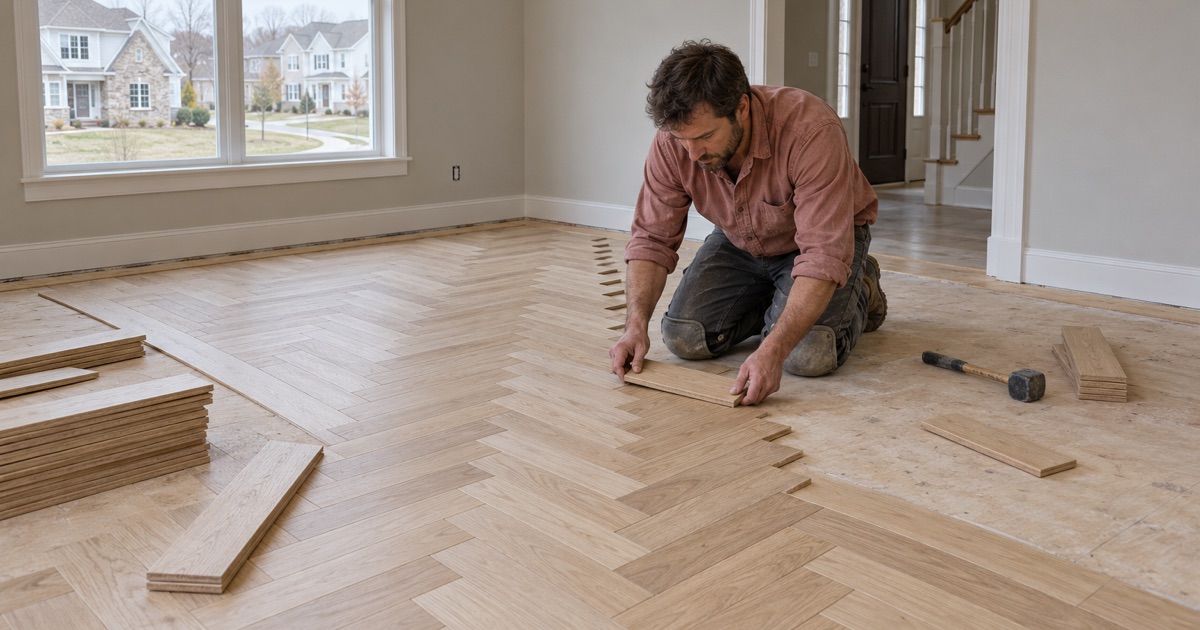
How Herringbone Is Laid Out
Herringbone is built from rectangular boards laid at an angle, each board’s end butting against the side of the next to form a zigzag. We snap a center line down the main axis of the room, usually lined up with the main entrance or the longest sightline, and build the pattern out from there so it stays straight and symmetrical at both walls.
The boards along the walls are cut to fit, and an expansion gap is kept at every edge. Many herringbone floors are finished with a border of straight boards around the room, which frames the pattern and makes it easier to meet doorways and fireplaces cleanly.
Solid Or Engineered Herringbone
Solid herringbone blocks are nailed or glued to a wood subfloor and can be sanded many times. Engineered herringbone has a real wood wear layer over a stable core and is the better choice on a concrete slab, over radiant heat, or in rooms that see larger humidity swings. Both are available in white oak, red oak and other species.
Prefinished Or Finished On Site
Prefinished herringbone saves days on the schedule and has a durable factory finish. Site-finished herringbone is sanded flat after installation and then stained and coated, which hides small height differences between blocks and lets us choose any color. Sanding a pattern takes multi-disc or orbital equipment, because the grain runs in two directions.
Chevron Floors
How Chevron Differs
Chevron boards have their ends cut at an angle, so each pair meets in a clean point and the pattern reads as a series of arrows down the room. It looks more formal and more modern than herringbone, and it is less forgiving: a point that wanders off the center line is obvious from across the room.
We lay chevron from a carefully set center line and dry-fit the first rows before fastening. Most chevron flooring arrives with factory-cut angled ends, which keeps every point consistent.
Where Chevron Works Best
Chevron shines in long rooms and hallways where the arrows lead the eye toward a window, a doorway or a fireplace. In small or irregular rooms, the cut edges take over and the pattern loses its effect, and we will tell you if herringbone or a straight lay would suit the room better.
Wide Plank Floors
Wide Plank White Oak
Wide plank white oak shows more of the grain in each board and gives a room a calmer, more open look than narrow strip flooring. White oak is hard, takes stain evenly and resists moisture better than red oak, which is why it is the most popular species for wide plank floors.
Wider boards also mean fewer seams across the room. Longer board lengths add to that effect, so we look for products with good length mixes rather than lots of short pieces.
Managing Movement In Wide Boards
The wider a solid board, the more it moves across its width as humidity changes, which shows up as winter gaps and summer cupping. We favor engineered wide plank in most rooms, or carefully acclimated solid boards fastened with flooring cleats and adhesive where the subfloor allows, and we check moisture in the subfloor and the wood before installation.
Keeping indoor humidity reasonably steady through the year protects any wide plank floor. A humidifier in winter and a dehumidifier in a humid summer make a visible difference in how much the boards open and close.
Finishes For Wide Plank
Many people choosing wide plank want a natural, matte look, which suits a hardwax oil finish or a matte waterborne polyurethane. Hardwax oil can be spot repaired but needs more regular care; polyurethane is tougher and easier to maintain. Every finish we use meets the Maryland wood coating limits in COMAR 26.11.39.
Planning A Patterned Or Wide Plank Floor
Subfloor Flatness Comes First
Patterns and wide boards show every dip, hump and loose spot in the subfloor beneath them. We check the subfloor with a long straightedge, refasten it to the joists and flatten high and low spots before any boards are laid. On concrete, the slab is ground and filled until it is flat enough for a glued pattern.
Transitions, Borders And Existing Floors
Where a herringbone floor meets a straight-laid floor in the next room, a border or a threshold in the same species makes the change look deliberate. We plan those meeting points before ordering, along with stair nosing, door heights and flush transitions to tile.
Stain Samples And Sheen
Patterns show stain differently from a straight floor, because the boards present their grain at two angles and catch light differently. We lay samples on a finished section or offcuts of the actual flooring so you can see how the color and sheen level look across the pattern in your own light.
- 20+ Years Experience
- Written Itemized Estimates
- Dust-Contained Sanding