Severn Wood Flooring has spent more than 20 years on wood flooring in Jessup and the communities around it, and the first thing we ask about a floor here is not its color but its age. A house that went up last decade and a house that has stood for generations can sit a short drive apart, and they need very different handling before a sander ever touches them.
We refinish worn floors, repair damaged boards, rebuild staircases, and install new solid hardwood or engineered wood where it makes sense. Every job starts with a walk-through and a written, itemized estimate that lists each room, each step and each repair, so you know the scope before you agree to anything and have a document you can keep.
That estimate also records what we found: the build year, any painted trim or old tile we need to treat carefully, moisture readings, and the finish we recommend. On an older house, those notes decide the order of the work. On a newer one, they usually mean the job is simpler than the owner feared.
Jessup’s named sections, from Route 175 outward
Jessup is a census-designated place rather than an incorporated town, and the census boundary is only one way to read it. The Jessup Improvement Association, which has worked on behalf of the community since 1938, describes Jessup as a set of named sections, each with its own beginnings. That map is the one we find more useful when we are planning floor work, because it tracks how the houses actually came to be.
Historic Jessup along Route 175
The association calls the old area along Route 175 the historic and central part of Jessup, where the early settlers built their homes. The community itself takes its name from Jonathan Jessup, an engineer on the B&O railroad. When a call comes from this stretch, we plan for a floor that may have been sanded, patched, covered and uncovered more than once over the life of the house.
That history matters for the wood itself. A floor that has been through several full sandings has less material above the tongue and groove, and we check board thickness at a floor register or a threshold before promising another drum-sander pass. Where the wear layer is thin, a screen and recoat or targeted board replacement can be the better call.
Montevideo and Champion Forest
The association describes Montevideo as thought to be the second-oldest section of Jessup. Between Route 175 and Montevideo sits Champion Forest, which it calls a comparatively new section, named after the land grant it was built on. Two neighbors a few streets apart can own houses from very different eras, and we never assume one from the other.
We treat the association’s descriptions as a guide to where a section began, not as a record of any single house. Each home in Montevideo or Champion Forest gets the same first visit: we confirm the build year, look under a register cover or at a closet edge to see how the floor was laid, and note whether it has been refinished before.
Looking for wood-flooring closer to Elkridge? See Wood-Flooring Services in Elkridge.
Older Jessup houses and the history behind them
Some of Jessup’s sections carry a history that is worth knowing before anyone starts work, both out of respect for the houses and because it shapes what we look for once we are inside.
Georgetown on Brock Bridge Road
Georgetown sits on the west side of Brock Bridge Road, about half a mile from Route 175. According to the association, it began as seven houses that Dr. Asa Linthicum built to house African-American families who dug iron ore in his nearby mines, and it took its name because the head of the house in four of the first families was named George. Nearby, Wyman’s Grove is remembered as a historic African-American meeting ground.
We do not guess at what is under the carpet in a house with that kind of past. We pull back a corner, look at the boards, the fasteners and the subfloor, and tell you what we actually see. Sometimes the answer is a floor worth saving with a careful weave-in repair; sometimes it is a subfloor that needs attention first.
What we check in any older house
Before sanding, we confirm the build year and look for painted surfaces such as baseboards, shoe molding and old stair parts, because homes built before 1978 fall under lead-safe renovation rules. Old resilient floor tile or black mastic found under carpet or in a back room gets identified first and is left for the right trade rather than sanded. We also look closely for powderpost beetle holes, frass and termite damage along the edges of rooms and around joists we can reach from below.
Common problems in floors with real mileage include squeaky floorboards and nail pops, wide winter gaps between boards, traffic lanes worn through the finish, and pet urine stains that have gone gray or black in the grain. Each one has its own fix, from face nails or flooring cleats driven into a joist to individual board replacement, and we price them line by line.
Sharewood Acres and the newer building around it
Jessup straddles the line between Howard and Anne Arundel counties, and the association places Sharewood Acres on the Howard County side, running from Route 175 to Dorsey Run Road, with about forty houses. A small section like that tends to share a building era, so one owner’s floor often tells us something about the next street over, though we still read each house on its own. Wherever a house sits in Jessup, we confirm the address and the county when we write the estimate, so any paperwork you need later points to the right place.
A decade of new building beside the old
The census figures for Jessup as a whole show how much the place has grown recently. Of the 1,586 housing units counted in the American Community Survey 2024 five-year estimates, 716 were built between 2010 and 2019, while 347 were built before 1980. Those numbers describe the whole census place, not any one named section, but they explain why a Jessup floor call can mean almost anything.
In practice, that range shapes our questions. A newer home usually has a prefinished or site-finished floor with a factory or builder finish, and the conversation is about scratches, rug shadow, board gapping or a first screen and recoat. An older home brings the build-year checks above, plus questions about past refinishing, wax residue and whether the floor has ever been sanded at all.
Renters, landlords and turnovers
The same survey counts 891 owner-occupied homes and 695 renter-occupied homes in Jessup, so a good share of our calls come from landlords. For rental floors in a pre-1978 house, we schedule around the lead dust test Maryland requires at each change of tenant, so the floor work and the test do not collide. At turnover we provide an itemized invoice that separates ordinary wear from damage, which gives a landlord the supporting documentation Maryland’s security deposit law asks for.
For a rented townhouse, we also plan around the association’s own rules, reading the documents rather than assuming what they allow, and we schedule the work so the unit is ready for the next tenant on time.
Planning floor work in an older Jessup house
The best result on an older floor comes from doing things in the right order. Here is how we usually approach a Jessup job once the walk-through is done.
Moisture, damage and the subfloor first
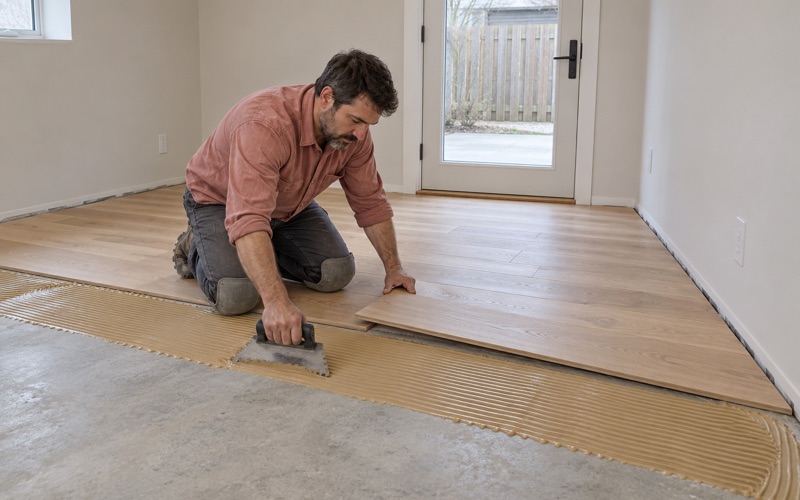
We take moisture meter readings across the room and at any suspect spots. Cupping, crowning and buckling usually point to moisture coming from somewhere, and refinishing over an active moisture problem wastes your money. If water got in, we trace it, dry it, read the boards again and document the damage room by room for your adjuster. Over concrete or in a finished basement, we read the moisture and the grade before recommending engineered wood or a different floor altogether.
Patches, stairs and the sanding itself
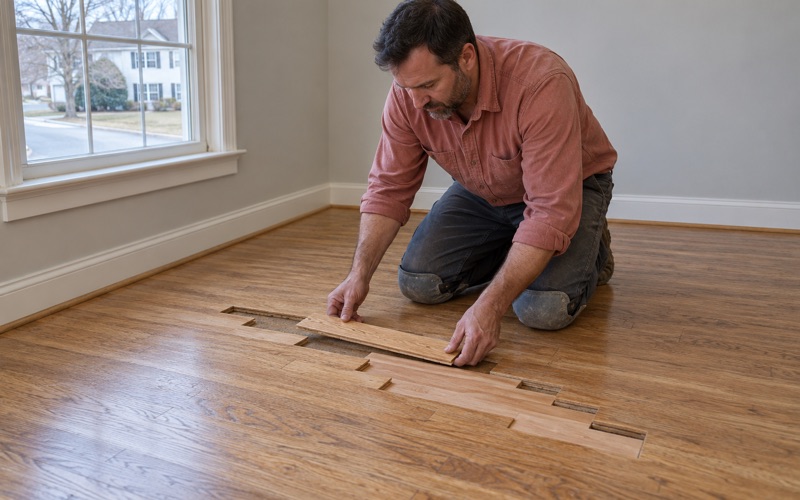
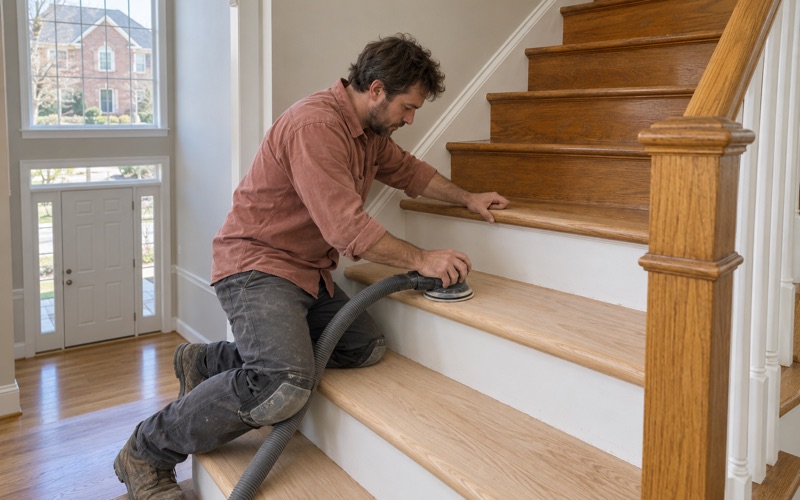
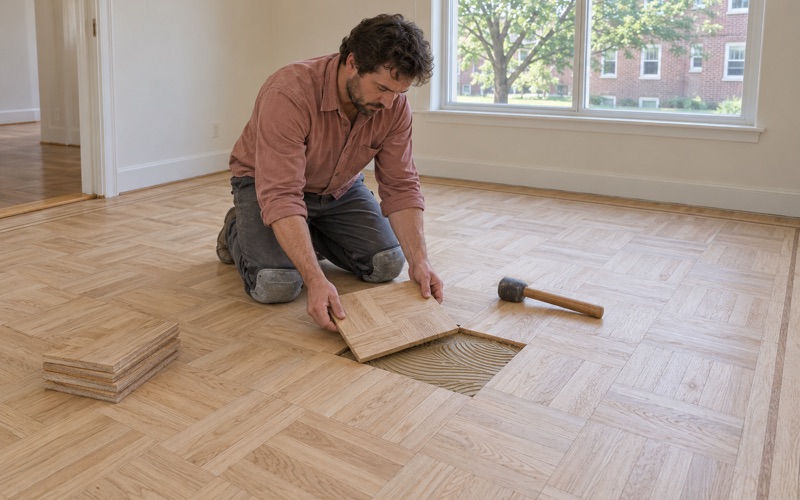
Older houses often have holes where a floor register was moved or a wall came out. We patch those with boards woven into the existing floor rather than a square plug that reads as a repair. Staircases get quoted tread by tread, since stair treads, risers and nosing each take their own time and are not priced by the square foot.
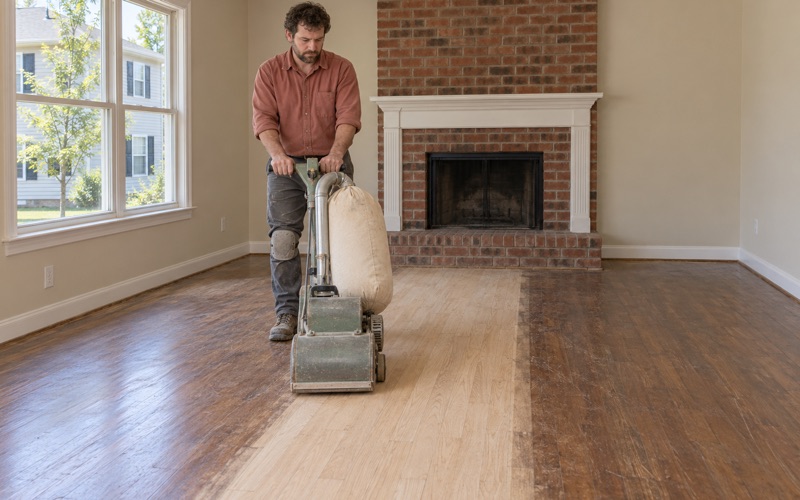
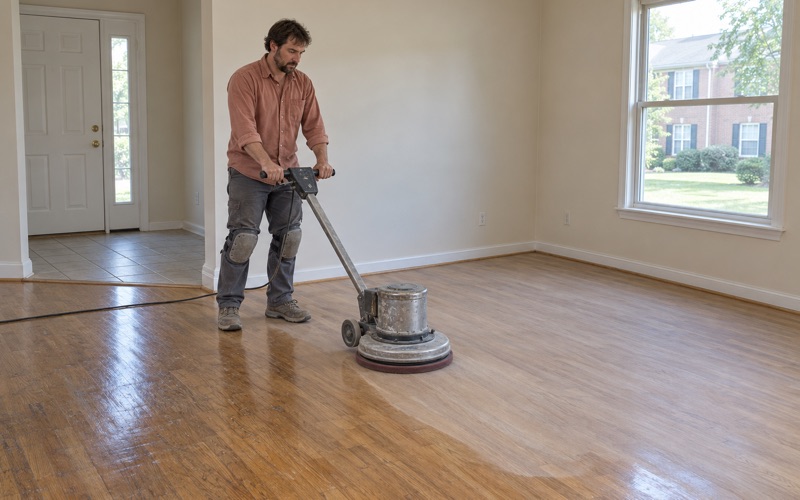
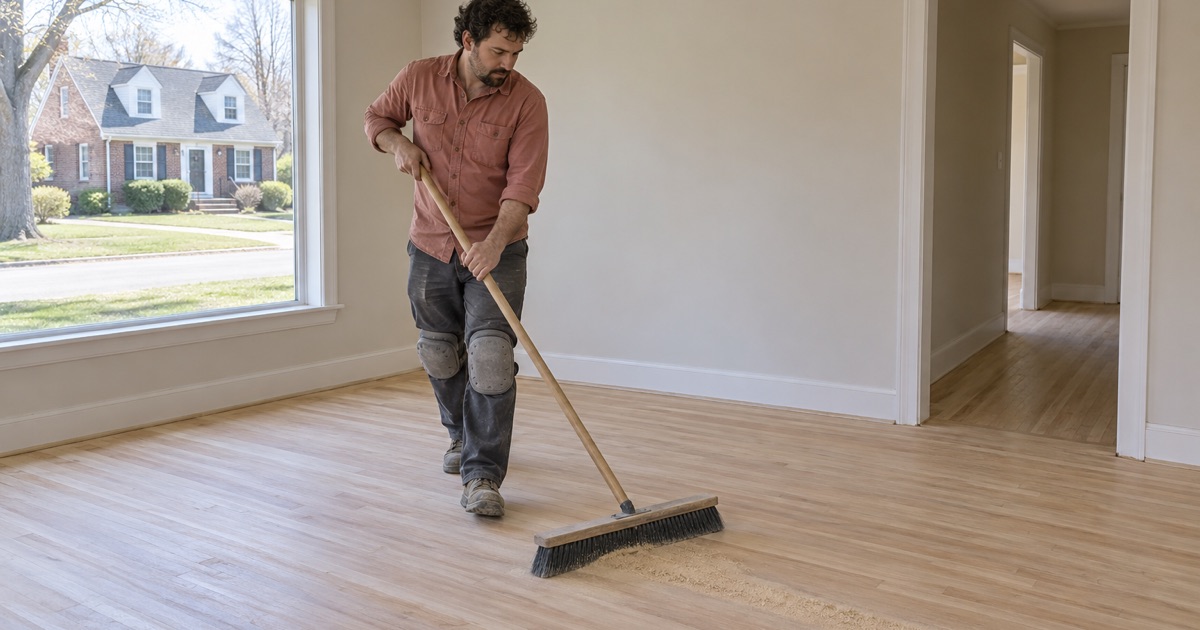
When sanding starts, we contain the dust to the rooms being worked on, sealing doors and return vents and running a HEPA vacuum through each step of the grit sequence. A drum sander handles the field and an orbital sander follows for the final passes, so the floor takes stain evenly.
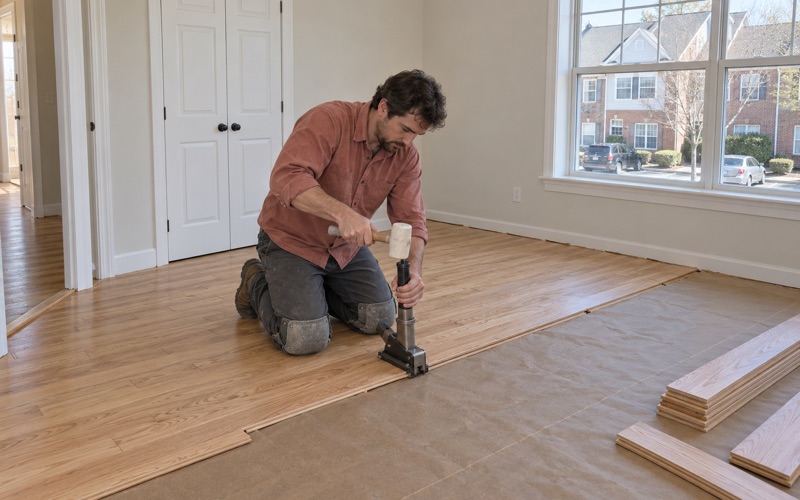
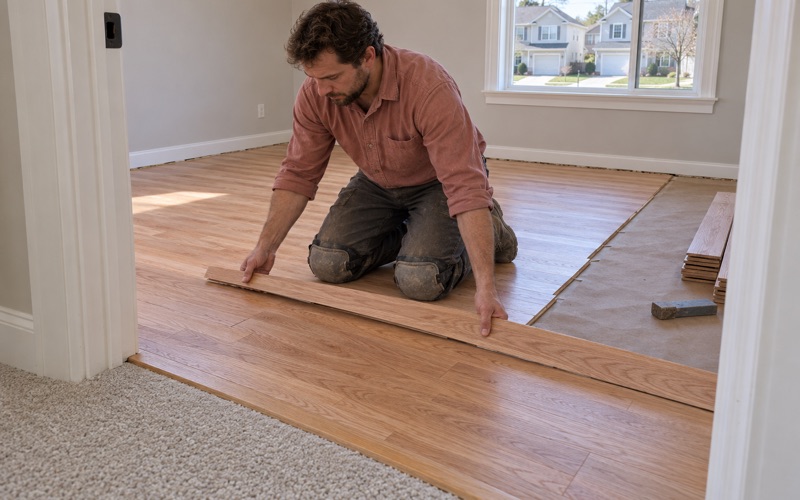
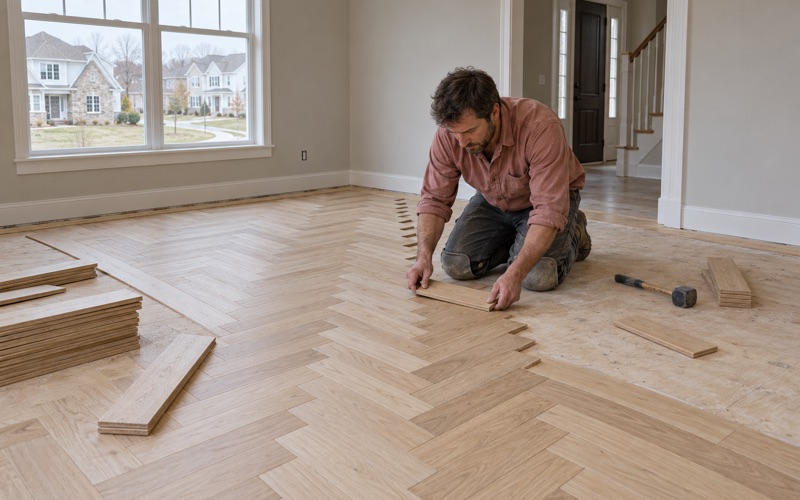
When a floor is past saving, or a room has carpet over a plain subfloor, we install new solid hardwood or engineered wood. New boards acclimate in the house before installation, the subfloor is checked for flat spots and loose areas, and we follow the NWFA Installation Guidelines for fastening and expansion space. Where carpet comes up, we pull the tack strip and carpet pad, fill the holes, and plan transitions so the new floor meets the existing rooms cleanly.
Choosing the finish
Before you pick a color, we lay stain and sheen samples on your own floor, because a sample board in a showroom never matches wood that has aged in your house. Finish choices include waterborne polyurethane, oil-modified polyurethane and hardwax oil, all chosen to fit Maryland’s VOC limits for wood coatings. We plan fume and drying times around your household, so you know which rooms are off-limits and for how long.
Whether your house stands in one of the older named sections or went up in the last decade, the process starts the same way: a visit, a close look at the floor, and a written estimate that tells you exactly what we found and what we recommend.
- 20+ Years Experience
- Written Itemized Estimates
- Dust-Contained Sanding