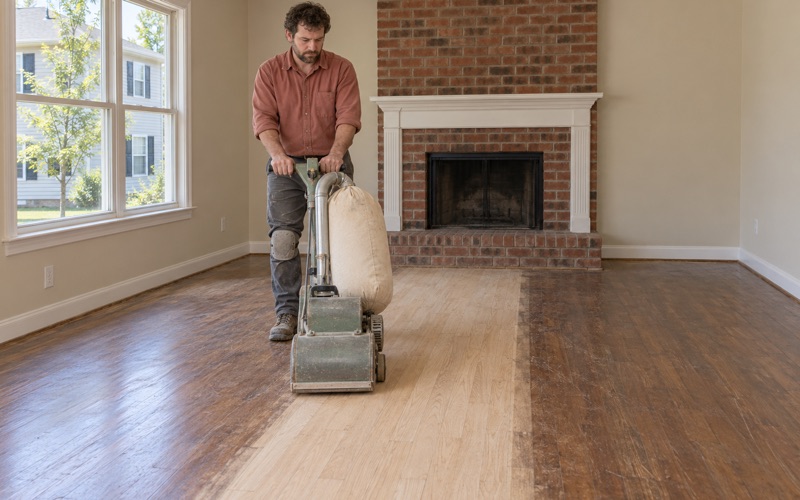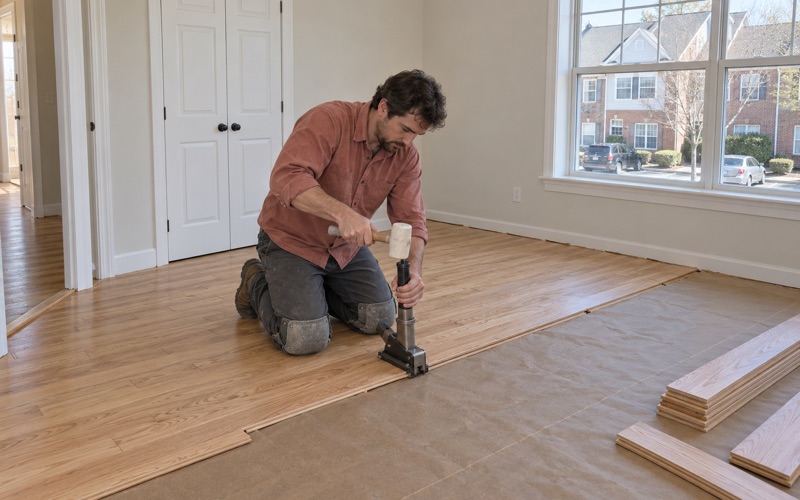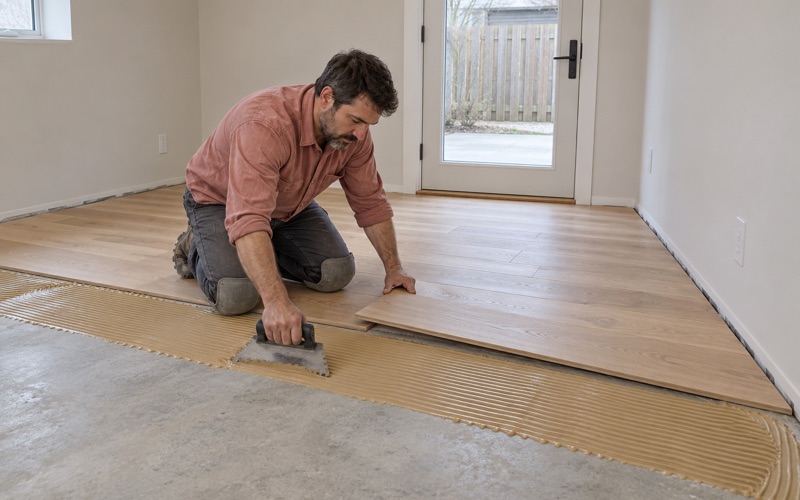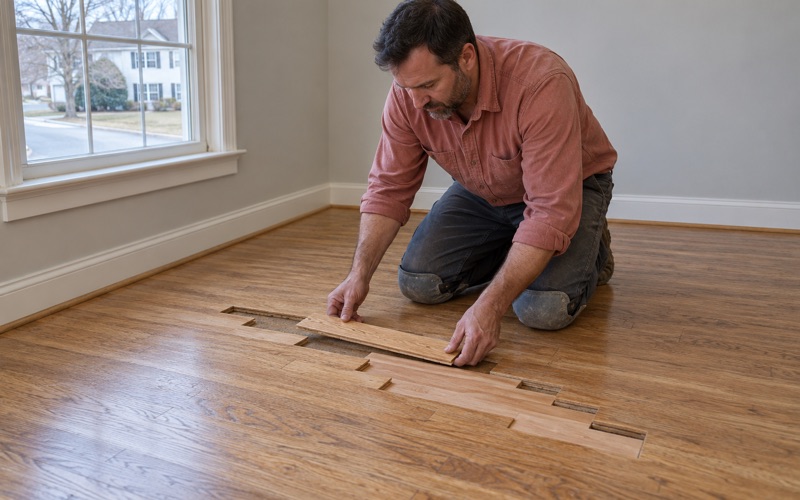
Severn Wood Flooring has handled wood-flooring in Lansdowne and across this part of Baltimore County for more than 20 years, and most of the floors we see here have been worked on before. Sanding, patching, refinishing and repairing older wood is the core of what we do, along with new installation when a floor is past saving. We come out, read the boards, and tell you plainly which of those a room actually needs.
Before any sanding starts, we confirm the build year and look for painted surfaces, since a house built before 1978 is covered by lead-safe renovation rules. We also lift a corner of any old resilient tile or sheet goods to check for black mastic underneath, and when we find it we stop and point you to the trade that handles it. Every job begins with a written, itemized estimate you can file away.
The sections below explain how the age and layout of Lansdowne’s housing shape that work, from the oldest homes in the community to the coverings later owners laid over them. If you already know what you want done, the last section covers how we plan a job around a lived-in house.
A Turn-of-the-Century Community on Recorded Lots and Blocks
When the Lansdowne-Baltimore Highlands Bicentennial Committee prepared the National Register nomination for Hull Memorial Christian Church, it described Lansdowne as “a small community of houses built around the turn of the century.” The same nomination added that none of its structures were of particular architectural merit, except for the church itself. That is an unusually frank line for a historic document, and it is a useful one for anyone deciding what to do with an old floor here.
Hull Memorial Christian Church stands at 101 Clyde Avenue. The congregation organized in 1903, the cornerstone was laid that November, and the building was dedicated in June 1904, with white clapboard siding over a full basement. It was entered on the National Register on September 15, 1977, and it remains the community landmark the nomination named.
What Plain Means for a Floor
Plain houses tend to have practical floors, laid to be walked on rather than admired. That works in a homeowner’s favor, because a floor nobody treated as precious has usually been repaired, recoated and covered in ordinary ways we can read and undo. We do not assume what species or construction sits under any particular Lansdowne house; we find out on site, board by board.
How Much of That Housing Still Stands
The age of the housing stock is not just a line from 1977. The Census Bureau’s 2024 five-year American Community Survey counts 534 homes in the Lansdowne CDP built in 1939 or earlier, and another 230 from the 1940s. Those houses sit alongside a much larger share of later construction, so the oldest floors in the community are a minority, but a real and recognizable one.
The Joshua Section and Lansdowne’s Recorded Layout
Lansdowne was laid out on paper in recorded sections divided into numbered lots and blocks, and houses filled them in over time. The church nomination shows how that worked in practice: Charles Wesley Hull, a Union Army veteran, gave Lots 25 and 26, Block 1, in the Joshua section of Lansdowne for the building. A gift described in those terms is typical of a planned turn-of-the-century town, where houses went up lot by lot over years rather than all at once.
Why Lot-by-Lot Building Shows Up in the Floors
When a community fills in one lot at a time, neighboring houses can differ in age, builder and materials even when they look alike from the curb. For us that means two homes a few doors apart may need entirely different approaches. We do not carry a diagnosis from one Lansdowne house to the next; we take moisture readings, check for nail pops and loose boards, and look at the subfloor wherever a register opening gives us a view.
Pinning Down the Build Year
Deeds and title papers describe a property in the same section, lot and block terms, and together with county records they are one way to settle when a house was built. That date matters because it decides whether lead-safe practices apply before we sand. If the paperwork is unclear, we treat painted trim, baseboards and old finishes as suspect until a test says otherwise.
Looking for wood-flooring closer to Arbutus? See Wood-Flooring Services in Arbutus.
Floors in Plain, Modest Early-1900s Houses
Older, modest houses tend to share a set of floor problems that come from decades of use rather than from any single event. Traffic lanes worn through the finish in hallways and doorways, rug shadow where furniture sat for years, and board gapping that opens in winter and closes in summer are the patterns we see most. None of these alone means a floor needs replacing.
Movement, Squeaks and Settling
Squeaky floorboards and nail pops usually mean boards have loosened from the subfloor or the joist below, and both can often be fixed from above without tearing anything out. Cupping and crowning tell us about moisture history: cupping points to dampness from below, while crowning often follows a floor that was sanded flat while it was still cupped. We read those patterns with a moisture meter before recommending a sand, because sanding a floor that is still wet only creates the next problem.
How Many Sandings a Floor Has Left
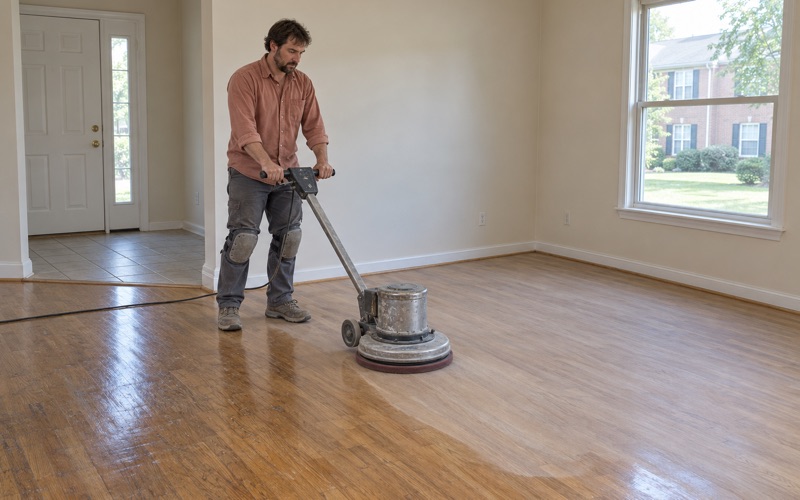
Solid hardwood in tongue and groove can be sanded more than once, but every pass removes wood above the tongue. A floor that has been refinished several times over a century may have little left to give, and we check board edges and register openings to see how much remains. When a full sanding would go too deep, a screen and recoat can refresh the finish without cutting into the wood.
Matching Boards During a Repair
Repairs only disappear when the new boards match the old ones in species, width and grain. Across older houses in general we see red oak strip flooring most often, with white oak, maple and Douglas fir turning up as well, and we identify what is actually in your house before ordering anything. An amber, orange oak tone from an aging finish usually sands away, which changes how a patch will blend once the whole room is recoated.
Insects and Old Damage
In older houses we also look for signs of powderpost beetle or termite damage, such as small exit holes or frass. Most floors we open up show nothing of the kind, but finding it early changes what we quote. Damaged boards are replaced and woven into the surrounding floor rather than patched with a mismatched square.
Coverings, Patches and Repeat Sanding in an Older Lansdowne House
Many of the oldest floors in Lansdowne have spent part of their lives under something else. Carpet over a carpet pad and tack strip is the most common, followed by resilient floor tile, sheet vinyl and occasionally a later layer of wood laid straight over the first. What sits underneath is often in better shape than owners expect, though the tack strip leaves a row of nail holes around the edge of the room that need filling.
When Old Tile and Black Mastic Turn Up
Resilient tile laid decades ago was often set in black mastic, and both can contain materials that should not be sanded. We identify those layers before any work starts and leave removal to the trade qualified to handle it. Once the floor is clear, we pick up from there.
A Second Wood Floor Over the First
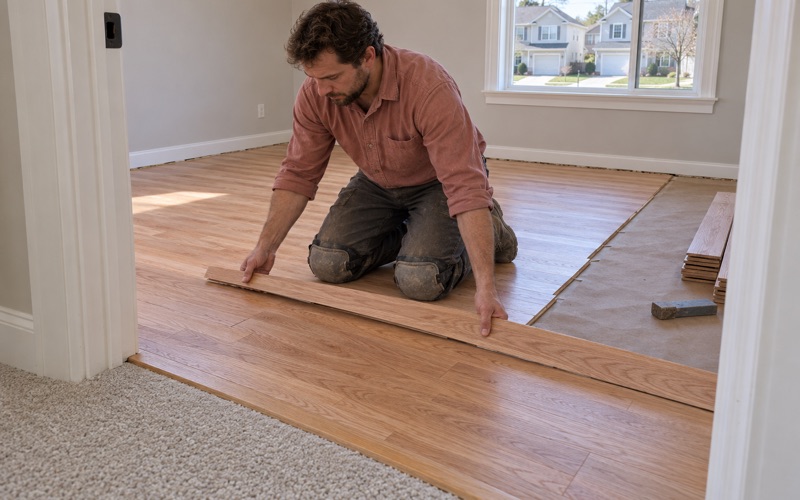
When a later wood floor was nailed straight over the first, the two layers are worth separating only if the lower one is sound and the height change works with doors and thresholds. We check both layers at a register opening or along an edge before recommending which one to keep. Sometimes the newer layer is the better floor to refinish, and we say so.
Patching Where Walls and Registers Moved
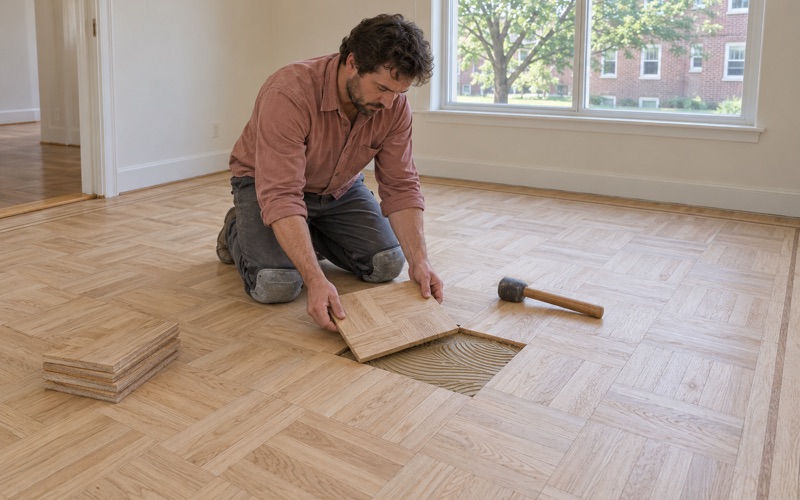
Owners of modest houses have rearranged them over the years, taking out a wall here or moving a heat register there. Each change leaves a gap in the floor, and a square plug of new wood stands out after the finish goes on. We weave replacement boards into the existing courses so the repair follows the floor’s own pattern.
Stains and Wax From Earlier Finishes
Water stains near radiators and windows, pet urine stains, and wax residue from older finishing methods all show up once old carpet comes up. Wax has to come off before a modern polyurethane will bond, or the new coat will end up as peeling polyurethane. Some dark stains sand out, while others go through the board and call for a replacement.
Planning Floor Work in a Turn-of-the-Century Lansdowne Home
Lansdowne is an unincorporated community, so the governing authority for housing questions is Baltimore County rather than a city government or Baltimore City. We plan around a household that is still living in the house: dust containment with doors and returns sealed, the work area closed off, and a HEPA vacuum running alongside the sander.
Choosing a Finish and a Color
Before you commit to a stain, we lay samples on your own boards so you can see them in your light. We use waterborne polyurethane, oil-modified polyurethane or a hardwax oil depending on how the room is used, and choose products that meet Maryland’s VOC limits for wood coatings. Drying and fume times get planned around your schedule, not ours.
Older Rentals Between Tenants
For landlords, a pre-1978 rental floor has to be scheduled around the lead dust test Maryland requires each time a tenant changes. We build our sanding and finishing days around that test so the unit is ready on time. The itemized estimate and invoice we provide also serve as documentation in a landlord’s file.
Stairs and Landings
Older stairs often carry the most worn wood in the house, with stair treads dished at the center and stair nosing rounded off by decades of use. We quote a staircase tread by tread and riser by riser rather than by the square foot, because each piece is handled on its own. That lets you see exactly what refinishing or replacing the stair treads will cost before work starts.
Getting Started
A visit begins with a walk through the rooms, a few moisture readings and a look under whatever covering is already there. From that we write up what we found and what we recommend, room by room. You keep the estimate whether or not you hire us.
- 20+ Years Experience
- Written Itemized Estimates
- Dust-Contained Sanding