
Severn Wood Flooring has handled wood-flooring in Little Italy and across the Baltimore area for more than 20 years, and on these blocks the hardest part of a job is rarely the wood itself. It is the timing. Sanding, edging and buffing are loud, and here the people who hear them live on the other side of a shared wall or a single floor away. We build the schedule first and fit the floor work inside it.
That means refinishing, board replacement, new solid hardwood and stair work all start with a daytime plan we put in writing. Before any sanding we check the build year and look for painted surfaces, since homes built before 1978 come under lead-safe renovation rules. The estimate is itemized, so you have a document to keep for a landlord file, an insurer or a sale.
Owners and landlords both call us here. A long-held family house and a rented unit over a neighbor’s kitchen need the same thing from a floor contractor: a clear start time, a clear finish time and dust that stays in the rooms being worked on.
Little Italy’s blocks: attached houses, small buildings and towers next door
Little Italy is a neighborhood in southeastern Baltimore with a strong Italian-American identity. Italian immigrant families arrived in the late 19th and early 20th centuries, following an earlier community of Irish, German and Jewish immigrants, and many residents today are their descendants. St. Leo the Great Church, established in 1881, is individually listed on the National Register of Historic Places, and the neighborhood has a longstanding tradition of keeping houses within the family.
For a floor contractor, what matters is how the blocks are built. The grid is tight, a mix of older attached houses and small apartment buildings, while Harbor East’s towers rise right next door. The neighborhood figures we rely on come from the combined Harbor East/Little Italy community statistical area, so they describe both neighborhoods together, not Little Italy on its own.
Rented units and shared walls
Across that combined area, the 2024 American Community Survey counts 1,587 of 2,267 occupied units as renter-occupied, or about seven in ten. It also counts 818 units in buildings of two to nineteen units, the small multi-unit buildings where apartments typically stack above one another. On blocks like these, the noise of a floor job travels to people who did not hire us.
That rental share shapes the calendar too. In pre-1978 rental housing, Maryland requires a lead dust test at each change of tenant, so we schedule rental floor work around that test and the turnover date. When a unit changes hands, we can document what was ordinary wear and what was damage, which gives a landlord the itemized support Maryland’s security deposit law asks for.
Older houses under the finish
Across the same area, 812 of 2,717 housing units were built before 1940, while many others date from the 2000s and 2010s. In older attached houses we often find original strip flooring, layers of finish, old patches and, now and then, resilient floor tile glued down with black mastic. We identify tile and mastic before anything is sanded and leave that material to the right trade.
Older floors also show their history in the boards themselves. Cupping, board gapping and winter gaps, rug shadow and orange oak from an aging finish can all show up in older houses, and powderpost beetle frass or termite damage occasionally turns up under carpet. We note what we find and price repairs before the sanding day is set.
Looking for wood-flooring closer to Fulton? See Fulton Wood-Flooring.
Baltimore City’s construction hours and the Health Code’s power-tool hours
Little Italy has no government of its own; it is a Baltimore City neighborhood, and Baltimore City is an independent city, separate from Baltimore County. Two city rules frame the working day here. Neither one names floor sanding, which is why we plan as though both of them matter.
Building Code §3301.3
Section 3301.3 of the Baltimore City Building Code says no site work, demolition, pile driving or construction work is permitted between 7:00 p.m. and 7:00 a.m. when the work, or any part of the premises where it happens, is within 300 feet of any dwelling. On a tight block, a typical address sits well within that distance of a home. The code exempts emergency operations specifically approved by the Building Official, and the Department of Housing and Community Development’s Permits and Inspections office is the authority behind it.
Health Code §9-208, weekends and holidays
The Baltimore City Health Department enforces the noise rules in Health Code Title 9. Section 9-208(b) allows home workshops and power tools between 7 a.m. and 9 p.m. on weekdays, and between 10 a.m. and 10 p.m. on weekends and legal holidays. That later weekend start is easy to miss when a homeowner hopes to get an early Saturday jump on a room.
We read the two sets of hours together and keep loud work inside the narrower window. On a weekday that means machines run after 7 a.m. and stop well before 7 p.m.; on a weekend or holiday, nothing loud starts before 10 a.m. The Health Code also lets the Commissioner of Health grant temporary exemptions, for no more than 30 days and no more than three times a year at one location, but we plan our floor work so it never depends on one.
Late afternoons
Sometimes a finish coat is still going down late in the afternoon. Applying finish with a pad or roller is quiet work, so it fits the later hours of the working day once the sanders are packed away. Anything that needs a machine waits for the next morning’s window rather than the last hour of the day.
The loud parts of a floor job, and where they go in the day
Not every hour of a refinishing job is noisy. Moving furniture, pulling carpet pad and tack strip, filling nail holes and hand scraping corners are comparatively quiet. The loud stretches are the drum sander, the edger and the orbital sander or buffer, plus the HEPA vacuum that follows each pass, and those are the hours we place in the middle of the day.
Sanding and edging
A full sand moves through a grit sequence, coarse to fine, and each pass covers the whole room before the edger works the perimeter. On a tight block we start the drum sander after the morning rush has settled and aim to finish the final grit with time to vacuum before evening. If a room runs long, we stop and pick it up the next day rather than push toward the cutoff.
Repairs and stairs
Smaller jobs follow the same logic. A weave-in repair where a register or an old wall came out, a board replacement over a nail pop, or squeaky floorboards fastened back down to the joist involve short bursts of saw and nailer noise that we group together. Stairs are quoted tread by tread, and sanding stair treads, risers and nosing is detail work we keep inside the same daytime window.
New boards add one more scheduling step. Solid hardwood and engineered flooring need time to acclimate, and we take moisture meter readings on the wood and the subfloor before installation. Delivery and acclimation are quiet, so they can happen early, while cutting and nailing stay inside the same daytime window as sanding.
Finishing is the quiet part
Once sanding is done, the noise mostly ends and the waiting begins. Waterborne polyurethane, oil-modified polyurethane and hardwax oil each carry their own fumes and drying times, and we choose finishes that fit Maryland’s VOC limits for wood coatings. In a building where a neighbor shares the hallway or the air, we talk through odor and cure time before you pick a product.
Stain and sheen samples go down on your own floor during the quiet hours, so color decisions never hold up a sanding day. Where a floor only shows traffic lanes and dull finish, a screen and recoat can skip the drum sander entirely, which keeps the loud time to a short buffing session.
Planning a floor job around neighbors on a tight block
The practical work of a quiet job happens before the first machine arrives. We confirm the start date, the loud days and the expected finish in writing, so an owner or landlord can pass the schedule along to whoever lives next door or upstairs. Many neighbors in attached houses and small buildings simply want to know when the noise will start and when it will stop.
Keeping dust on our side of the wall
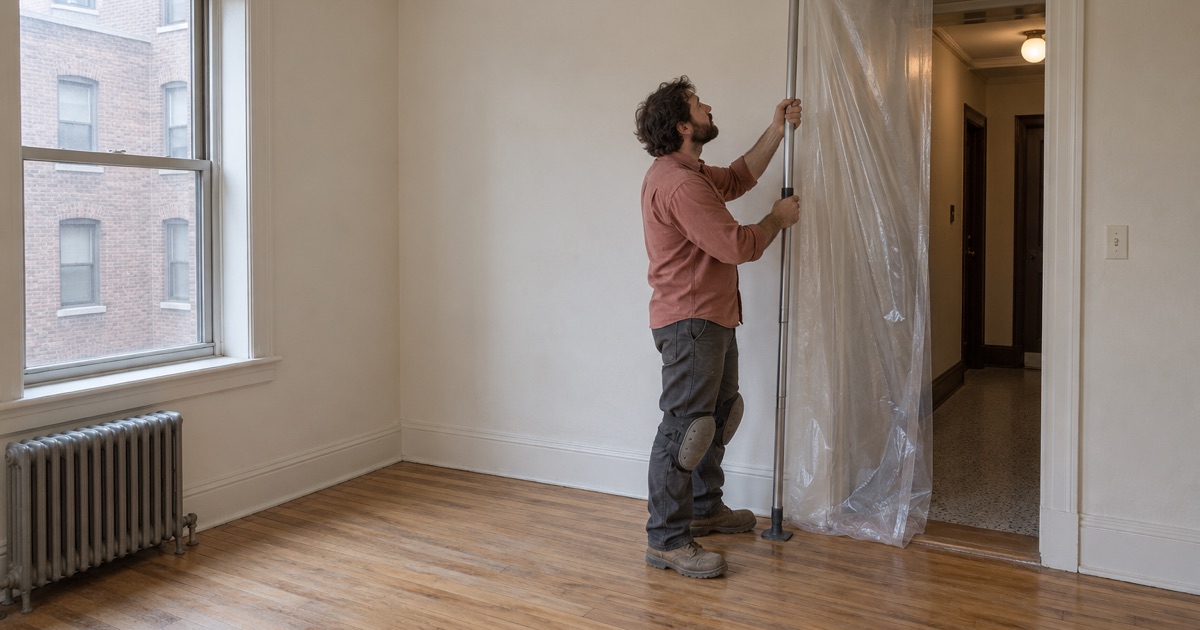
Dust containment matters as much as noise when a party wall or a ceiling separates two households. We seal doors and returns to the rooms being worked on and run a HEPA vacuum between grits. Where an old floor hides wax residue or peeling polyurethane, we test a small area first, so a surprise does not stretch a loud day into a second one.
Equipment staging is part of being a good neighbor too. On tight blocks we bring in the drum sander, edger and finish supplies in as few trips as practical and keep shared hallways clear while we work. Cords and hoses stay inside the unit we are working in whenever the layout allows.
Summer evenings at High and Stiles
Little Italy also has a public life outdoors. In summer, the neighborhood’s outdoor film festival is projected onto a wall at the intersection of High and Stiles Streets. Since our machines are packed away well before evening, a floor job on a nearby block does not compete with it.
Before we start
Tell us the build year if you know it, whether the unit is rented and when the next tenant moves in, and whether anyone upstairs or next door works from home. With that, we can propose sanding days that fit the city’s hours and your neighbors’ routines. You get a written, itemized estimate before any work is scheduled.
- 20+ Years Experience
- Written Itemized Estimates
- Dust-Contained Sanding