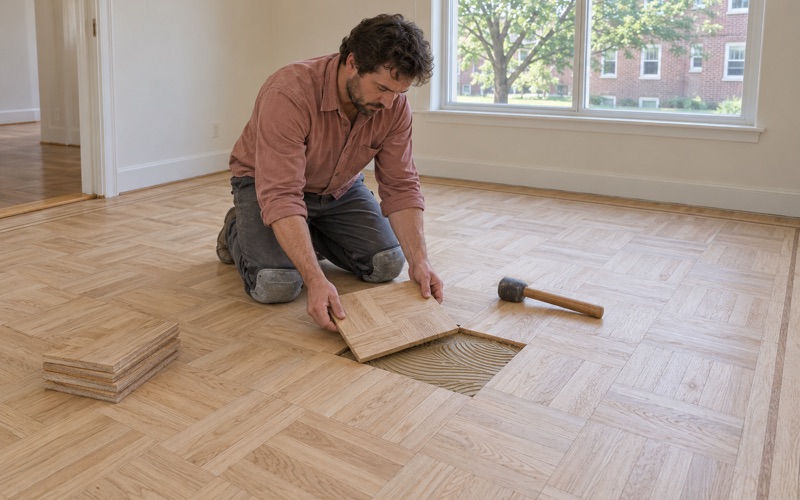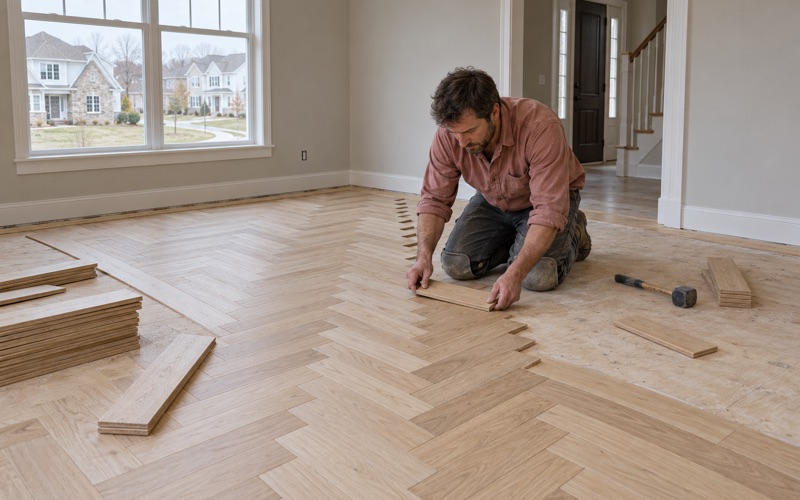
Severn Wood Flooring has spent more than 20 years on wood-flooring in Locust Point and the rest of our Maryland service area, and most of the work we see here is refinishing and repair rather than new installs. Owners in this part of Baltimore tend to keep their houses for a long time, so they want a floor sanded and finished once, properly, instead of patched every few years.
We start every job by checking the build year and any painted surfaces before a sander is switched on. Houses built before 1978 fall under lead-safe renovation rules, and many houses in this neighborhood predate that line by decades. That check shapes how we contain dust, which sanders we use and how the rooms are cleaned at the end.
You also get a written, itemized estimate before any work begins. Owners keep it for an insurer, a future sale or their own records, and it spells out what each room, stair and repair costs so nothing arrives as a surprise.
Locust Point’s Workers’ Rowhouses and the People Who Kept Them
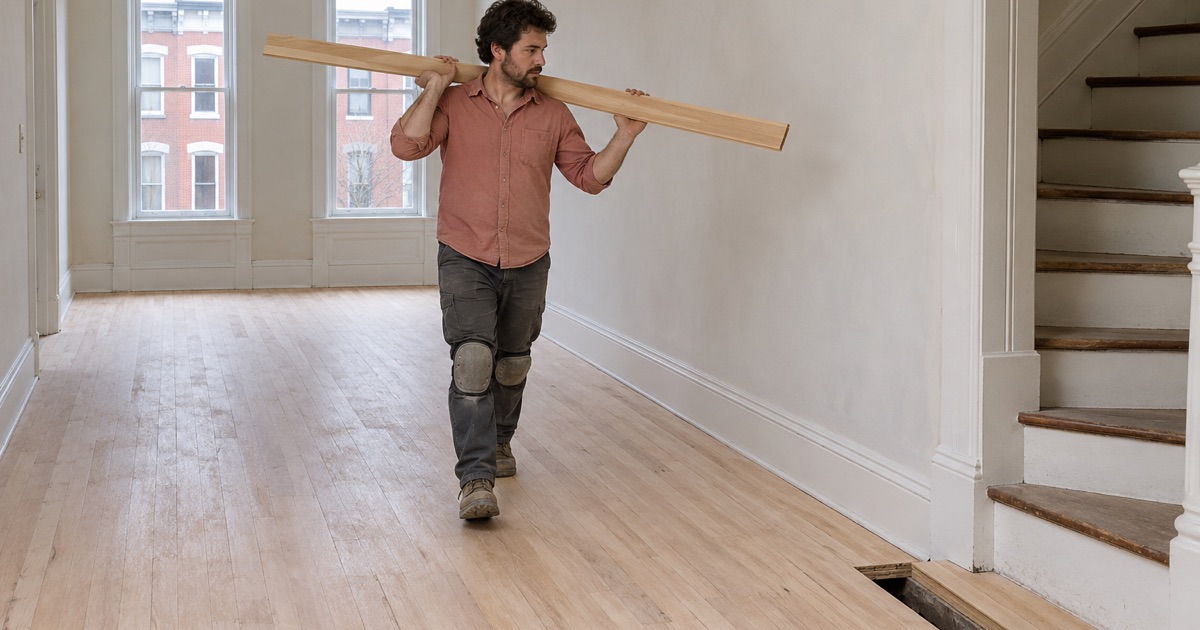
The Locust Point Historic District was listed on the National Register in 2012 under Maryland Historical Trust inventory B-5223. The listing describes a dense residential area of about two dozen city blocks, made up mainly of two- and three-story brick rowhouses built between 1845 and 1928. It counts 115 resources, 98 of them contributing to the district.
Built around the piers
Those houses went up because of work on the water. The neighborhood grew as a center of transportation and industry, with the B&O’s piers drawing workers who needed housing close by. Before 1851, several groups of two-story, gable-roofed houses had already gone up for workers on Cuba and Andre Streets, and the 1880s added rows and rows of mainly two-story Italianate houses.
The 1868 immigration pier
In 1868 an agreement between B&O president John Work Garrett and the North German Lloyd line opened an immigration pier at Locust Point. From then until the piers closed in 1914, about 1.2 million European immigrants entered Baltimore through this neighborhood. The National Register record names that history directly, describing the district as significant for its association with transportation, industry and immigration in Baltimore.
Owner-occupied blocks today
The houses that served pier and railroad workers are now mostly held by owners. Census figures here come from the BNIA South Baltimore statistical area, which Locust Point shares with Riverside and the Locust Point Industrial Area, so they describe the wider area rather than one neighborhood. In the ACS 2024 five-year data for that area, 2,254 of 2,496 owner households live in one-unit attached houses, about nine in ten, and 2,453 of 4,488 housing units were built in 1939 or earlier.
Looking for wood-flooring closer to Federal Hill? See Federal Hill Wood-Flooring.
Refinishing Floors in Two- and Three-Story Brick Rowhouses
A rowhouse floor plan changes how we sand. Rooms often connect front to back, the stairs link every level, and a typical job carries the floor through several connected spaces. We plan the sanding order so the finish coats can go down in one continuous pass without boxing anyone in on an upper floor.
Reading an old floor before sanding
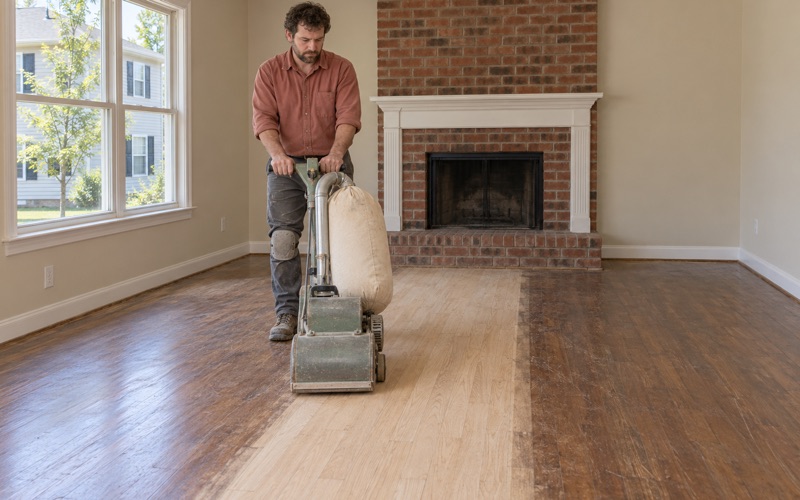
We never assume what is under a carpet or an old finish in a house of this age. We pull back the carpet pad and tack strip, look at the boards, and check for wax residue, peeling polyurethane, old patches and any face nails that would tear a sanding belt. Traffic lanes down a hallway, pet urine stains, water stains and rug shadow all tell us how deep the drum sander has to go and whether board replacement is a better answer than sanding through.
Board gapping and winter gaps are common in older floors and usually follow the seasons, so we read them before deciding whether to fill. Cupping, crowning and buckling point to moisture, and we take readings with a moisture meter before treating them as a sanding problem. If we find frass, termite damage or powderpost beetle signs, we stop and tell you, because that is a structural question before it is a finishing one.
We also identify the species before talking about color. Red oak strip flooring, white oak, maple and Douglas fir each take stain differently, and the amber cast owners call orange oak is often the first thing they want gone. Knowing the wood first keeps the sample boards honest.
Repairs that disappear into the floor
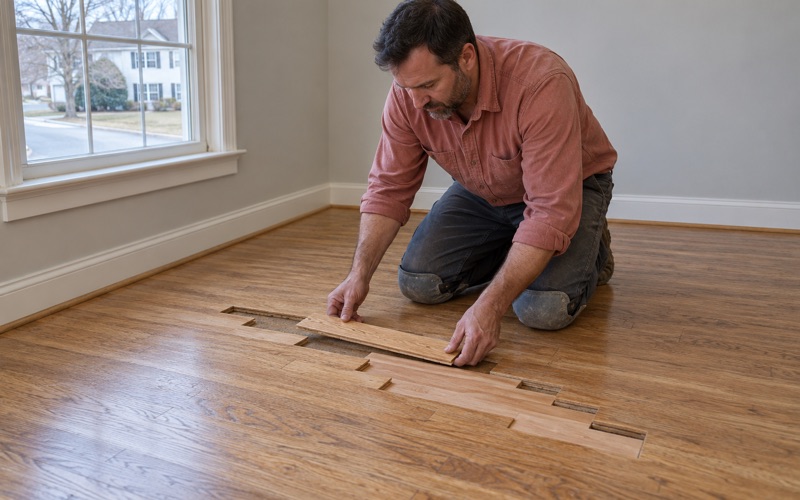
Older rowhouses are often opened up over the years, with walls moved and floor registers relocated. Where an old wall or register leaves a hole, we close it with a weave-in repair, working new tongue and groove boards into the existing rows so the patch does not read as a rectangle. Nail pops and squeaky floorboards get fastened down before sanding, not after.
Stairs, finishes and color
The staircase in a two- or three-story rowhouse is often the most worn surface in the house. We quote stair treads, stair risers and stair nosing tread by tread, because a staircase is not priced by the square foot. For finish, we walk you through waterborne polyurethane, oil-modified polyurethane and hardwax oil, along with sheen level, and we choose products that fit Maryland’s VOC limits for wood coatings with drying times planned around the household. Stain and sheen samples go down on your own boards so the color is picked in your light rather than from a brochure.
A National Register District Without a City Design Review
Owners often ask whether the historic listing means they need permission to refinish. The Locust Point Historic District is a National Register listing only; it is not one of the Baltimore City local historic districts administered by CHAP. That means there is no city design review attached to the district for interior floor work.
What the listing does and does not do
National Register status recognizes the district’s history, and it is not a review board for private work inside your house. Contributing houses in a National Register district can qualify for Maryland’s homeowner historic tax credit, so it is worth confirming your house’s status if you are weighing larger restoration work. We do not handle applications, but our itemized invoice gives you a clear record of what was done and what it cost.
Permits and the building code
Baltimore City is an independent city, and permits come through the Department of Housing and Community Development, Permits and Inspections. Section 105.2 of the Baltimore City Building Code exempts interior painting, tiling, carpeting and similar interior finish work from permits, but wood flooring is not named in that list. If your project goes beyond refinishing into subfloor or joist work, we talk through whether a permit question applies before we start.
Lead-safe work in older rowhouses
The era of these houses matters more to a floor job than the listing does. Paint on baseboards, door casings and stair stringers in a house this old can contain lead, and sanding beside it without precautions spreads dust through the whole house. We follow lead-safe practices, contain dust to the rooms being worked on, seal doors and returns, and finish with a HEPA vacuum cleanup.
Planning Floor Work in an Owner-Occupied Locust Point Rowhouse
Because many owners here hold their houses for the long term, we treat a refinish as a long-term decision rather than a quick cosmetic pass. Our first visit covers the floors room by room, the stairs, any repair areas, and how you live in the house while work is underway. We also note anything we will not touch, such as old resilient floor tile or black mastic, which we identify before sanding and leave for the right trade.
Sequencing a multi-floor job
In a three-story rowhouse we often work one level at a time so the household keeps a usable floor. Sanding, staining and the first finish coat usually happen on one level before we move to the next, and the stairs come last because they connect everything. We give you dry times and a realistic window for moving furniture back, rather than a single date that ignores cure time. If you plan to stay in the house during the work, we map out which rooms and which bathroom stay open each day.
When a screen and recoat is enough
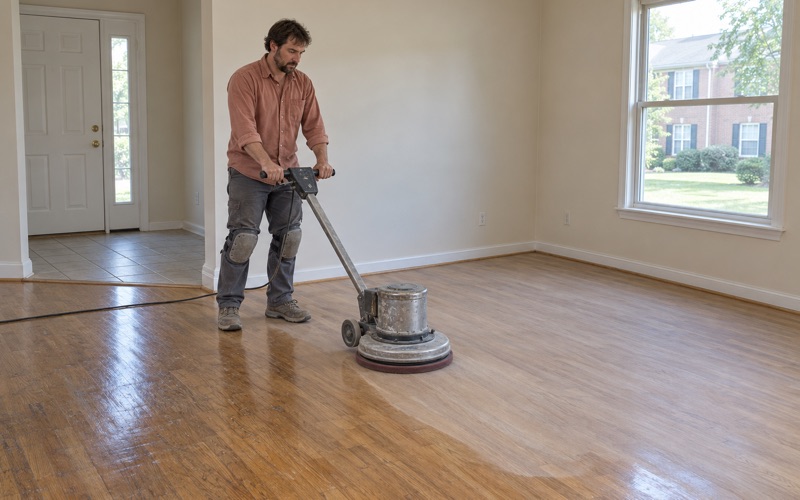
Not every floor needs a full sand. If the finish is dull but the wood beneath is sound and free of deep wear, a screen and recoat can restore it with far less dust and time. We tell you honestly which option fits, because taking wood off an older floor is a one-way decision you only want to make when it is needed.
Water, basements and the next owner
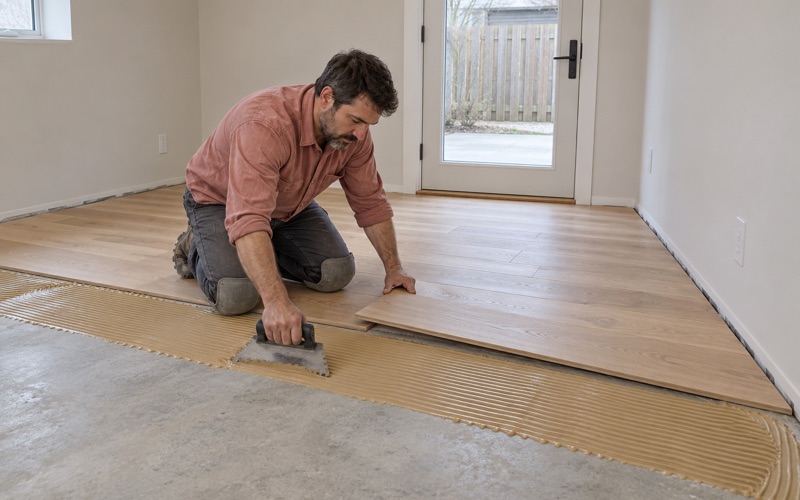
If a floor has water damage, we trace the source, dry it, and read it with a moisture meter before deciding on repair. Where an adjuster is involved, we document the damage room by room. For a finished basement, we take moisture readings on the concrete and typically recommend engineered wood or a different floor rather than solid hardwood below grade. When the work is done, your itemized invoice stays with the house’s records, which helps when the time eventually comes to sell.
If the rowhouse is a rental
Some houses on these blocks are rentals, and rental floors in pre-1978 houses follow a different calendar. We schedule the work around the lead dust test Maryland requires at each change of tenant, so the floor is finished and cleaned before the test rather than after. For landlords, our itemized invoice separates ordinary wear from damage, which supports the documentation Maryland’s security deposit law asks for.
- 20+ Years Experience
- Written Itemized Estimates
- Dust-Contained Sanding