Severn Wood Flooring has spent more than 20 years on wood-flooring in New Carrollton and the surrounding part of Maryland, from sanding tired red oak strip flooring to weaving new boards into a room where a wall came out. Most of our work here is straightforward refinishing and repair. The jobs that need more thought are the ones where the floor is only one piece of a bigger change to the house.
That distinction matters more in this city than in many places nearby, because a homeowner can be dealing with two offices instead of one. We plan the floor so it fits whatever sequence the rest of the project has to follow, and we put the scope in writing before a single board is touched. You get a written, itemized estimate you can keep with the project file, show an inspector, or hand to a lender.
What follows explains how the two layers of review work, where a flooring job tends to get caught up in them, and how we schedule our part so it never lands out of order. None of it changes the craft of the floor itself; it changes when that craft happens.
Two Permit Layers: Prince George’s County and the City

New Carrollton is a city in central Prince George’s County, about 10 miles east of Washington, D.C., with a 2020 census population of 13,715. It keeps a permit process of its own on top of the county’s. The City of New Carrollton issues its own building permits, so a project that needs county approval can also need the city’s.
Where the city’s authority comes from
The city’s permit power traces back to Charter Amendment No. 74-1, dated March 21, 1974. That amendment authorized the Mayor or a delegate to review building permit applications and to grant building permits, and it covered buildings, fences and signs to be erected, constructed or reconstructed in the town. Half a century later, the same idea still shapes how a remodel moves through the city.
What the city’s permit language reaches
The city’s code, as published excerpts and the permit application describe it, is broad. A permit is called for when a person would erect, construct or repair, or in any way change any building or other structure, or make any other improvement of a permanent nature to real property in the city. That wording is wide enough that a homeowner planning a renovation should ask the city before work starts rather than assume.
We are careful about one point here. We have not seen anything in the sources we rely on that settles whether refinishing or replacing a floor on its own falls inside that language, so we never tell a customer either way. The office that decides is the city, and the place to ask is Code Enforcement.
Looking for wood-flooring closer to Takoma Park? See Wood-Flooring Services in Takoma Park.
County Permit First, Then the City’s Review and Inspection
The order of the two layers is not a matter of preference. According to the city’s code excerpts, no building permit is issued by the City of New Carrollton for construction that requires a Prince George’s County permit until that county permit has been issued. In practice, the county application goes in first, and the city application follows it.
The city’s ten working days
Once the county permit is in hand, the city issues or denies its own permit within ten working days of the county permit being submitted. The city application asks for two copies of a scaled site plan and an estimated cost of construction. A written, itemized estimate from each trade on the job makes that cost figure easier to assemble honestly.
The city inspects the work itself
The permit application also states that all construction will be inspected and approved by the City of New Carrollton. That means the city’s inspector, not only the county’s, has a say in when a project is finished. For the homeowner, it is one more appointment that needs to fit between trades.
Where to ask
The city’s Code Enforcement office, at 6016 Princess Garden Parkway, is where residents go for procedures on acquiring a Prince George’s County and city building permit. The office can be reached at (301) 459-3771, Monday through Friday from 8:30 a.m. to 5:00 p.m. A short call before demolition starts is cheaper than a stop-work conversation afterward.
Floor Work Inside a Larger Renovation
Most floor jobs we see in New Carrollton are not renovations at all. A living room with traffic lanes, a hallway with pet urine stains, or a bedroom with a rug shadow is a sanding and finishing project, and the work stays inside the rooms we touch. The planning changes when the floor is the last step of something bigger.
Remodels that change the house
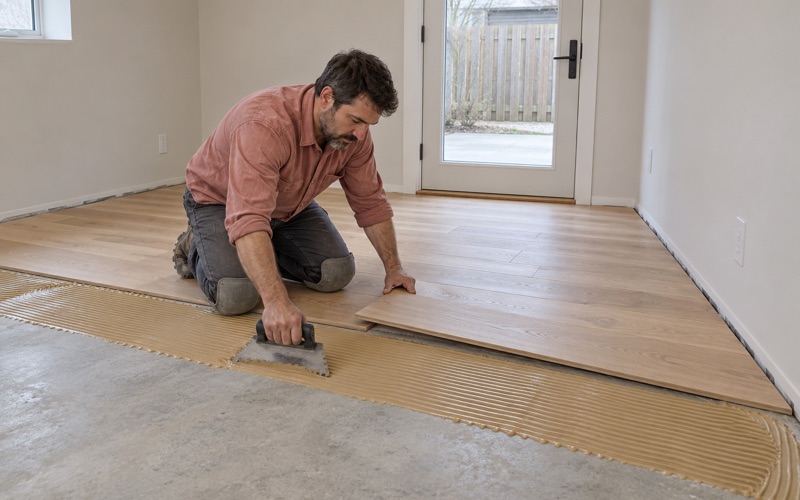
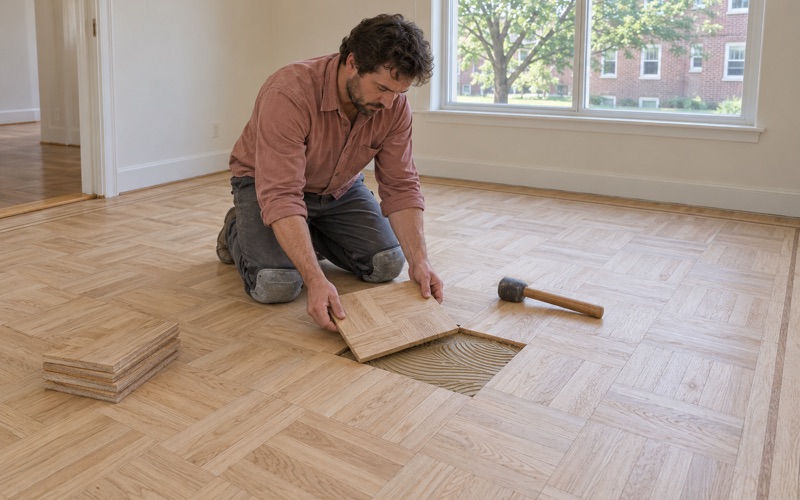
Taking out a wall, adding a room, finishing a basement or rebuilding a kitchen are the kinds of projects where the broader permit language can come into play. When a wall comes out, it often leaves a strip of bare subfloor and a gap in the boards, and we close it with a weave-in repair so the new boards run into the old ones rather than stopping at a seam. Holes where floor registers moved get the same treatment.
On these jobs, our work usually comes after framing, electrical and any inspections of what sits under the floor. Installing new tongue and groove over a subfloor before the inspector has seen the joists or the work beneath them can mean pulling up finished boards. We would rather wait a week than refinish the same room twice.
Basements and below-grade rooms
A finished basement is a common part of a larger remodel, and it is the one place we are most cautious about wood. We take moisture readings on the concrete and look at the grade before recommending anything. Where solid hardwood is a poor fit, we suggest engineered wood or a different floor entirely.
The houses themselves
The city’s housing stock shapes what we find under the carpet. American Community Survey figures show 2,143 of 4,699 housing units, about 45.6 percent, were built in the 1960s, with another 1,028 from the 1950s. When we pull back carpet pad and tack strip in houses of that age, we check for red oak strip flooring underneath, and we look for old resilient tile glued down with black mastic in basements and kitchens.
Because most of these homes were built before 1978, we check the build year and any painted surfaces before sanding, since that work falls under lead-safe renovation rules. Old tile and black mastic are identified before any sanding starts and left for the trade that handles them. Those checks happen whether or not the job is part of a permitted remodel.
Planning a New Carrollton Floor Project: Who to Call, in What Order
A larger project runs smoothest when everyone agrees on the sequence before the first wall comes down. The steps below are how we suggest homeowners think about it, with our part placed where it causes the least rework. The permit decisions themselves belong to the county and the city.
Step one: confirm what the project needs
Start with the city’s Code Enforcement office and Prince George’s County’s permitting office (DPIE) to find out what the overall project requires. If a county permit is needed, it comes first, and the city’s application follows with its site plan and cost estimate. Whoever files the applications, our itemized estimate can sit in the file alongside every other trade’s.
Step two: schedule the floor after the rough work
We book the flooring once walls, plumbing and wiring are settled and any inspection of that work is done. New boards need time to acclimate in the house before installation, so we have material delivered while the last of the rough work wraps up. That keeps the floor off the critical path without leaving it exposed to the dust of other trades.
Step three: finish with the household in mind
When it is time to sand and finish, we lay stain and sheen samples on your own floor before a color is chosen. Dust stays in the rooms being worked on, with doors and returns sealed and a HEPA vacuum running through the grit sequence. We pick finishes that fit Maryland’s VOC limits for wood coatings, and we plan fumes and drying time around when the family needs the rooms back.
Step four: leave room for the final inspection
If the city’s inspector still has to approve the finished project, we keep the floor protected until that visit is done. Furniture, appliances and cabinets going back in can scratch a fresh coat of waterborne polyurethane or oil-modified polyurethane, so we talk through cure times with the other trades. The goal is a floor that is finished once and stays finished.
Smaller jobs move faster
Not every project needs this much choreography. A screen and recoat, a few board replacements for water stains, or stairs quoted tread by tread can usually be booked on their own timeline. If you are not sure which kind of job yours is, tell us what else is happening in the house and we will help you sort out who to call first.
- 20+ Years Experience
- Written Itemized Estimates
- Dust-Contained Sanding