Severn Wood Flooring has spent more than 20 years on wood-flooring in Odenton, and much of that work starts with a date on a calendar rather than a worn spot on the floor. A closing is set, a lease is ending or a new household is due to arrive, and the floors have to be sanded, repaired or replaced in the days between. We plan the job backward from that date, so you know before we start which work fits the gap and which does not.
That planning covers refinishing tired red oak strip flooring, screening and recoating a finish that is only dull, replacing damaged boards, and putting down new solid hardwood or engineered wood where carpet used to be. Every job begins with a written, itemized estimate you can keep for a buyer, a landlord file or an insurer.
Most of the floors we see here are not old. They are builder-grade hardwood and engineered wood that have taken a decade or two of traffic, pets and furniture moves, and they respond well to the right work done in the right order.
A Fort Meade Town Where Houses Change Hands on a Schedule
Odenton, an unincorporated community in Anne Arundel County, saw its growth spurred by the establishment of Fort Meade in 1917, when the War Department acquired land west of the town at the start of World War I. More than a century later, the installation still shapes how often Odenton houses empty out and fill up again, and that rhythm drives the timing of much of the floor work we do here.
What the numbers say about turnover
According to the Census Bureau’s 2024 five-year estimates, 1,318 of the 26,233 people in Odenton’s labor force serve in the Armed Forces, which is 5.0 percent. That is a minority of workers, and it is not a count of military households, but it is a large enough group that moves tied to assignments are a steady part of the local housing market.
Turnover shows up even more clearly among renters. Of Odenton’s 6,700 renter households, 3,752 moved in during 2020 or later, or 56.0 percent. Owners make up 62.8 percent of occupied homes, and they move too: a house bought by one family can come back on the market when that family relocates.
Why on-post housing does not absorb the demand
Fort Meade’s privatized housing, managed by Corvias, includes 2,628 family units in six neighborhoods plus 434 apartments. Living on post is not mandatory, though. Military OneSource states that service members and their families have the option to choose privatized housing on post or select from many off-post prospects, and Odenton sits right beside the installation.
That choice is what puts so many Odenton townhouses and detached houses into a cycle of tenants and owners arriving and leaving. Each change of hands creates a short window when the rooms are empty, and an empty room is the easiest room to refinish.
Who handles the floors
Floor work on a house that is changing hands is arranged and paid for by the owner, the seller or the landlord. We work directly with whoever holds that decision, and we write the estimate so the next person reading it, whether a buyer, a property manager or an insurance adjuster, can follow exactly what was done.
Looking for wood-flooring closer to Glen Burnie? See Wood-Flooring in Glen Burnie.
The Window Between Move-Out and Move-In
The gap between one household leaving and the next arriving is usually short, and it is shared with painters, cleaners and anyone else working on the house. We fit floor work into that gap by matching the scope of the job to the days actually available.
Matching the work to the days you have
A screen and recoat is the lightest option. We abrade the existing finish without cutting into the wood and apply a fresh coat, which works when the floor is dull and lightly scuffed but the finish has not worn through. It takes the least time of anything we do.
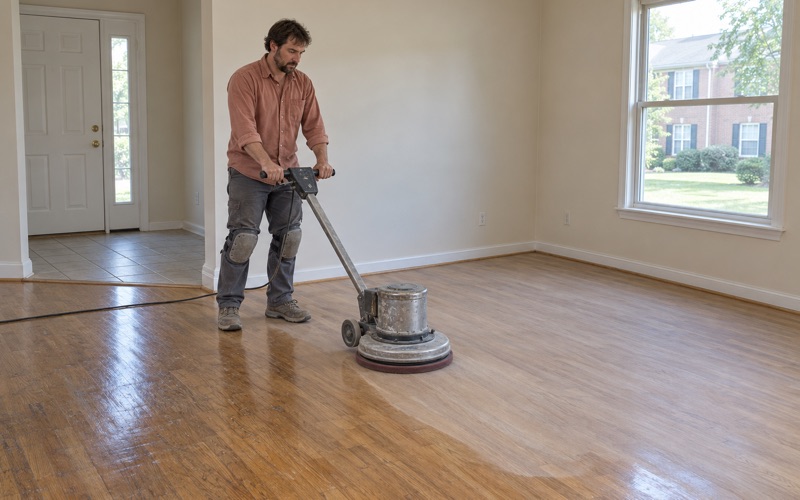
A full sand and refinish cuts back to bare wood. We work through a grit sequence with a drum sander and an orbital sander, then apply stain if you want one and two or three coats of finish. That is the right call for traffic lanes worn to gray wood, pet urine stains, water stains or rug shadow that a recoat will not hide. It needs more days than a recoat, and each coat has to dry before the next goes on.
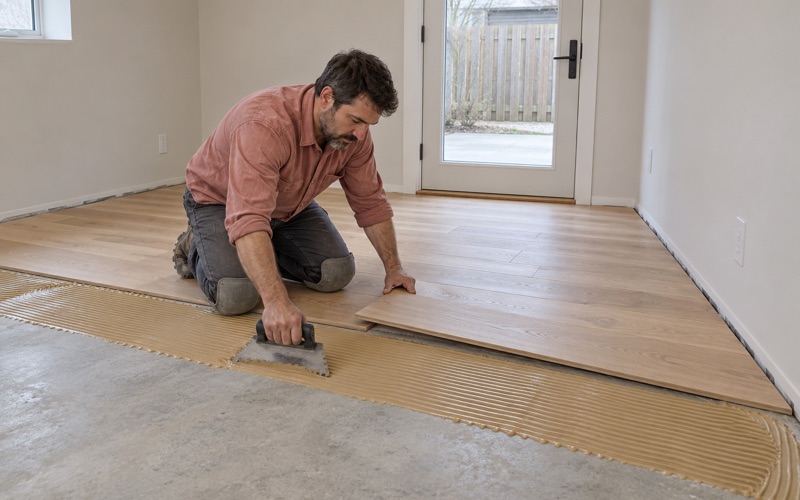
Board replacement and new installation sit at the far end. New boards need time for acclimation before they go down, and solid hardwood that is site-finished needs the sanding and coating steps on top of that. Prefinished flooring removes the finishing step, which can matter when the calendar is tight.
Finish choice and drying time
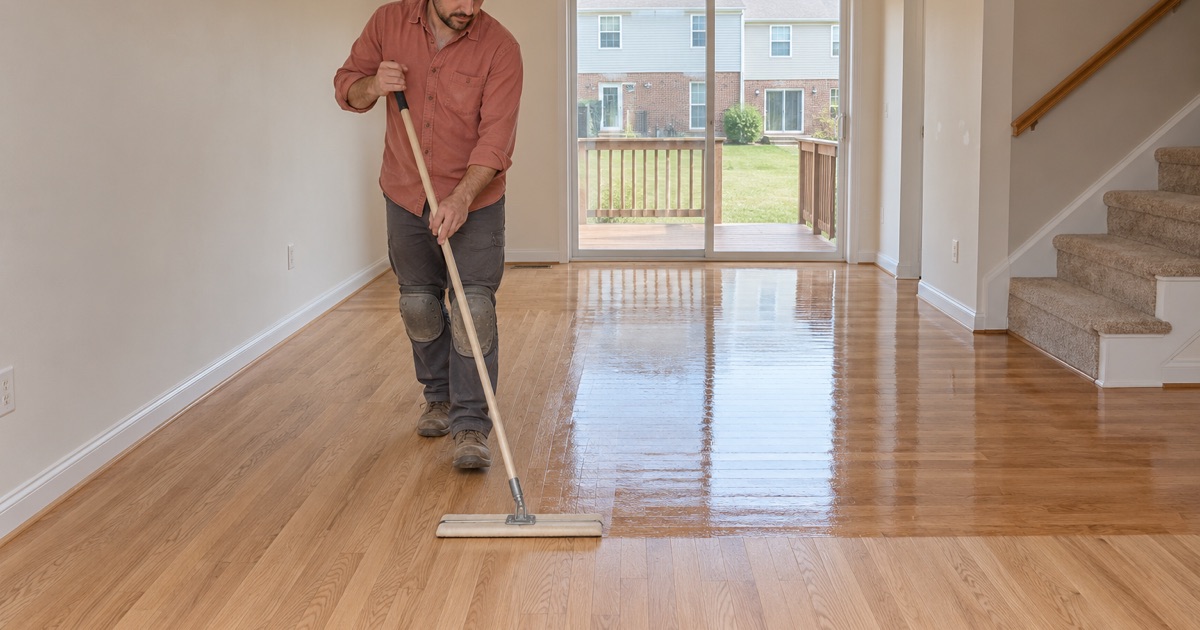
Waterborne polyurethane dries faster and has less odor than oil-modified polyurethane, which is why it is often the better fit for a house that has to be ready soon. We choose finishes that fit Maryland’s VOC limits for wood coatings, and we tell you the drying and curing time for the product we plan to use before you set your move-in date.
We do not promise that a floor will be ready by a specific hour. Humidity, temperature and airflow all change how a finish dries, so we build a margin into the schedule rather than a guarantee. If the move-in date is fixed and the margin is thin, we will tell you which scope fits and which should wait.
Keeping the rest of the house usable
Dust containment matters when painters or cleaners are working in the next room. We seal doors and returns around the rooms being sanded and clean up with a HEPA vacuum, so the dust stays where the work is.
What Is Usually Underfoot in Odenton Townhouses and Newer Houses
The median year built for Odenton housing is 1999. Of 18,601 housing units in the 2024 estimates, 5,442 were built in the 1990s and 4,965 between 2000 and 2009, with another 3,083 added in the following decade. Neighborhoods such as Seven Oaks, Piney Orchard and Chapelgate reflect that era.
Attached homes
Odenton has 6,587 one-unit attached homes, which is 35.4 percent of all housing units, slightly more than the detached houses. In townhouses of this age, we commonly see solid red oak strip or maple on the main level, engineered wood or carpet upstairs, and carpet on the stairs. Shared walls mean noise travels, so on upper-floor installs we talk through sound-reducing underlayment, and we read the association’s documents for any floor rules rather than assuming them.
Detached houses from the 1990s and 2000s
Detached houses from the same period usually have tongue and groove strip flooring nailed to a plywood subfloor over joists. After 20 or 25 years we see nail pops, squeaky floorboards, winter gaps that open and close with the seasons, and occasional cupping near kitchens and doors where water has reached the boards. Most of this is repairable without replacing the floor.
Stairs and basements
Stairs are often the first thing a buyer or new tenant notices. We quote stair treads, stair risers and stair nosing tread by tread, because a staircase is not priced by the square foot. For a finished basement, we take moisture readings on the concrete first and usually recommend engineered wood or a different floor for below-grade installation rather than solid hardwood.
Refinishing Before a Listing or a New Lease, Planned Around Your Move
Owners preparing to sell and landlords preparing for a new lease come to us with different goals, and we plan the work around which one you are. A seller is usually after how the rooms look in photographs and at showings, while a landlord is weighing how long the finish will last before the next turnover.
Getting a house ready to list
Before a listing, refinished floors photograph well and make rooms read as move-in ready. We lay stain and sheen samples on your own floor before you choose a color, because a sample board in a showroom rarely matches the way red oak takes stain in your living room. Some sellers ask to move away from the orange oak look of an aging oil finish toward a natural or lighter tone with a satin sheen level.
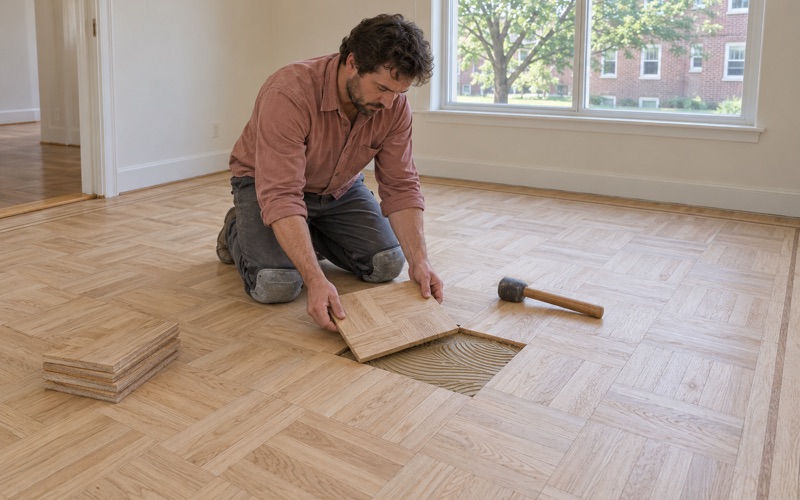
If a few boards are damaged, we replace them with a weave-in repair rather than a patch that shows. The same method fills the holes where a floor register or an old wall came out, so the floor reads as one surface in the listing photos.
Turning a rental between tenants
For a landlord, the goal is a durable floor that holds up through the next lease. We document the condition of each room before we start, separating ordinary wear such as light traffic patterns from excess wear or damage such as deep gouges and pet stains. That itemized record gives you the supporting documentation Maryland’s security deposit law asks for when a deduction is taken.
When the floor has a bigger problem
Some floors reveal more than wear once the furniture is gone. Buckling or crowning can point to a moisture source that has to be found first. If we find water damage, we trace it, dry it and read it with a moisture meter, then document it room by room for the adjuster.
Planning around the moving date
The best results come from booking early and being clear about the dates that cannot move. Orders and closings can change, so we build the plan with room for that. Tell us the date the house will be empty, the date the next household arrives and which rooms need work. Photos of the worst areas help us judge whether a recoat or a full refinish is the realistic choice before we visit, and for a townhouse, the association’s rules should be on hand.
How we sequence the job
We usually handle floors after painting and before the final cleaning, so wet paint and ladders are not crossing new finish. For a seller, we set the work so the floors are done before the listing photographs. For a landlord, we aim to finish with drying time to spare before the new lease begins.
Work that crosses into another trade
If an older floor in the house turns out to hide resilient floor tile or black mastic under carpet, we identify it before anything is sanded and leave it for the right trade. We check rather than assume, and we tell you plainly if a job needs someone other than us.
Whether you are leaving for a new assignment, buying near Fort Meade or turning a rental between leases, we will give you a written plan that fits your moving date.
- 20+ Years Experience
- Written Itemized Estimates
- Dust-Contained Sanding