
Severn Wood Flooring has handled parquet floor refinishing in Severn, MD for 20+ years, serving surrounding cities including Jessup, Elkridge, Odenton, Glen Burnie and Linthicum. We reset loose blocks, replace damaged ones, sand the pattern flat with equipment suited to grain that runs in every direction, and refinish it in a color you have sampled on the floor itself. When the adhesive underneath is the problem, we say so before any sanding begins.
Parquet looks like one floor but behaves like hundreds of small ones. Each block or slat is glued down rather than nailed, each has its grain at an angle to its neighbors, and each reacts to moisture a little on its own. Refinishing it well takes different tools, a slower sanding progression and a careful look at what is holding it down.
Much of the parquet we see is in older houses and condos, often laid in black mastic adhesive. That adhesive decides how far a refinish can go, so identifying it comes first on every job.
Before Sanding: What Holds The Parquet Down
Black Mastic And Older Adhesives
Older parquet was commonly set in black mastic, an asphalt-type adhesive, and some formulations from past decades contain asbestos. As long as the mastic is intact and covered by the blocks, it is generally left in place. It must never be sanded, dry-scraped or ground, because that is when fibers can be released.
When we find loose blocks with exposed black mastic, we stop, recommend testing and leave any removal to a licensed abatement trade. We do not sand near exposed mastic or lift large areas of suspect adhesive ourselves, and we tell you plainly when that changes the plan for your floor.
Tap-Testing For Loose Blocks
We tap across the whole floor to find blocks that sound hollow or move underfoot. A few loose blocks scattered across a sound floor can be re-glued. A large area of hollow blocks usually means the adhesive has failed underneath, and sanding over it would only break more blocks loose.
We mark the loose areas on a sketch of the room and include it with the written estimate. That way you can see how much of the floor needs attention before sanding and why the price for re-gluing is what it is.
Moisture Under Parquet On Concrete
Much parquet sits directly on a concrete slab, often in condo buildings and on lower levels. If the slab is damp, the blocks swell, lift and release from the adhesive. We take moisture readings before quoting, because refinishing a parquet floor over a wet slab is wasted money until the moisture is dealt with.
Repairing Parquet Before Refinishing
Re-Gluing Loose Blocks
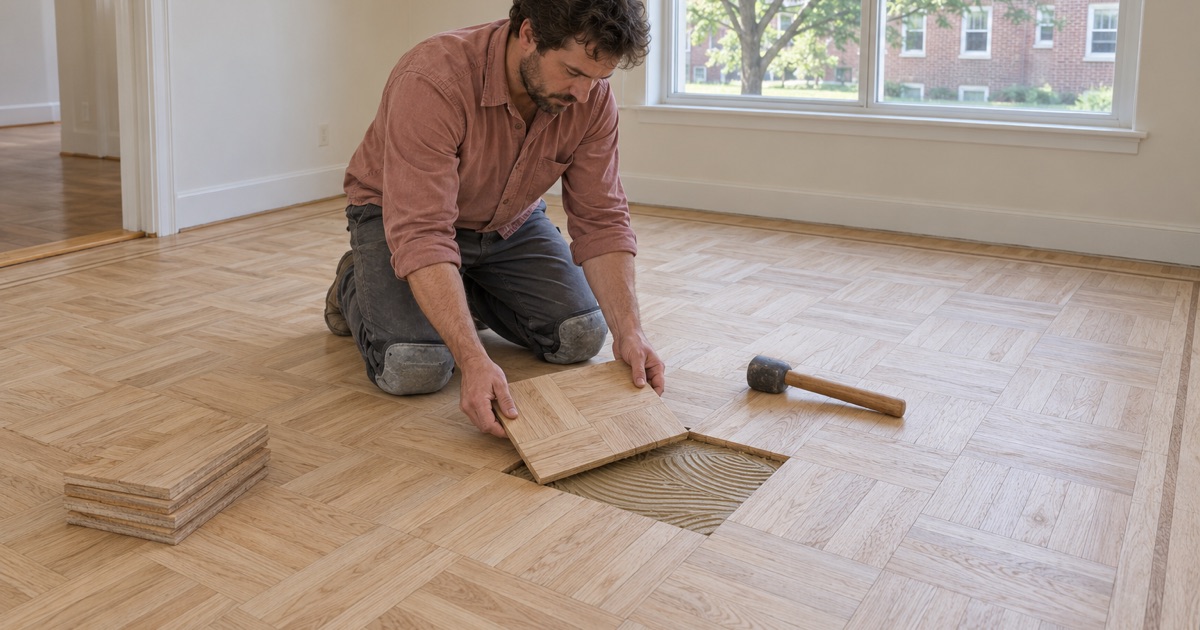
Loose blocks are lifted, cleaned of loose debris and set back in a compatible flooring adhesive, then weighted until the adhesive sets. Where the old adhesive is suspect, we do not scrape it; we leave it undisturbed and work around it, or recommend abatement if the area is too large.
Re-glued blocks need time for the adhesive to cure before sanding starts, or the sander can pull them loose again. We build that wait into the schedule rather than sanding the same day.
Replacing Damaged Or Missing Blocks
Blocks with deep stains, burns, splits or insect damage are cut out and replaced with matching wood of the same size, species and thickness. Where an exact match is hard to find, we can borrow blocks from inside a closet or under a built-in and use new material in the hidden spot.
Pet urine stains on parquet are common near doors, and they often run into several neighboring blocks. Replacing the stained blocks before sanding gives a much better result than trying to sand them out.
Filling Gaps Between Blocks
Older parquet often develops small gaps as blocks shrink. Gaps that do not change with the seasons can be filled with a color-matched filler during sanding, which keeps dirt out and makes the pattern read as continuous. Seasonal gaps are left alone, because filler in a moving joint cracks out.
Sanding And Finishing Parquet
Sanding Across Multiple Grain Directions
A drum sander run in straight lines cuts with the grain on some blocks and across it on others, leaving scratches that show badly once stain or finish goes on. We use multi-disc and orbital sanders that cut evenly in every direction and step through a finer grit sequence, vacuuming between passes.
Parquet is also often thinner than strip flooring, so we sand only as much as the floor needs. We check the thickness at an edge or a register before choosing the starting grit.
Stain And Sheen On A Pattern
Because each block presents its grain at a different angle, stain can look lighter on some blocks and darker on others, which emphasizes the pattern. Many owners prefer a natural finish that lets the pattern speak for itself. We lay samples on the sanded floor so you can see both options in your own light.
A satin or matte sheen level hides scratches and dust better on a busy pattern, while a higher gloss shows off the geometry more but also every mark. We sample the sheen along with the stain so you see both together.
Finishes For Parquet
We apply waterborne polyurethane for a clear, quick-drying finish, or oil-modified polyurethane where you prefer a warmer amber tone. Hardwax oil is another option for a matte, natural look. Every product meets the Maryland wood coating limits in COMAR 26.11.39, and we plan drying times around your household.
Parquet In Condos And Shared Buildings
Parquet is common in older condo buildings, where sanding noise, dust and finish odor affect the neighbors as well as you. We read the association’s rules on work hours and notice before scheduling, seal the unit’s doors and returns, and choose a low-odor waterborne finish where the building calls for it.
If the parquet has to be lifted because the adhesive underneath has failed, any replacement floor may need to meet the association’s requirements for underlayment and sound. We check those documents before recommending a new floor.
- 20+ Years Experience
- Written Itemized Estimates
- Dust-Contained Sanding