Severn Wood Flooring has handled wood-flooring in Savage for more than 20 years, from refinishing red oak strip floors upstairs to putting new boards into a finished basement. Every job starts with reading the floor itself: the species, the wear, the subfloor underneath and, on a lower level, the moisture coming up through the concrete. That reading decides what we recommend, and it goes into a written, itemized estimate you can keep.
A lot of what homeowners ask us here comes down to one question: what belongs on the bottom level of a house in a town with a river running past it? The honest answer starts by separating two things people tend to blur together, the river rising and water actually reaching a floor. This page walks through what the nearby river gauge has recorded, what its flood stages are documented to reach, and how we choose between solid hardwood, engineered wood and other floors for a basement or ground-level room.
Upstairs, the work is what you would expect from a refinishing and installation crew. We sample stain and sheen on your own boards, seal off the rooms being sanded, and check the build year and painted trim before a drum sander touches a floor in a house built before 1978.
The Little Patuxent and What Its Gauge Has Recorded
The river that matters for floors here is the Little Patuxent, which runs past the old mill village after the Middle and Little Patuxent join west of it. The National Weather Service tracks it at gauge SAVM2, listed as ‘Little Patuxent River near Savage,’ the same station as USGS 01594000. That gauge sits just outside the Savage census-designated place line in Howard County, so its readings describe the river rather than any particular street.
Flood stages on the gauge
The weather service sets action stage at 8 feet and flood stage at 10 feet on that gauge. Moderate flooding begins at 14 feet and major flooding at 20 feet. Those categories are the frame for every historic number on the record, and they are worth knowing before reading the crests.
The crests on record
The highest crest is 25.4 feet, reached on June 22, 1972, more than 15 feet past flood stage. Since then, three crests have cleared 17 feet: 18.74 feet on June 26, 2006, 17.97 feet on May 1, 2014 and 18.52 feet on July 31, 2016. An older mark of 17.5 feet dates to August 1, 1933.
The river has also drawn attention after heavy local storms. After heavy rain in central Maryland on May 27, 2018, the U.S. Geological Survey sent crews out for high-water marks, and the Little Patuxent River in Howard County was one of the target watersheds. Savage itself was not named in that report, and we do not stretch it to say more than it does.
What the listed stages reach
The weather service publishes what each stage is expected to touch. At 10 feet, riverside trails begin to flood, and water approaches fields off Bald Eagle Drive and nears Brock Bridge Road. At 14 feet, Maryland State Route 198, the Laurel-Fort Meade Road, begins to flood and water starts to encroach on the Tipton Airport property, and by 16 feet that road is listed as covered.
Read that list closely and notice what is missing. The listed impacts are trails, fields, roads and an airfield, not houses. None of the published stages names a home or a residential street, and we will not tell you otherwise.
Looking for wood-flooring closer to Brooklyn Park? See Brooklyn Park Wood-Flooring.
A River Rising Is Not Water on Your Floor
That gap in the record is the most useful thing a homeowner can take from the gauge. A crest describes the height of the channel at one point, while whether water reaches a floor depends on where the house sits, how the lot drains and what is happening below grade. Those are different questions with different answers.
How water usually reaches a lower-level floor
In most of the basement floors we inspect, the water that damages wood never came over a riverbank. It rises through a concrete slab as vapor, seeps in at a wall after a long rain, or arrives from a failed sump pump, a water heater or a supply line. A slab can read damp for weeks with no flood stage anywhere in sight.
Those sources show up in the boards in recognizable ways. Cupping, where the edges of each board rise above the center, usually means moisture is coming from below. Crowning, buckling and dark water stains along one wall tell us more about where the water came from and how long it stayed.
Why we measure before we talk about the river
Before any wood goes down on a lower level, we take moisture readings on the concrete and the subfloor with a moisture meter, and we look at the grade outside the room. A river that crests well away from a house says nothing about a slab that is wet from the inside. A dry slab and sound drainage, on the other hand, tell us a great deal.
We also do not guess at flood zones. We have not looked up a FEMA designation for any address on this page, and nothing here should be read as a statement about whether a particular property falls inside or outside one. If your lender or insurer has that information, bring it to the estimate and we will plan around it.
Choosing Wood for a Lower Level in a River Town
Living near a river is a reason to be deliberate about the bottom floor of the house, not a reason to give up on wood. The choice comes down to what the moisture readings say and whether the room is below grade, at grade or a step up from it. Here is how we work through it with you.
Engineered wood for a finished basement
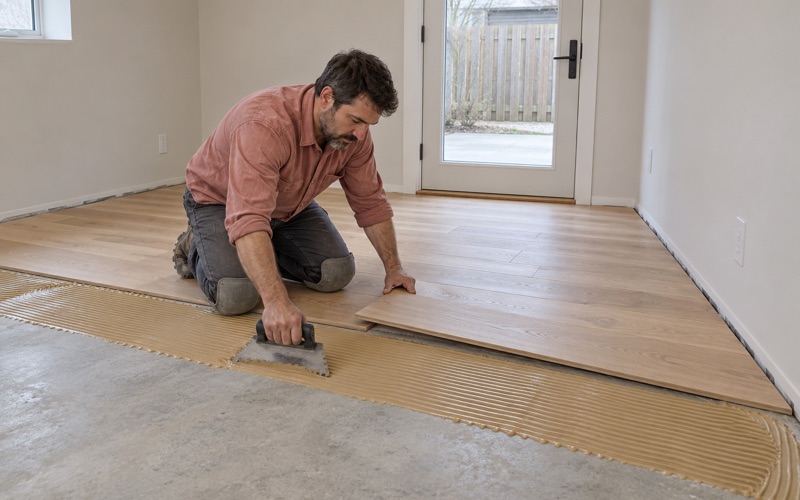
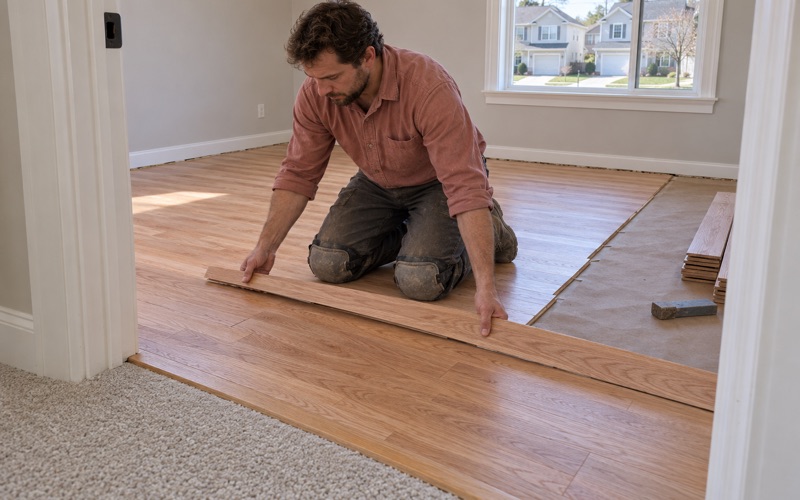
For a finished basement, we usually recommend engineered wood rather than solid hardwood. An engineered board carries a real hardwood wear layer over a cross-layered core, and that construction moves far less with seasonal moisture than a solid board, which is why it is the usual choice for below-grade installation. It can float over a moisture barrier or be glued to a slab that reads dry enough, and a thicker engineered wear layer can still be sanded and refinished years later.
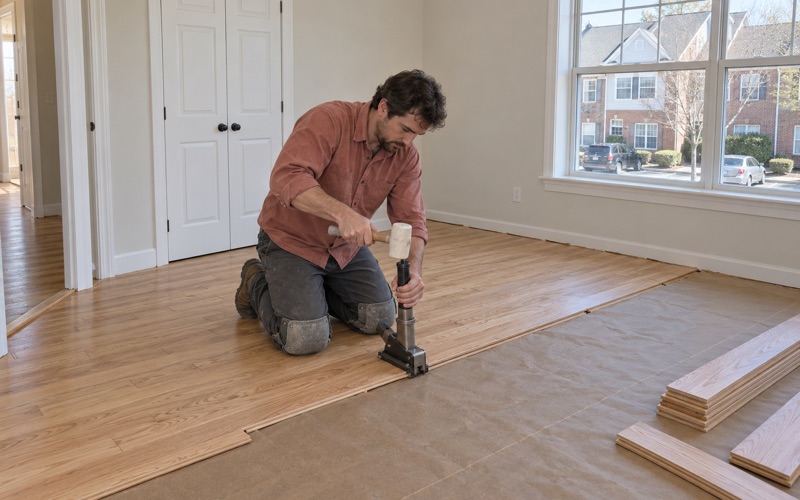
Solid hardwood behaves differently on a slab. A solid tongue and groove floor wants to be fastened with flooring cleats into a wood subfloor, and below grade it has more ways to cup, gap and buckle. We put it on a lower level only when the readings, the subfloor and the room justify it, and we say so in writing when they do not.
When a different floor is the better call
Sometimes the right answer for a lower level is not wood at all. If a slab reads consistently wet, if the sump pump cycles often, or if the room doubles as a mudroom or laundry, we will tell you that another floor will hold up better than any board we could sell you. That advice comes from the readings and how the room is used, not from a blanket rule against wood downstairs.
Acclimation and finish downstairs
Whatever goes down, the boards acclimate inside the house before installation, and we check them against the subfloor with the same meter. On a lower level we lean toward a waterborne polyurethane or a prefinished engineered product, with fumes and drying times planned around the household and within Maryland’s VOC limits for wood coatings. A sound-reducing underlayment can go under a floated floor when the basement sits below a bedroom or office.
Planning Floor Work in a Savage Home Near the River
Most of the floors we see in Savage sit well above any basement question. Census estimates count 3,092 housing units in the Savage CDP, and 1,153 of them were built in the 1980s. In a house of that age we often find builder-grade hardwood or red oak strip flooring under carpet. A smaller share is older, including the brick workers’ houses of the Savage Mill Historic District, listed on the National Register in 1975.
Upper floors: refinishing and repair
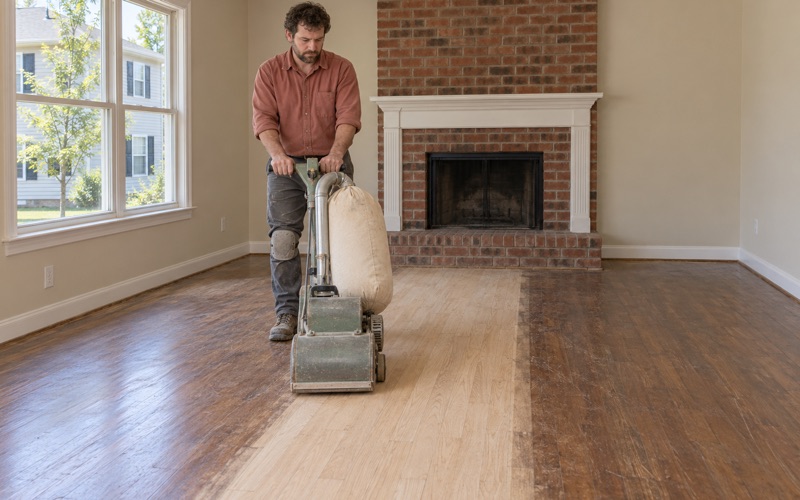
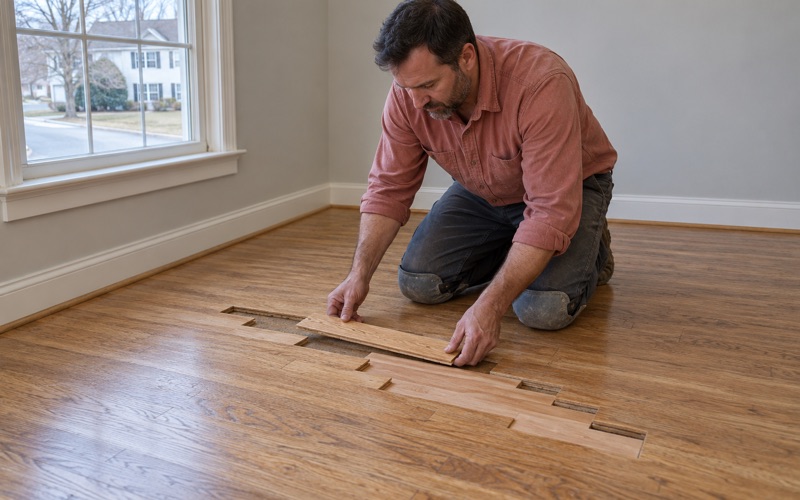
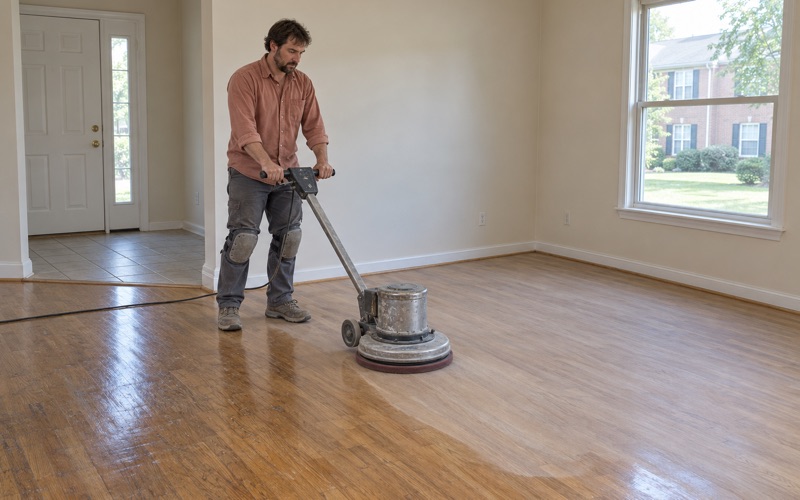
In a 1980s house, the common job is pulling carpet, tack strip and carpet pad, then sanding out traffic lanes, rug shadow and pet urine stains in the oak beneath. We run a drum sander through a full grit sequence, finish the edges with an orbital sander, and keep dust inside the rooms being worked on, with doors and returns sealed and a HEPA vacuum on every pass. Where a register or an old wall has come out, we weave new boards into the floor rather than dropping in a patch.
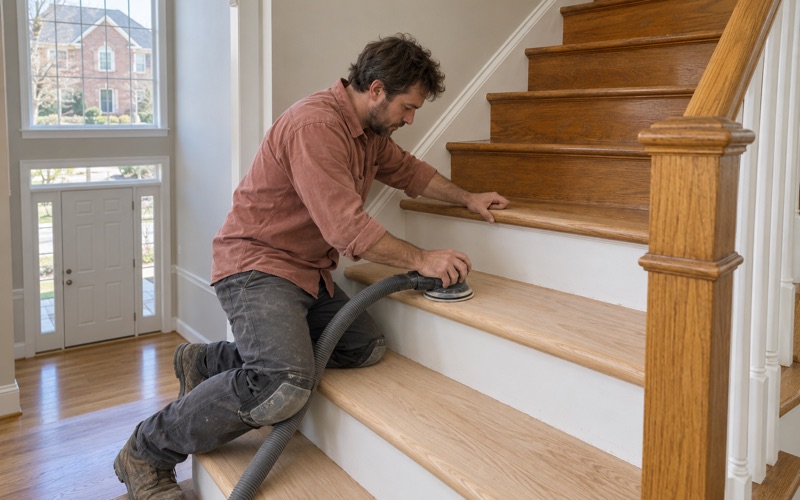
Stairs get their own lines on the estimate, priced tread by tread, since stair treads, risers and nosing take far more handwork than open floor. Before you settle on a color, we lay stain and sheen samples on your own boards so you judge them in your own light.
Older homes and lead-safe preparation
In any house built before 1978, we confirm the build year and check painted surfaces before sanding, because lead-safe renovation rules apply to that work. If you rent the house out, we schedule the floor around the lead dust test Maryland requires at each change of tenant. We also look for old resilient floor tile and black mastic before any sanding starts, and when we find them we leave that layer to the right trade.
Lower-level work on your schedule
For a basement, we sequence the job so the moisture readings come first and the floor choice comes second. If the numbers are high, we stop and explain why rather than installing on a hope. Once they support a floor, you get an itemized estimate covering material, subfloor preparation and finish, one you can keep with your house records or hand to an insurer.
- 20+ Years Experience
- Written Itemized Estimates
- Dust-Contained Sanding